
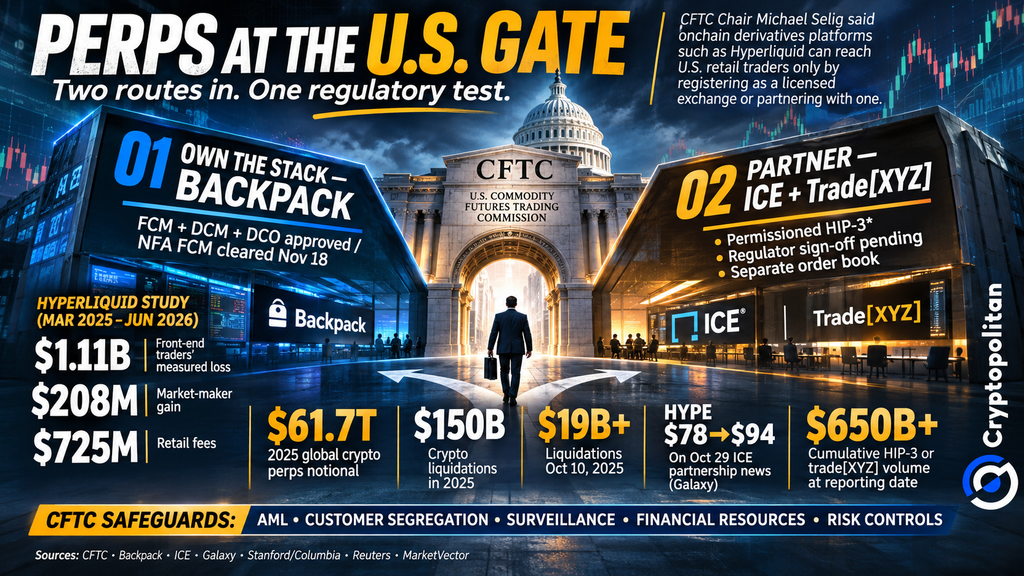
CFTC Chairman Michael Selig says cryptocurrency derivatives platforms, like Hyperliquid, have two routes for gaining access to the US retail market.
The routes are securing their own exchange licenses or teaming with an existing licensed operator. Both routes require compliance with US derivatives regulations, including safeguards for investors. Hyperliquid has not yet received approval to serve US retail traders.
Two doors into the US market
At Thursday’s Capitol Crypto Forum, Selig outlined two routes for onchain trading platforms to enter the US market. They can obtain their own exchange licenses or partner with an already licensed exchange, according to reports.
However, in no scenario do these routes mean that the platforms will not comply with the regulations in force already.
In a statement released on November 16, Selig specified the regulatory requirements related to anti-money laundering, customer protection and fund segregation, market surveillance, financial resources, and risk management.
The CFTC had already opened the door to perpetual futures through a May policy allowing case-by-case reviews. The agency also approved a bitcoin-linked perpetual futures contract.
Backpack’s full stack versus ICE’s planned venue
Backpack is taking the exchange license route. It has secured three authorizations: futures commission merchant (FCM), designated contract market (DCM) and derivatives clearing organization (DCO).
Its FCM approval came November 18, two days after the others. Backpack plans to connect US traders with global liquidity through one order book, although trading has not yet been confirmed to have started.
Intercontinental Exchange (ICE), on the other hand, has chosen the partnership route. Under its partnership with Trade[XYZ], it is planning to launch a new trading venue in the US.
The platform involves requiring identity verification and using a permissioned version of Hyperliquid’s HIP-3 technology. However, the venture still needs regulatory approval, according to Galaxy Research.
Billionaire Stan Druckenmiller has invested in Trade[XYZ], reflecting the increasing interest of Wall Street in blockchain-based derivatives, according to Cryptopolitan.
After the announcement regarding the partnership between ICE and Trade[XYZ] on October 29, the value of Hyperliquid HYPE token has increased from $78 to $94.
Separate order books and the liquidity question
ICE’s proposed trading venue in the US is set to work independently of Hyperliquid’s current markets. According to Galaxy Research, Trade[XYZ]’s HIP-3 markets have already processed over $650 billion in trading volume. However, the proposed US venue would need to build its own pool of buyers and sellers.
Separate markets could create problems during sudden price swings, particularly over weekends. Prices might differ between the two venues, making it harder for traders to manage risks.
The implications extend beyond cryptocurrencies. Talos research shows perpetual contracts expanding into equities, commodities, and stock indices.
Why Wall Street is fighting the futures label
Efforts to introduce perpetual futures contracts in the US have sparked a legal battle over how to regulate them. According to a report by Reuters, CME Group and an organization associated with Cboe Global Markets and Citadel Securities have taken their complaints against the CFTC to court.
Unlike traditional futures, perpetual contracts have no expiry date and use recurring funding payments. Critics argue that these features make them more like swaps, which face different regulatory requirements. They warn that treating perpetuals as futures could weaken safeguards against excessive leverage and counterparty risk.
Selig disagrees. He argues that funding payments are similar to margin adjustments in traditional futures. The legal dispute could determine how US regulators oversee both crypto and stock-linked perpetual contracts.
Who actually loses on perps
Trading data already shows the risks. A Stanford-Columbia study examined ten Hyperliquid contracts from March 2025 to June 2026. Traders using the platform’s front end, considered mostly retail, recorded an estimated $1.11 billion in losses. Market makers gained $208 million, while trading fees accounted for $725 million of the retail group’s losses.
The researchers measured trading performance using prices two hours after each transaction. These figures do not represent total realized retail losses.
The broader market faces similar risks. The study cited $61.7 trillion in global crypto-perpetuals trading volume in 2025 and nearly $150 billion in reported liquidations. More than $19 billion occurred on October 10, 2025, alone.
A BIS analysis also highlights credit and liquidity risks. Bringing offshore trading under US supervision could strengthen investor protections. However, keeping trading venues separate could divide liquidity and raise costs for brokers and investors.
If you’re reading this, you’re already ahead. Stay there with our newsletter.
This articles is written by : Nermeen Nabil Khear Abdelmalak
All rights reserved to : USAGOLDMIES . www.usagoldmines.com
You can Enjoy surfing our website categories and read more content in many fields you may like .
Why USAGoldMines ?
USAGoldMines is a comprehensive website offering the latest in financial, crypto, and technical news. With specialized sections for each category, it provides readers with up-to-date market insights, investment trends, and technological advancements, making it a valuable resource for investors and enthusiasts in the fast-paced financial world.