
Bitcoin’s sustained price correction is deepening as demand from US investors weakens, leaving the world’s largest cryptocurrency increasingly exposed to leveraged positions clustered below $60,000.
According to CryptoSlate’s data, the top crypto traded at $59,800 at press time, down 16% this month. This decline has brought the asset closer to price levels where forced liquidations could intensify selling pressure.
Record withdrawals from US spot exchange-traded funds, deteriorating performance during American trading hours, and defensive positioning in the options market suggest buyers have yet to regain control.
Without a recovery in spot demand, Bitcoin risks drifting toward a critical test of support below $60,000.
US demand weakens despite friendlier policy backdrop
The clearest sign of weakening American demand has emerged during US trading hours, a period that previously benefited from stronger exchange activity and purchases by institutional funds.
Data from Velo showed that Bitcoin’s cumulative return during the American session was about -15% over the past month. A strategy that held Bitcoin only during those hours would therefore have recorded a 15% loss, indicating that the US session has become a source of selling pressure rather than support.
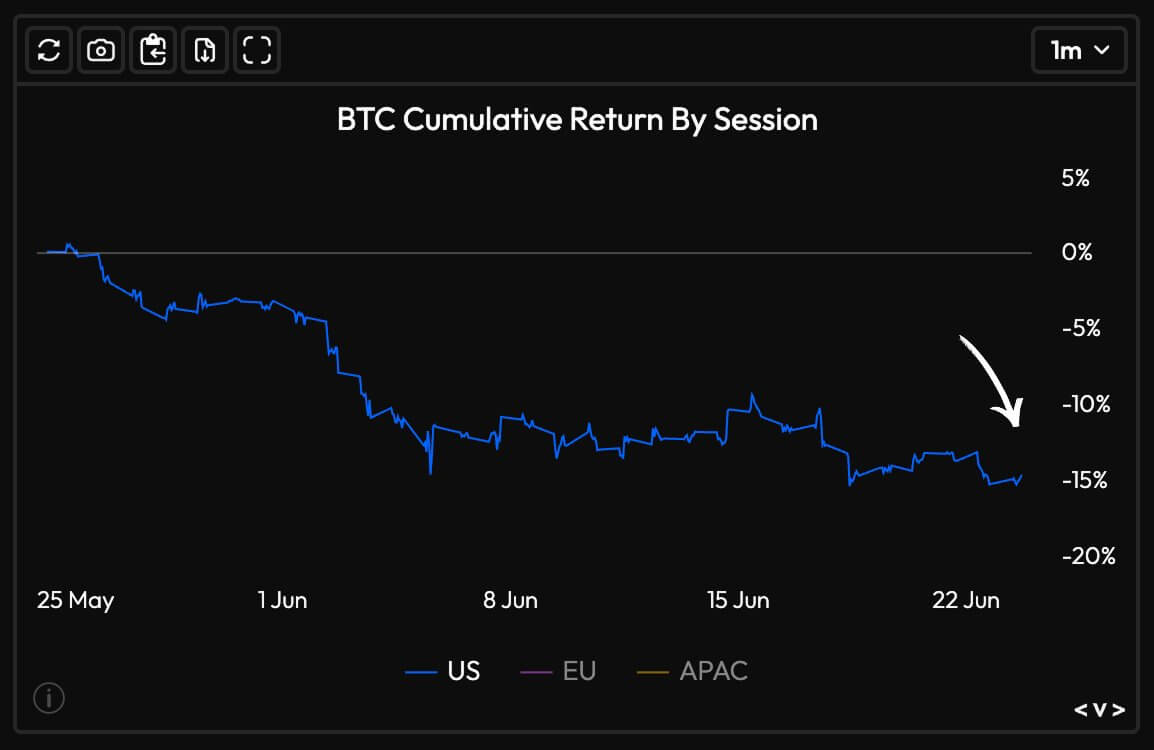
That performance contrasts with the country’s increasingly favorable stance toward the cryptocurrency industry.
Over the past year, President Donald Trump’s administration has introduced a more supportive policy environment than its predecessor, strengthening expectations that the US would become a leading center for digital asset investment.
However, that political shift has not translated into sustained buying during Bitcoin’s latest decline.
Evidence of this weakening in BTC demand can also be seen in flows into regulated investment products.
US-listed spot Bitcoin exchange-traded funds recorded net withdrawals of about $6.35 billion over the past 30 days, according to Galaxy Research data. This is the largest outflow among the 582 rolling 30-day periods covered by the firm’s analysis.
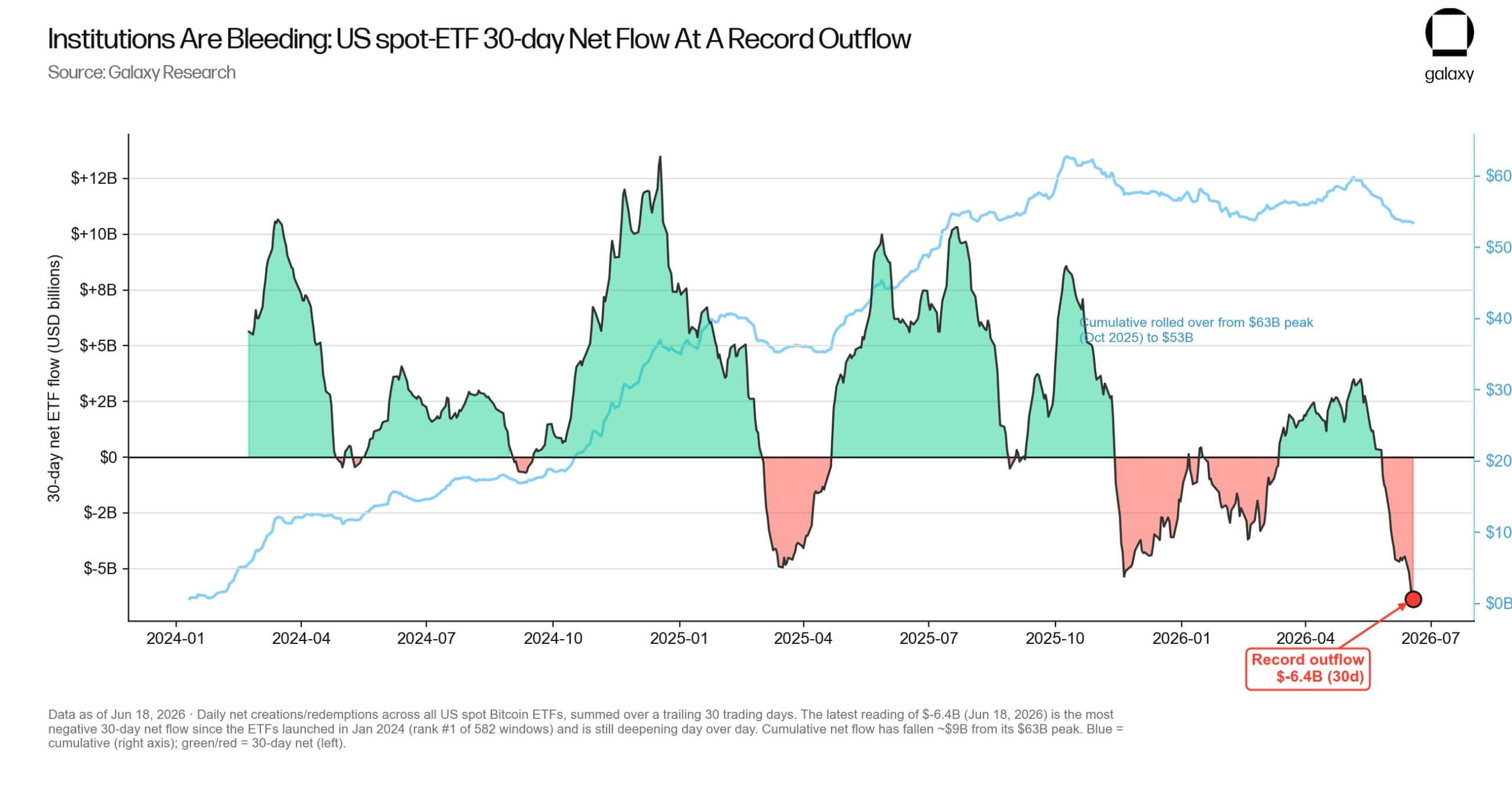
While the withdrawals do not necessarily indicate that every ETF investor has turned bearish, the scale of the redemptions has weakened a source of demand that helped absorb Bitcoin supply during earlier rallies.
Moreover, the Coinbase Premium Index has also remained negative at about -0.13. The measure compares Bitcoin’s price on Coinbase with prices on offshore exchanges and is commonly used to gauge relative demand from US investors.
The reading has improved from a late-February low of about -0.25, suggesting that selling pressure is less severe than it was then. Its failure to return to positive territory, however, shows that buyers on Coinbase are still unwilling to pay more than traders on offshore platforms.
Together, these data points show a broad retreat in US demand rather than an isolated decline on one exchange.
$57,300 emerges as the next leverage test
With spot demand subdued, the market has become more sensitive to leveraged derivatives positions.
João Wedson, chief executive of analytics platform Alphractal, identified $57,300 as a significant liquidation level after examining data from 30 exchanges over the previous 30 days.
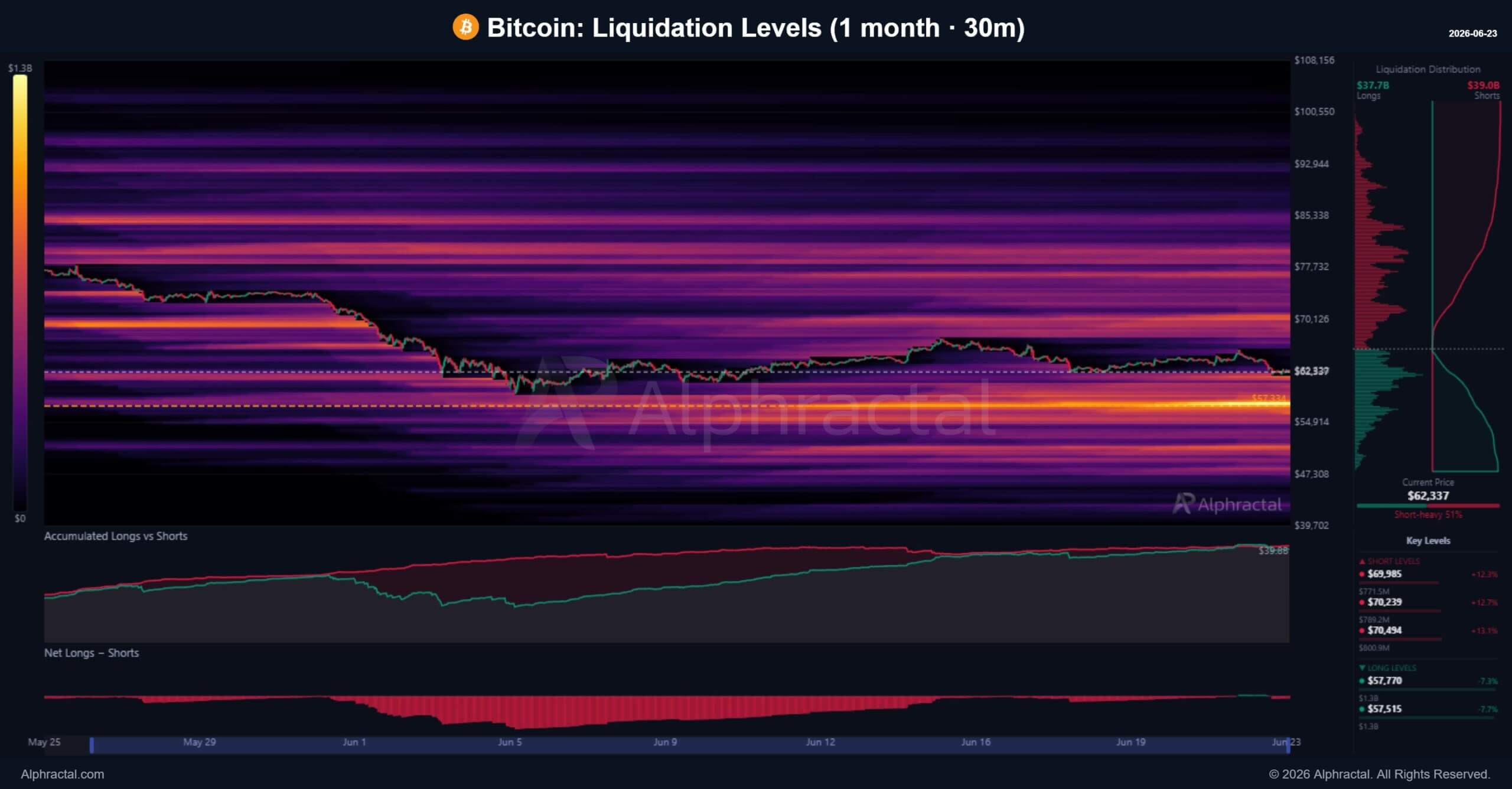
Liquidation levels are price levels at which leveraged traders may no longer have sufficient collateral to maintain their positions. Exchanges can then automatically close those trades, adding market sell orders during a decline and potentially increasing volatility.
The concentration around $57,300, therefore, represents a risk if Bitcoin falls below $60,000 and continues losing strength.
Notably, derivatives traders on the options exchange Deribit are actively positioning for this downside scenario.
According to the firm’s data, about $1.1 billion in positions are concentrated at $60,000, making that level an immediate area of interest. Another $1.4 billion was positioned across the $50,000 and $55,000 strikes.
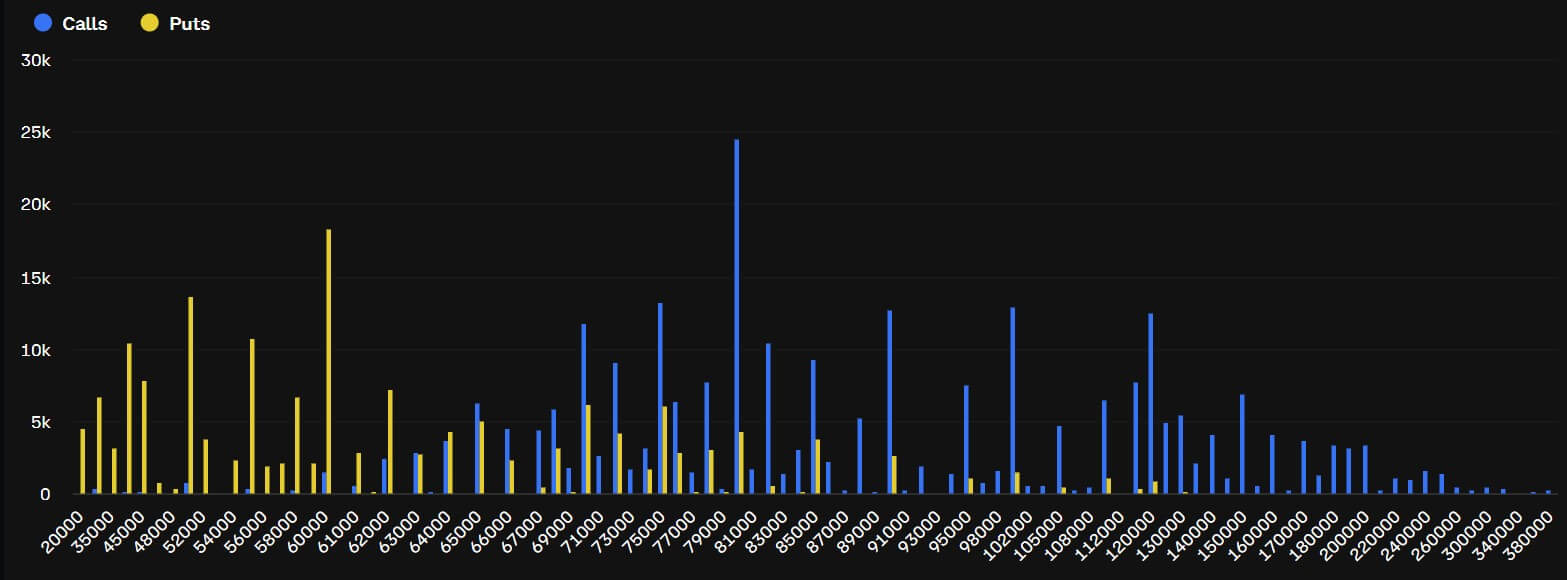
The figures show substantial derivatives exposure below the current price, though the supplied data does not establish that all of the positions represent outright bearish bets. Options can be used to hedge existing holdings, generate income, or build strategies involving multiple strikes.
Even so, the accumulation highlights how much attention has shifted from recovering previous highs to managing the possibility of a deeper decline.
Weak demand leaves Bitcoin rebounds vulnerable
Bitcoin’s market structure suggests buyers have yet to return with sufficient force to reverse the current decline, leaving short-lived recoveries vulnerable to renewed selling.
CryptoQuant analyst Axel Adler pointed to the Net Taker Volume Oscillator, which measures the difference between market buys and market sells and smooths the result with a 30-day moving average.
The indicator helps show which side is trading more aggressively because market orders are executed immediately against available liquidity.
The oscillator remained firmly positive two months ago and climbed to about 1.7% in mid-May, when aggressive buying helped push Bitcoin toward local highs. It later fell to -0.9% during the early-June selloff before recovering to the zero line.
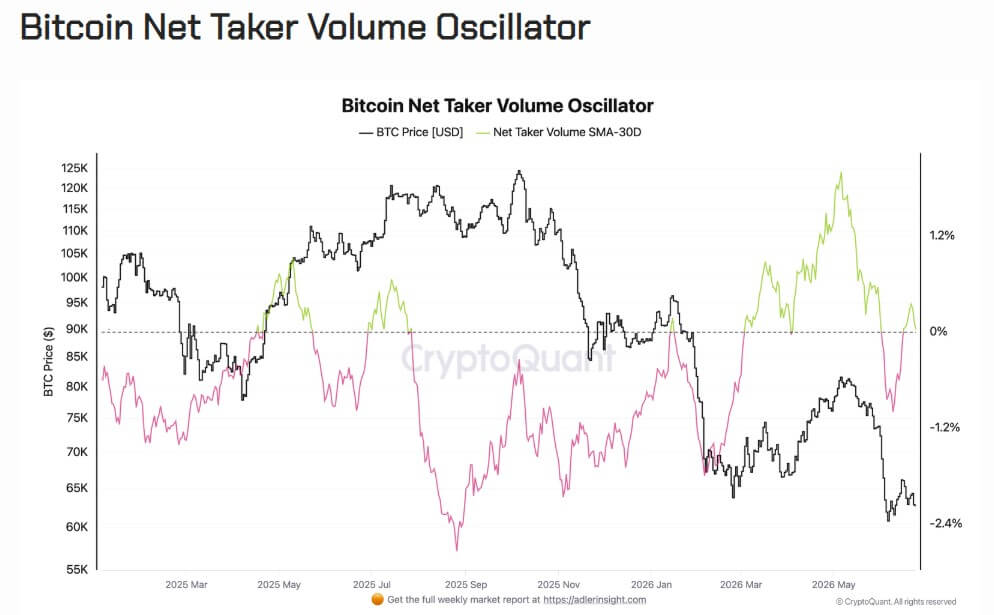
While the return to zero suggests that the earlier dominance of market sellers has eased, it does not show that buyers have regained control.
A stronger recovery would require the oscillator to move decisively above zero and remain there, signaling that traders are once again willing to buy at prevailing market prices.
Adler said the current reading instead reflects a balance, with insufficient demand-side initiative to support a sustained rebound.
Liquidation activity strengthens that assessment. CryptoQuant’s liquidation oscillator stood at 18.4%, showing that long positions accounted for the larger share of forced closures. That marks a sharp reversal from mid-May, when the indicator fell to about -13% as rising prices forced short sellers out of their positions.
The shift means leveraged buyers are now absorbing more of the market’s losses. It also raises the risk that brief rebounds will attract new long positions that could be liquidated if Bitcoin resumes its decline.
Block Scholes’ risk-appetite indicators point to a broader retreat. Its Bitcoin measure has moved closer to the -1.0 threshold associated with weak risk appetite, having previously shown greater resilience than ETH.
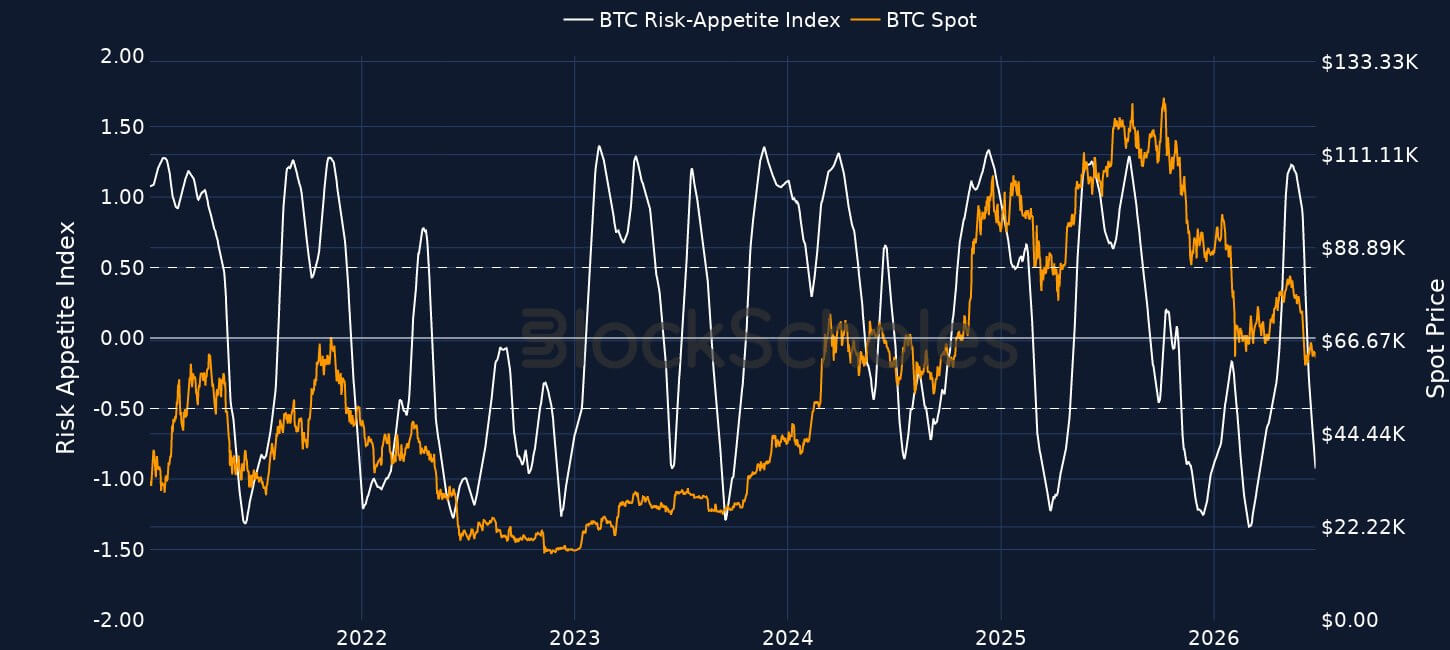
Indeed, Ethereum had already entered weak-risk territory, but Bitcoin’s continued deterioration has narrowed the gap between the two assets.
The convergence suggests investors are reducing exposure across the cryptocurrency market rather than treating Bitcoin as a relative refuge.
Together, the indicators show that selling pressure has eased without producing a meaningful return of buyers.
Until market-order demand strengthens and long liquidations subside, Bitcoin’s rebounds are more likely to provide temporary relief than mark the start of a durable recovery.
The post America’s Bitcoin buying turns negative as BTC drifts closer to the $57,300 liquidation trap appeared first on CryptoSlate.
Bitcoin’s sustained price correction is deepening as demand from US investors weakens, leaving the world’s largest cryptocurrency increasingly exposed to leveraged positions clustered below $60,000. According to CryptoSlate’s data, the top crypto traded at $59,800 at press time, down 16% this month. This decline has brought the asset closer to price levels where forced liquidations
The post America’s Bitcoin buying turns negative as BTC drifts closer to the $57,300 liquidation trap appeared first on CryptoSlate. Analysis, Featured, Liquidations, Market, Trading, Bitcoin, ETF, US
This articles is written by : Nermeen Nabil Khear Abdelmalak
All rights reserved to : USAGOLDMIES . www.usagoldmines.com
You can Enjoy surfing our website categories and read more content in many fields you may like .
Why USAGoldMines ?
USAGoldMines is a comprehensive website offering the latest in financial, crypto, and technical news. With specialized sections for each category, it provides readers with up-to-date market insights, investment trends, and technological advancements, making it a valuable resource for investors and enthusiasts in the fast-paced financial world.