
Binance is set to miss Europe’s July 1 MiCA authorization deadline, moving the bloc’s exchange-access fight from a policy countdown into a live test of where users, assets, and trading liquidity move next.
The exchange has told European customers it will be unable to meet the authorization deadline, according to Binance Square social media posts and a Financial Times report. The warning comes two days after Binance withdrew its MiCA license application in Greece and said it would pursue authorization in another EU Member State.

Binance is still saying it wants a European authorization rather than signaling a full retreat.
CEO Richard Teng told users the company remains committed to securing a MiCA license “in the coming months,” while providing clarity, minimizing disruption, and keeping customers informed. He also said, “Your funds remain safe and secure.”
If Binance cannot actively serve EU customers after July 1, users face a practical decision that policy debates often avoid: whether compliant alternatives can replace the convenience, product breadth, stablecoin routes, and order-book depth that made Binance the default venue for many traders.

What changes on July 1
In a June 23 public statement, ESMA said crypto-asset service providers that are not authorized under MiCA should stop onboarding new EU clients, stop marketing or soliciting services in the bloc, and restrict activity to orderly exits, transfers, position closures, or custody needed for the transition.
The July 1 date can therefore decide whether an affected exchange account remains a trading venue or becomes a way to leave, close, or transfer assets.
Binance’s position is complicated by its June 24 withdrawal from Greece. The company said in an official statement that it would seek authorization in another EU Member State and that some users may be affected as it works through the process.
Binance’s official X account stated that the exchange would pursue a new EU authorization path. The company has not provided a replacement authorization date.
As of June 26, the key gap is the period between the July 1 cutoff and any later approval in another member state.
| Question after July 1 | What it tests |
|---|---|
| Can users still trade? | ESMA’s guidance points to an end of active service for unauthorised providers, rather than only a pause in marketing. |
| Can users withdraw or transfer? | Orderly exits, transfers, position closures, and short transition custody remain central to the wind-down path. |
| Where does trading volume go? | Licensed venues may gain users, but licensing alone does not prove equivalent liquidity, product coverage, or execution quality. |
| Does Binance find another EU route? | Teng’s “coming months” language keeps the story open rather than making this a permanent exit. |
Binance argues that access to deep liquidity is itself a consumer-protection issue. CZ framed the debate that way on June 26, writing on X: “Sad to see EU cutting their users off from the best liquidity in the world. Liquidity is the best consumer protection.”
The argument is self-interested, but it is material for active traders. Poorer liquidity can mean wider spreads, more slippage, thinner markets in stressed conditions, and fewer efficient stablecoin routes.
For active users, those costs can be more visible than the regulatory status of the venue executing the trade. MiCA’s logic runs in the opposite direction, moving EU crypto access toward authorized providers that meet capital, governance, conduct, and consumer-protection requirements.
From that perspective, users are better protected when they use licensed firms, even if the transition forces them away from the deepest global venue.
The conflict is now concrete. Europe has licensed crypto-asset service providers under MiCA, and ESMA’s register gives the market a compliant path.
But a register does not answer whether those providers can absorb potentially affected Binance users at comparable depth, comparable cost, and comparable asset coverage.

In reality, the cutoff is less uniform than a single EU date suggests. MiCA’s grandfathering regime was implemented through national transition periods, so Binance’s practical position can differ depending on where a customer is booked and which local registration, if any, the relevant entity relied on before the bloc-wide deadline.
That does not remove the July 1 cliff, but it means some local regimes had already expired or required earlier action, while others ran to the final EU-wide date. After July 1, the question narrows: without a MiCA authorization, Binance can no longer offer active crypto services to EU clients and should be limited to orderly exits, transfers, position closures, and custody needed to complete the transition.
The test is where flow goes next
The market impact cannot be measured before the cutoff takes effect. Binance telling users it cannot meet the deadline turns July into a real-time test of customer behavior.
One outcome is orderly migration. Users move to licensed EU exchanges, complete fresh onboarding, adjust to different asset lists and stablecoin pairs, and keep most of their activity within the regulated perimeter.
That would strengthen MiCA’s consumer-protection case because it would show compliant access can replace offshore scale without obvious damage to execution.
The other outcome is fragmentation. Users may move assets to self-custody, pause trading, search for offshore access, rely more on wallets or decentralized venues, or split activity across platforms.
If that happens at scale, Binance’s liquidity argument becomes more politically uncomfortable: a rule designed to protect users may also push some of them toward less consistent, less transparent, or less convenient routes.
Recent CryptoSlate coverage has already shown why the issue extends beyond a single exchange account. A June 14 report explained the broad mechanics of MiCA exchange cutoffs, while a June 19 analysis focused on Binance access and USDT liquidity before the deadline.
A June 25 article examined why Europe was struggling to grant Binance the license it needs. The new development is that the customer-facing consequence is now close enough to test.

CryptoSlate’s Bitcoin and Ethereum pages highlight that Binance remains a major venue for BTC/USDT and ETH/USDT trading. The figures do not measure EU customer flow, but they explain why the venue question is high-stakes: Binance is tied to the dollar-stablecoin liquidity that still underpins much of crypto trading.
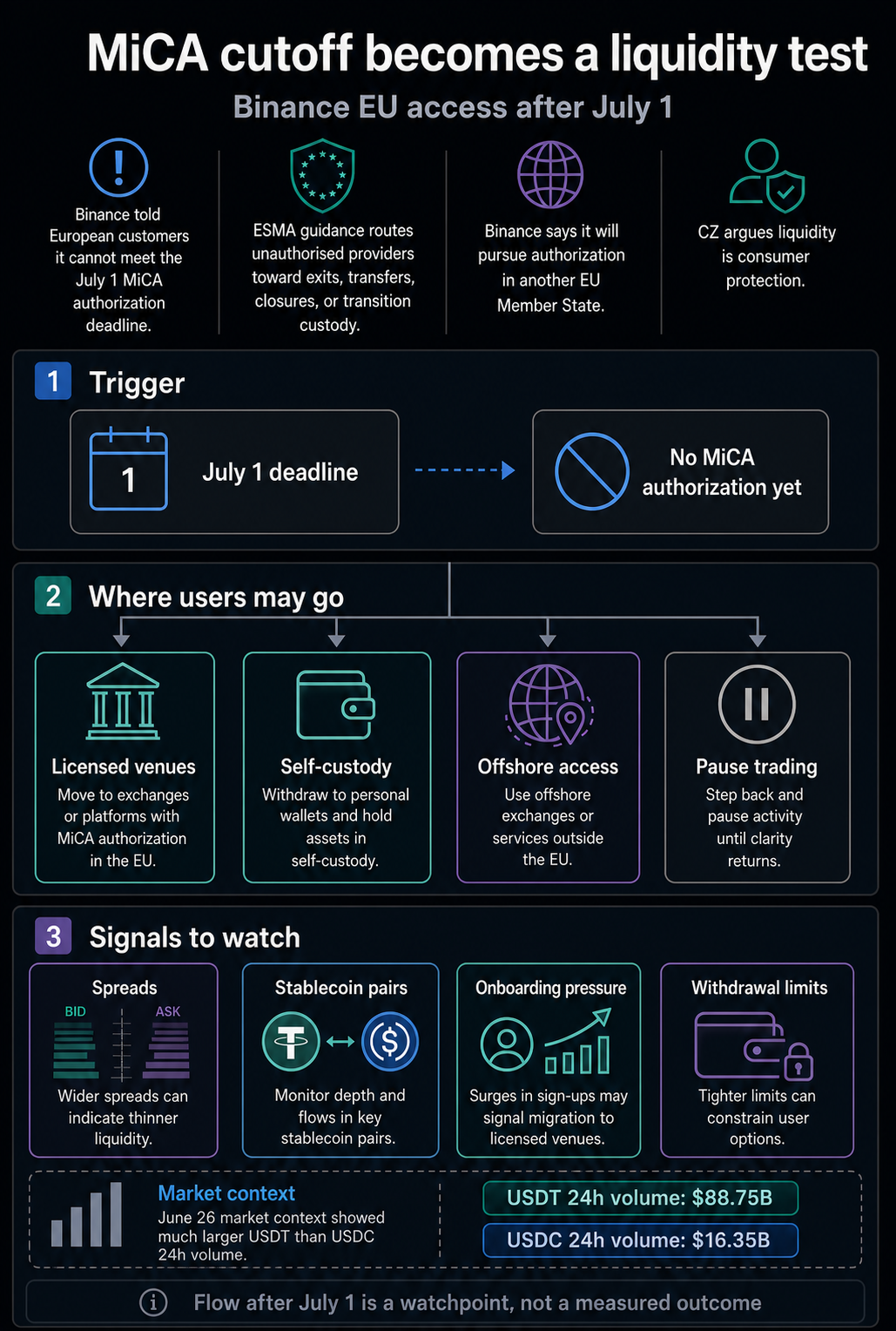
The cleanest post-July signal would be routine execution: users withdraw or transfer smoothly, licensed venues absorb new customers, spreads do not widen meaningfully, and Binance announces a credible new authorization path without emergency restrictions or prolonged uncertainty.
The weaker signal would be messier. Watch for support notices that limit what users can do, complaints about withdrawals or product closures, unusual onboarding pressure at licensed venues, visible changes in stablecoin-pair availability, wider spreads in euro-facing markets, or a larger shift toward offshore and self-custody workarounds.
If the largest exchange can be cut off from EU customers without visible execution damage, MiCA’s licensing model gets a market-structure win.
If users scatter and liquidity fragments, Binance and CZ will have a stronger argument that consumer protection cannot be separated from market depth.
For now, MiCA is about to test whether regulated access is liquid enough to feel like protection, while Binance is about to test whether its liquidity advantage remains a public-policy asset after telling users it cannot meet the deadline to serve Europe under the new rules.
The post Binance will be cut off from Europe on July 1 – Removes the “best liquidity in the world” says CZ appeared first on CryptoSlate.
The July 1 deadline will show whether licensed venues can absorb users without weakening execution or stablecoin access.
The post Binance will be cut off from Europe on July 1 – Removes the “best liquidity in the world” says CZ appeared first on CryptoSlate. Analysis, Exchanges, Featured, Outage, Regulation, Trading, Binance, Bitcoin, ethereum, regulation, stablecoins, Tether, usd coin, USDC
This articles is written by : Nermeen Nabil Khear Abdelmalak
All rights reserved to : USAGOLDMIES . www.usagoldmines.com
You can Enjoy surfing our website categories and read more content in many fields you may like .
Why USAGoldMines ?
USAGoldMines is a comprehensive website offering the latest in financial, crypto, and technical news. With specialized sections for each category, it provides readers with up-to-date market insights, investment trends, and technological advancements, making it a valuable resource for investors and enthusiasts in the fast-paced financial world.