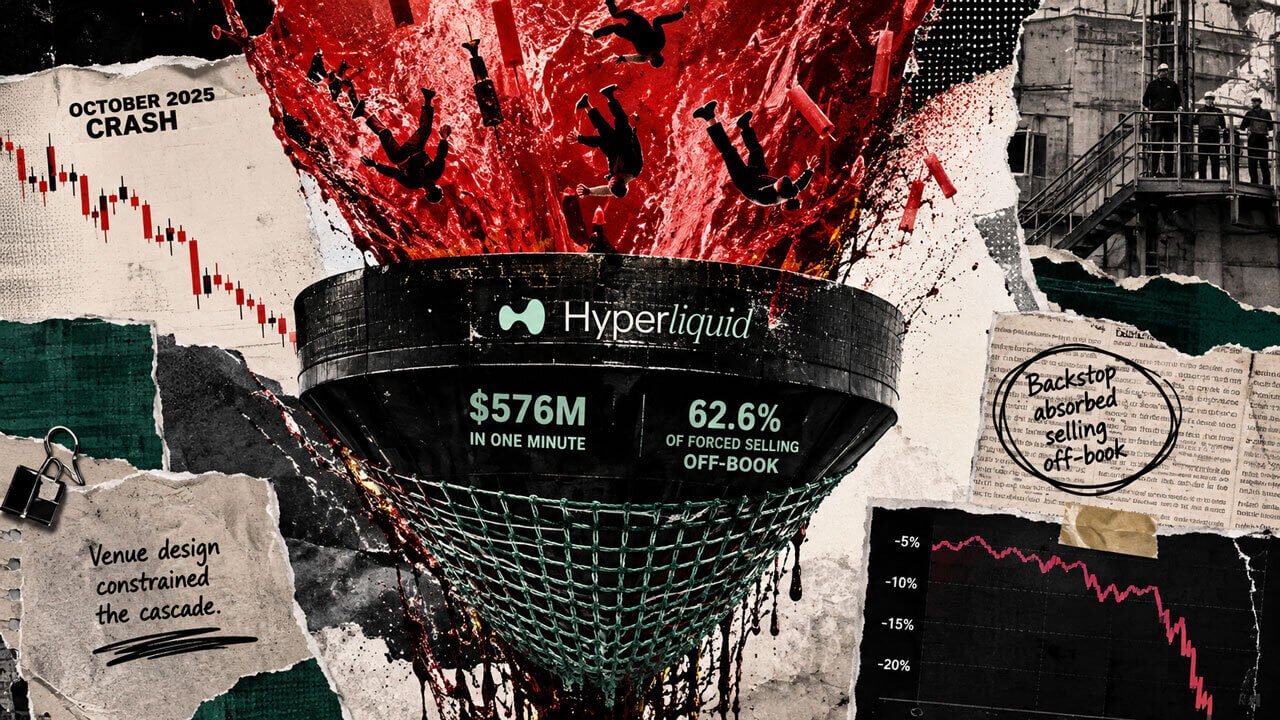
Hyperliquid, an on-chain perpetual futures venue, sent most of the forced selling in the worst minute of the October 2025 crypto crash to the Hyperliquid backstop rather than its public order book, according to a new research preprint.
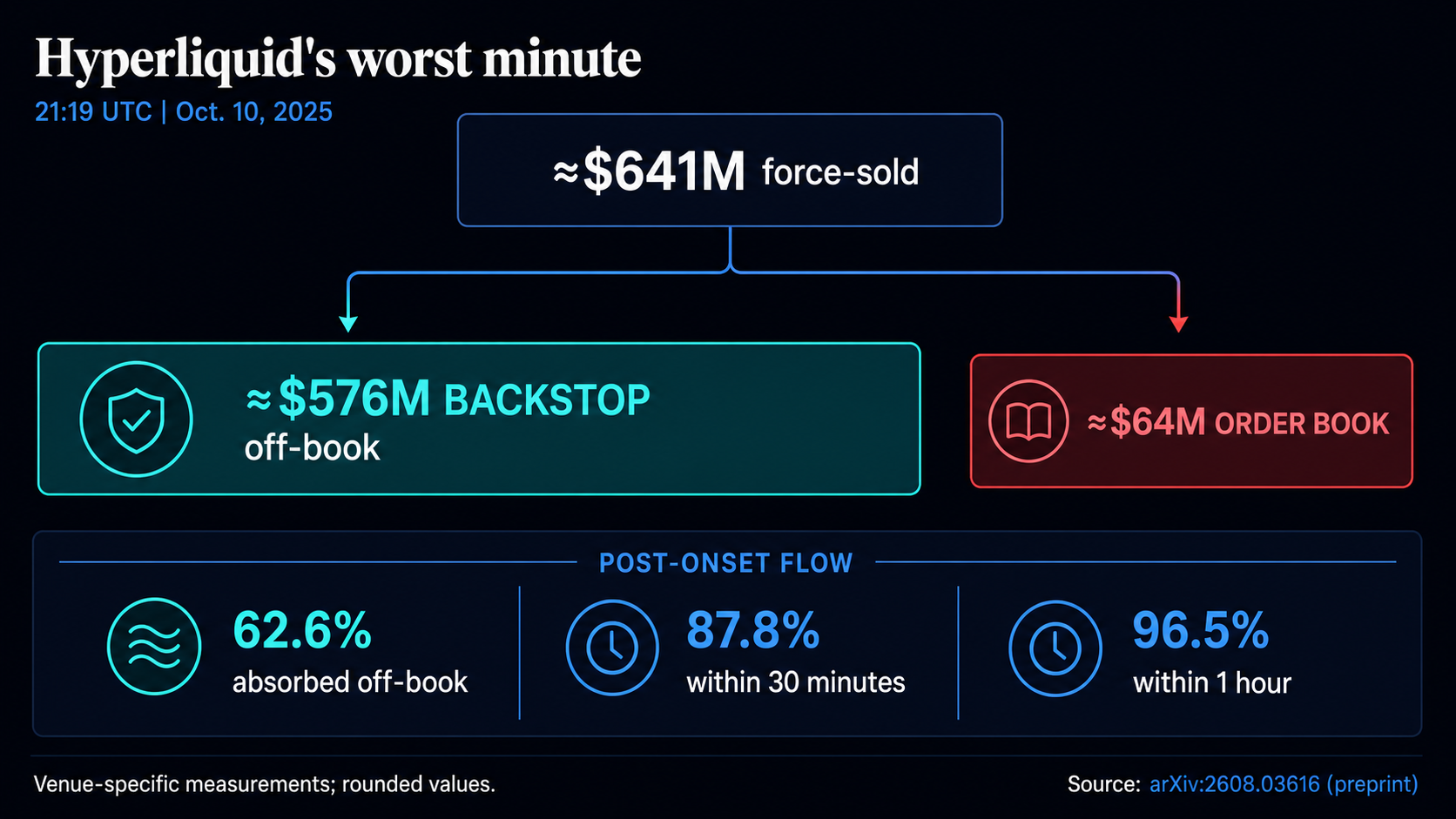
About $641 million was force-sold on Hyperliquid at 21:19 UTC on Oct. 10, the paper found. Roughly $576 million went to the Hyperliquid backstop, while about $64 million reached the order book.

The split is relevant because a thinning public order book can push prices lower and force more leveraged positions to close. The Hyperliquid backstop can interrupt that feedback by absorbing orders inside the venue. The preprint has not completed peer review, and its direct measurement covers Hyperliquid rather than the wider market.
Hyperliquid’s liquidation rules first try to close a position through market orders. Under specified conditions, a liquidator vault can take over the position instead. That vault is a component strategy within the Hyperliquidity Provider (HLP) protocol vault.

The study found that the backstop absorbed 62.6% of forced-sale value off-book after onset. The event was also highly compressed: 87.8% of forced selling after onset occurred within 30 minutes and 96.5% within one hour.
The paper tracked $733 million of book-directed forced-sale value across its 15.7-hour post-onset window, including $644 million during the initial nucleation phase. It reported the 62.6% backstop share as a separate off-book series, so the figures describe different parts of its measurement rather than a single combined liquidation total.
How the Hyperliquid backstop damped liquidation feedback
The paper modeled the cascade with a branching ratio, or the average number of additional liquidations associated with each forced sale. A ratio approaching 1 would indicate a self-sustaining chain inside the venue.
Hyperliquid’s structural estimate remained below 0.2 in every measured regime. It reached 0.195 during nucleation and eased to 0.140 at the peak, while a separate amplification calculation implied a ratio of 0.122.
The authors interpret the Hyperliquid backstop as damping feedback inside the venue at the climax. The finding applies only within the venue; shared prices across exchanges may still have amplified liquidations across the broader market.

The study places the Hyperliquid backstop in the context of seven major Bitcoin perpetual futures cascades from 2022 through 2025. Its Part I companion, previously covered by CryptoSlate, found no event-invariant early-warning variable across those episodes. Part II shifts from warning signals to the mechanism operating during a cascade.
Hyperliquid’s fill-log archive begins on May 25, 2025, making the October 2025 event the paper’s only in-flight case study. The authors frame higher realized branching on venues without a comparable backstop as a hypothesis for future cross-venue testing.
The post Shifting $576M of forced sales off public order books saved Hyperliquid from a systemic crash appeared first on CryptoSlate.
A new preprint says off-book routing damped liquidation feedback inside Hyperliquid, while wider market effects remain untested.
The post Shifting $576M of forced sales off public order books saved Hyperliquid from a systemic crash appeared first on CryptoSlate. Analysis, Derivatives, Featured, Liquidations, Research, Bitcoin, BTC
This articles is written by : Nermeen Nabil Khear Abdelmalak
All rights reserved to : USAGOLDMIES . www.usagoldmines.com
You can Enjoy surfing our website categories and read more content in many fields you may like .
Why USAGoldMines ?
USAGoldMines is a comprehensive website offering the latest in financial, crypto, and technical news. With specialized sections for each category, it provides readers with up-to-date market insights, investment trends, and technological advancements, making it a valuable resource for investors and enthusiasts in the fast-paced financial world.