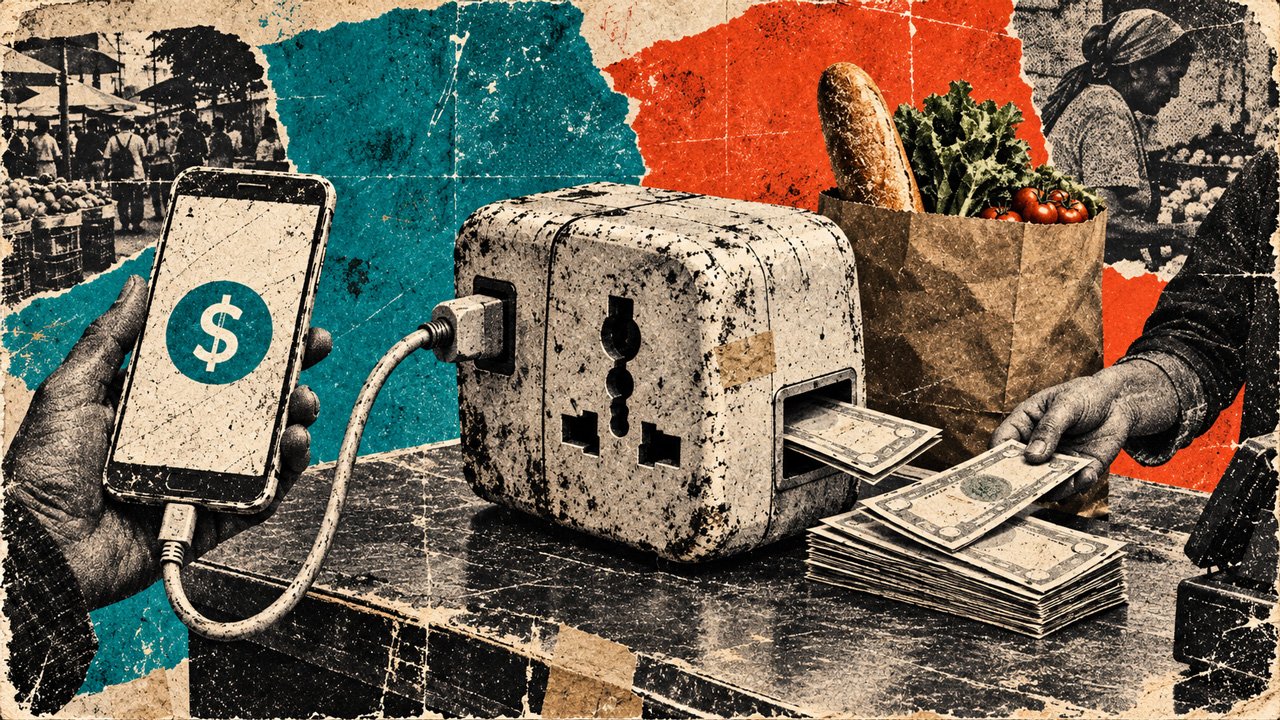
When you send money to someone abroad, the confirmation on your phone is only your half of the transaction: the other half belongs to the person who has to use it. Their rent may be due in local currency. Their nearest cash collection point may be across town. They may want to spend some of the money immediately and keep the rest in dollars.
Transfers can take seconds and leave recipients with an afternoon’s work. Stablecoin payments compete in that everyday setting. These privately issued digital tokens are designed to track a currency, usually the dollar, and move across blockchain networks. Recipients can also keep them, retaining dollar exposure until they want to convert the money into the currency used at home.
But receiving a dollar token isn’t the same as receiving money in a local bank account. Whether it’s better depends partly on what the recipient intends to do next. The same transfer can be convenient for someone already using a crypto app and very difficult for their parent who wants cash for the week.
Where stablecoins stop being cheap
Consider a transfer that begins with euros in a bank account and ends with reais available to spend in Brazil. Senders using stablecoins might first fund an exchange account and buy tokens, then transfer them to the recipient. At the other end, the recipient sells those tokens and withdraws the proceeds into a local account.
The blockchain handles the movement of the token, but it doesn’t set every exchange rate or control the price of every service around that movement. An inexpensive transfer between digital addresses can therefore be surrounded by more expensive transactions.
Some costs are explicit fees, while others are built into the exchange rate. Services can advertise low transfer fees while supplying fewer reais for each euro than a competitor. Households experience both as less money received, regardless of where the charge appears on the receipt.
Bank of Italy researchers examined $200 USDC transfers across routes connecting Italy with five countries in a paper published in July. Its Brazil results show how the same pair of countries can produce very different comparisons depending on which way the money travels.
| Direction | USDC route cost | Cost on $200 | Wise quote used in the paper | Cost on $200 |
|---|---|---|---|---|
| Italy to Brazil | 2.70% | $5.40 | 2.20% | $4.40 |
| Brazil to Italy | 2.21% | $4.42 | 4.68%–4.89% | $9.36–$9.78 |
USDC transactions were conducted in March 2026; Wise simulations were conducted on April 14. These are a small set of dated observations, not current quotes or market-wide averages. Dollar amounts are calculations from the paper’s percentages.
The cheaper route switched with the direction of the payment. That makes sense once the transfer is understood as a sequence of purchases and withdrawals in different markets. Someone selling tokens in one country faces a different set of prices and services from someone buying them there.
The World Bank’s remittance-price work also includes exchange-rate margins in the cost of sending money. Comparing the sender’s total spending with the recipient’s payout captures costs that an advertised fee can leave out. Country averages provide context, while individual households need quotes for the route and payout method they will actually use.
Speed depends on those surrounding services too. Tokens may appear in a wallet within seconds, while conversion or withdrawal requires a banking step that takes a day. Recipients who need the local payout have to wait for that step before they can spend.
Well-connected exchanges and fast domestic payment systems can make the last step painless. Recipients in Brazil may have little reason to care which network carried the token if the proceeds become spendable in the app they already use.
That’s a much more demanding standard than counting how quickly a blockchain confirms a transfer, but it’s also the standard payment services are supposed to meet.
Stablecoins give the recipient another choice
There’s also another reason a simple cheapest-route comparison can miss the appeal of digital dollars: it often assumes the recipient wants to convert everything immediately.
Imagine, instead, someone receiving $200 who wants the local-currency equivalent of $120 for expenses and wants to retain the rest in dollar form. It’s a hypothetical household, but it exposes two separate decisions: how to move the money and what to hold once they receive it.
Stablecoins can combine those decisions. Recipients can convert part of the balance and retain the rest, provided the available services and local rules permit it. Alongside any savings on the transfer, they gain control over how much to convert.
Keeping dollars brings exchange-rate risk for people whose expenses are in local currency. Dollars can also lose purchasing power, and holding them as tokens adds dependence on the issuer’s reserves and redemption arrangements. Stablecoin balances generally lack the deposit insurance that eligible bank accounts provide.
Still, the ability to choose when and how much to convert can have genuine household value. It’s different from a provider deciding that a transfer must be paid out entirely in local currency, and different again from a sender insisting the recipient learn a new financial system simply because the sender prefers it.
Access to the issuer follows its own rules. Circle Mint serves institutions obtaining and redeeming USDC, while retail users often buy and sell through exchanges or payment providers. Circle’s EEA redemption policy provides a separate route for eligible holders under European rules. Households may therefore have redemption rights even when they can’t open institutional accounts.
For someone sending money home, those rights work with the services they can actually reach. Redemption with an issuer still leaves the recipient needing local conversion or cash access, with support they can understand if something goes wrong.
Familiarity has an economic value here. Recipients who know the person behind the counter can ask for help; relatives using the same app can explain an unfamiliar step. Those relationships save time and reduce mistakes. They also spare the sender from becoming unpaid technical support for the whole family, a cost absent from blockchain fee estimates.
Recipients deserve a say in how they get their money. The sender’s preferred app becomes a poor choice if using it means giving someone else a task they didn’t ask for.
The best payment is the one you can actually use
Much of the appeal of remittance technology comes from making small payments less expensive. Fees that look modest in a comparison table add up when the same family pays them every month.
In a purely illustrative example, reducing the all-in cost of a $200 monthly transfer from 5% to 2% saves $6 each time, or $72 across twelve transfers. That’s the relevant financial gain; whether it comes from a stablecoin, a bank, or a specialist payment company is secondary to whether the household can actually receive it.
The comparison also needs a fixed starting point. If the sender has $200 in total, adding a fee on top produces a different result from deducting that fee from the amount sent. Comparing only the advertised transfer amounts can accidentally compare different budgets.
Getting started takes work too. New customers may need to verify their identity and fund another account before learning which network their recipient supports. Sending to the wrong address or an unsupported network can make recovery difficult or impossible, depending on who controls the receiving account. Experienced crypto users may navigate those steps easily, while first-time customers need help that the quoted transfer price may exclude.
Conventional services impose their own work. Cash collection can require travel and waiting, while account access may depend on documents the recipient lacks. Providers with excellent apps in the sending country can offer poor service at the destination. The comparison has to include the effort each route demands from both people.
Payment companies can take on much of that work themselves. They might move stablecoins between their own accounts and pay out ordinary money through a familiar local system, handling the conversion and network choices for the household.
For someone paying for food, a familiar local balance may be the whole point. The company can choose its settlement method while the customer chooses where to spend.
Other recipients will prefer the wallet because retaining the token is the point. Services that offer both choices let households decide how much of the balance to convert, with the costs explained before they commit.
Sending money home is a personal financial transaction. The sender has often already decided who needs the money and what they want it to accomplish. The payment service earns its fee by carrying that intention through to the recipient.
For one family, that may mean more local currency for the week’s expenses; for another, it may mean keeping part of the payment in dollars. Both depend on what the person receiving the money can do with it.
The post Stablecoins make sending money easy until someone needs to spend it appeared first on CryptoSlate.
When you send money to someone abroad, the confirmation on your phone is only your half of the transaction: the other half belongs to the person who has to use it. Their rent may be due in local currency. Their nearest cash collection point may be across town. They may want to spend some of
The post Stablecoins make sending money easy until someone needs to spend it appeared first on CryptoSlate. Adoption, Analysis, Featured, Payments, Stablecoins
This articles is written by : Nermeen Nabil Khear Abdelmalak
All rights reserved to : USAGOLDMIES . www.usagoldmines.com
You can Enjoy surfing our website categories and read more content in many fields you may like .
Why USAGoldMines ?
USAGoldMines is a comprehensive website offering the latest in financial, crypto, and technical news. With specialized sections for each category, it provides readers with up-to-date market insights, investment trends, and technological advancements, making it a valuable resource for investors and enthusiasts in the fast-paced financial world.