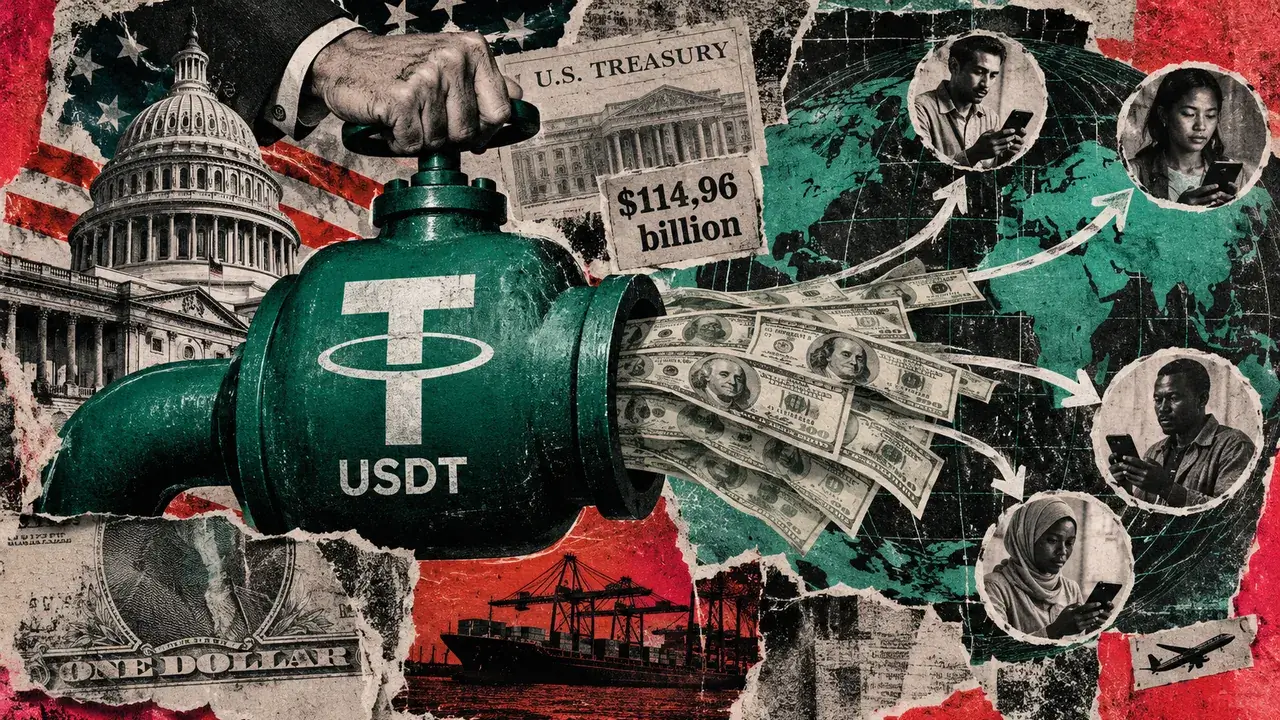
Not that long ago, Washington fined Tether for misleading people about the dollars behind its tokens. Today, the company’s insatiable appetite for American debt is the main argument for sending those tokens further around the world.
The distance between those two positions tells us a great deal about where crypto ended up. Tether built a business giving people access to dollars through markets and wallets outside conventional banking. It became the largest stablecoin issuer, then put much of the money backing that business into US government debt. The company, which operated beyond much of America’s financial establishment, has now become one of the best and biggest customers of the American state, with a distribution network the state has good reasons to want.
On Sept. 23, Bloomberg reported that the Trump administration was considering an overseas stablecoin initiative, including possible joint ventures with private companies. Treasury and the State Department could participate, as could the US International Development Finance Corporation. The goal is to extend dollar use and support demand for Treasuries.
The report doesn’t establish a deal with Tether, and the initiative hasn’t been announced as an operating program. But Tether is central to understanding why a proposal like this would appeal to Washington. By the company’s account, USDT represented more than 60% of the stablecoin market at the end of June. Its latest reserve report listed $114.96 billion in directly held US Treasury bills.
That makes Tether a leading private distributor of digital dollars and a large customer for short-term American debt. The dollar’s global position still rests on a much larger financial system. Tether’s particular contribution is extending that system to people who can buy a token more easily than they can open an American bank account.
Its reach gives the company political value. The assets that make its token credible also give Washington influence over the business. Both sides have something the other wants, while the people using USDT have much less say in the terms.
The reserve portfolio became a political asset
In October 2021, the CFTC ordered Tether to pay $41 million over misleading representations about its backing. The order covered claims made between 2016 and 2019 that USDT was fully backed by corresponding fiat currency held in bank accounts. The regulator found that Tether had held other assets and relied on arrangements that didn’t match those representations.
Tether’s reserves subsequently took a different form. In October 2022, it announced that it had eliminated commercial paper, the short-term debt companies issue, and replaced those investments with US Treasury bills. Moving toward highly liquid government debt addressed a basic financial problem: people expect to exchange their dollar tokens for dollars, including when confidence in crypto collapses.
That portfolio decision also made Tether easier for American policymakers to appreciate. Every business wants dependable customers. The US government issues debt, and Tether had become a very large customer with at least a hundred billion reasons to keep returning.
The company’s reserve report put total reserve assets at $187.75 billion and liabilities at $183.64 billion on June 30, leaving $4.11 billion above liabilities. Its directly held Treasury bills had a weighted average maturity below 90 days. It also listed $18.63 billion in overnight reverse repo agreements, transactions in which Tether lends cash against collateral.
Those positions shouldn’t be combined and presented as identical Treasury ownership. They do, however, show how deeply Tether’s reserve management depends on short-term dollar finance. USDT can move between wallets at any hour; much of the value supporting it comes from very conventional financial contracts.
Its reserves also include other assets. The report lists $18.84 billion in precious metals, $5.80 billion in Bitcoin, and $13.45 billion in secured loans. Saying Tether is a major Treasury holder is true, but treating its entire reserve as a 1:1 portfolio of Treasury bills would be wrong.
Tether’s reporting of its reserve has evolved, too. On Aug. 13, the company announced that KPMG US had completed an audit of its 2025 financial statements, issuing an unqualified opinion. It means that the auditor accepted that its financial statements fairly presented its finances under the accounting standards used. That’s a considerable departure from the years when the absence of a financial-statement audit dominated almost every argument about Tether.
While neither of these documents gives Washington a reason to treat USDT as a government obligation, they help explain how a company once defined by arguments over its reserves can present itself as an established financial counterparty.
The economics here are pretty straightforward. When customers supply dollars for newly issued USDT, Tether takes on a redemption obligation and holds assets against it. Treasury bills pay a return, but USDT itself doesn’t give its holder a contractual share of that return. Tether reported about $1.50 billion in second-quarter net operating profit, led by Treasury and repo income.
CryptoSlate has already examined who owns Tether’s Treasury portfolio. The company owns the reserves, while users hold tokens whose value depends on its ability to honor its obligations. The political consequence goes further: Tether can turn demand for accessible dollars into both private earnings and financing for the country issuing those dollars.
Washington gets a debt buyer without having to operate the retail service, Tether gets income from assets that also support confidence in its product, and the user gets a dollar-denominated balance that can travel through markets the user can actually reach.
There are, of course, limits to the debt argument. Treasury purchases don’t retire the national debt, and buying short-dated bills doesn’t commit Tether to financing the government for decades. Its portfolio must serve people who may want their money back. It’s a large, recurring buyer whose decisions depend on the condition of its own business.
But its real value to Washington extends beyond the size of today’s portfolio. Lots of institutions can buy Treasury bills. Tether has built a way to gather dollar demand from people who might never become customers of those institutions.
The customer Washington can’t easily reach
Imagine a shop owner who wants to keep part of the week’s earnings in dollars. Depending on where he lives, opening an overseas bank account could be impossible, and holding cash in dollars can be a burden when the time comes to exchange it. Using USDT, on the other hand, is the fastest and easiest option, especially for people who already own crypto or use digital services like exchanges. The fact that USDT is so widespread means that the overwhelming majority of its users don’t have an opinion on American foreign policy.
But the decision to use USDT still has consequences for American influence. Dollars become the unit in which savings are measured. Large and popular businesses that accept the stablecoin create even more reasons for other people to hold it. Familiarity, available trading partners, and places to exchange it for local money all make USDT look more attractive with repeated use.
This is why Tether’s customer base deserves more attention than a league table comparing its portfolio with countries’ Treasury holdings. A favorable government policy can certainly attract a new issuer, but it can’t instantly reproduce a network of dealers, exchanges, and people willing to accept the same token.
But to fully understand the way USDT works, we need to take a closer look at its funding mechanism.
Buying existing USDT from another person doesn’t automatically send new money to Tether or produce another Treasury purchase: it just transfers a token already in circulation. Additional reserve assets become relevant only when demand leads to net new issuance. Payments volume and new funding for the US government measure different things.
Nor does every dollar entering stablecoins represent fresh demand for American assets. Someone moving money from a dollar fund into USDT is just rearranging existing dollar savings. Someone seeking dollar exposure for the first time, however, presents a completely different and much more lucrative opportunity.
Federal Reserve Governor Stephen Miran made that point in a November 2025 speech on overseas stablecoin demand. He distinguished transfers from existing dollar holdings from demand among foreign savers whose access to dollars is restricted. His argument was that this second group offers the larger opening.
That helps explain the overseas focus of the reported initiative. Persuading an American with a bank account and a Treasury fund to buy a digital dollar will just reshuffle existing capital. But making dollar balances accessible to someone previously excluded from them can extend the dollar’s reach.
Treasury Secretary Scott Bessent has already stated the policy objective. In his July 2025 statement on the GENIUS Act, he connected stablecoins with wider access to the dollar economy and more demand for US Treasuries. Washington’s interest in this outcome is explicit.
Government participation could make access easier through financing or partnerships, if a program eventually gets established. The DFC’s existing financial products include loans, guarantees, and equity investments. Those are different forms of support, with different risks for the public. Nothing in the reported proposal establishes which would be employed for stablecoins or which companies would qualify.
The choice of institution fits the proposal. Overseas finance already combines commercial objectives with American foreign policy, and a dollar-token business can fit that logic without Washington issuing the token or managing its customers.
However, the people who most value an alternative to their local financial system may live in countries whose governments don’t welcome another route into dollars. What looks like financial autonomy to a household can look like the loss of monetary control to its central bank.
The IMF has described how foreign-currency stablecoins can displace local money in savings and transactions where inflation, currency volatility, or weak institutional credibility makes alternatives attractive. That doesn’t make the household’s choice irrational, though. People shouldn’t have to sacrifice their savings to help a government defend its currency. It does mean that Washington and the user can benefit from an arrangement that leaves the user’s government with less influence over domestic finance.
There’s something distinctly American about letting a private company earn the distribution income while the currency’s issuer collects the geopolitical advantage. Tether has already built much of the business that an official overseas initiative would want to encourage. The next negotiation is over how much freedom that earns the company, and what Washington expects in return.
Washington wants the reach and the controls
Tether’s dependence on dollar finance makes the relationship work in both directions. Its reserve assets derive their value from American institutions, and its business needs financial counterparties and reliable access to markets where those assets can be held and sold. Operating an international token won’t remove those dependencies.
There’s also an enforcement relationship here. In December 2023, Tether adopted a voluntary freezing policy tied to US sanctions designations. The company can restrict tokens at specified addresses even when the person holding them controls the wallet’s private keys. Self-custody of a centrally issued token doesn’t remove the issuer’s powers.
That kind of cooperation continues to have a huge value for the US. In a Sept. 9 announcement concerning alleged scam proceeds, the Justice Department described restraining $52 million and thanked Tether for assistance. Recovering money linked to fraud is a legitimate public benefit. The same technical capacity also establishes that this supposedly borderless money has an identifiable company capable of acting on demands from authorities.
Washington can therefore want more people to use the product while also wanting stronger control over its issuer. Greater reach expands the relevance of the dollar; cooperation makes that reach more manageable for the state.
The GENIUS Act builds access conditions into the legal framework. Its foreign-issuer route includes a determination that an overseas regulatory regime is comparable, registration requirements, and compliance with lawful orders. Being foreign doesn’t simply place an issuer beyond American conditions for entering American markets.
Implementation is still in progress. Treasury’s Aug. 17 proposed rule describes Jan. 18, 2027, as the expected effective date of the act and July 18, 2028, for a further restriction on offers and sales to US persons. The proposal also addresses foreign issuers’ ability and willingness to comply with lawful orders. Companies have time to prepare, but the direction is explicit: access to American customers will come with American conditions.
Tether has prepared for a more institutional business through a separate product. In January, it announced the launch of USA₮, issued by Anchorage Digital Bank, with Cantor Fitzgerald as the designated reserve custodian and preferred primary dealer. The issuer and token are distinct from offshore USDT. The announcement also says USA₮ is neither government-guaranteed nor covered by federal deposit insurance.
That arrangement gives the group another way into American finance while USDT serves its international market. It also shows how much institutional machinery a dollar token can contain, even when the transfer itself happens on a public blockchain.
This doesn’t mean Tether gets to dictate the bargain. Washington’s objective is a larger dollar network, and several companies can help supply one. Supporting competing issuers could reduce dependence on Tether while advancing the same monetary goal. The company has a distribution advantage, but an administration promoting stablecoins has no inherent obligation to preserve its market share.
The uncomfortable prospect is that commercial scale becomes a reason to tolerate weaknesses that would be unacceptable in a smaller firm. Officials could come to see an issuer’s failures chiefly as threats to Treasury demand or overseas dollar access. That is a risk of the relationship, rather than evidence that an exemption or rescue has already been promised.
The protection against it would have to be specific. Public support should identify who receives funding, what losses the public could bear, and which obligations apply to the issuer. Reserve oversight and routes for contesting restrictions on funds should hold up even when enforcing them inconveniences a politically valuable company. Audits can provide financial assurance about a defined period; they can’t settle those choices about power.
Stablecoins were well suited to institutional adoption because their main promise was institutional from the beginning. Keeping a private token worth a dollar requires assets, counterparties, and an organization capable of honoring that promise. Once a company performing that role became large enough, interest from the government issuing the underlying currency was inevitable.
Tether’s success is that it made dollars accessible through channels people were willing to use. Washington now has reasons to help expand those channels and reasons to demand influence over them. Users can gain a meaningful escape from the limits of local finance while entering a different set of dependencies. The bargain can work for all three parties, but the state and the issuer will have far more power to write it.
The post Washington has $114 billion reasons to want Tether around appeared first on CryptoSlate.
Not that long ago, Washington fined Tether for misleading people about the dollars behind its tokens. Today, the company’s insatiable appetite for American debt is the main argument for sending those tokens further around the world. The distance between those two positions tells us a great deal about where crypto ended up. Tether built a
The post Washington has $114 billion reasons to want Tether around appeared first on CryptoSlate. Analysis, Banking, Featured, Macro, Politics, Stablecoins
This articles is written by : Nermeen Nabil Khear Abdelmalak
All rights reserved to : USAGOLDMIES . www.usagoldmines.com
You can Enjoy surfing our website categories and read more content in many fields you may like .
Why USAGoldMines ?
USAGoldMines is a comprehensive website offering the latest in financial, crypto, and technical news. With specialized sections for each category, it provides readers with up-to-date market insights, investment trends, and technological advancements, making it a valuable resource for investors and enthusiasts in the fast-paced financial world.