
The United States joined Japan’s effort to support the yen after preliminary central-bank data indicated Tokyo may have deployed almost $96 billion over two days, putting Bitcoin traders on alert for a possible unwind of positions financed with cheap Japanese capital.
On Aug. 3, Japan’s Ministry of Finance confirmed that it purchased yen in coordination with the US Treasury on July 31 to counter months of “excessive volatility and disorderly movements.”
According to Reuters, the Bank of Japan may have spent as much as $58.97 billion during an initial intervention last Thursday and another $36.58 billion during last Friday’s coordinated operation with the United States.
The operation marked Washington’s first coordinated yen-buying intervention with Japan since 1998. It was also the Treasury’s first foreign-exchange intervention since 2011, when the Group of Seven acted in the opposite direction by selling yen after the earthquake and Fukushima nuclear disaster.
The current intervention lifted the yen from a 40-year low near 164 per dollar to 155.20 on Monday. It gave back part of that gain on Tuesday, weakening to about 157.8 as traders assessed whether the United States and Japan would intervene again.
US Treasury Secretary Scott Bessent and Japanese Finance Minister Satsuki Katayama said their governments remained prepared to intervene again.
Bessent said:
“Treasury remains attentive and in close communication with our counterparts at MOF and BOJ. We will not hesitate to participate in further joint intervention.”
Data from CryptoSlate showed that BTC fell to as low as $62,382 during the last 24 hours before touching a high of $64,163 during the reporting period. However, it later pared back its gains and was trading around $63,510 as of press time.
This price performance provided no clear evidence that the yen’s rise had triggered a broad liquidation of leveraged carry trades.
Treasury-market risk gives Washington reason to support the yen
Washington’s decision to support the yen reflected the wider financial risks created by Japan’s currency decline.
Japan held $1.14 trillion of US government securities at the end of May, making it the largest foreign holder of Treasuries. That was down from about $1.21 trillion one month earlier.
Tokyo can finance yen purchases by selling foreign reserve assets and converting the proceeds into its domestic currency.
If further intervention requires large Treasury disposals, the resulting sales could lower bond prices and push US yields higher as Washington increases borrowing and competes with companies raising capital for artificial intelligence infrastructure, data centers, chips and power projects.
James Thorne, chief market strategist at Wellington-Altus Private Wealth, said that possibility had turned the yen’s decline into a potential issue for US borrowing costs. He noted:
“If Tokyo must defend the yen, the Ministry of Finance may need to sell US Treasuries, and when the largest foreign holder of US debt becomes a seller, the long end will reprice.”
The larger risk, however, extends beyond the securities Japan might sell during an intervention.
Higher domestic yields could encourage Japanese banks, insurers and pension funds to retain more capital at home rather than buying overseas bonds. That would weaken a major source of foreign demand for Treasuries even if Tokyo avoids large direct sales from its reserves.
The Bank of Japan held its benchmark rate at 1% last week but indicated that another increase could come as early as September. Japan’s two-year government-bond yield briefly reached 1.545% on Monday, its highest level since 1995, as investors increased bets on further tightening.
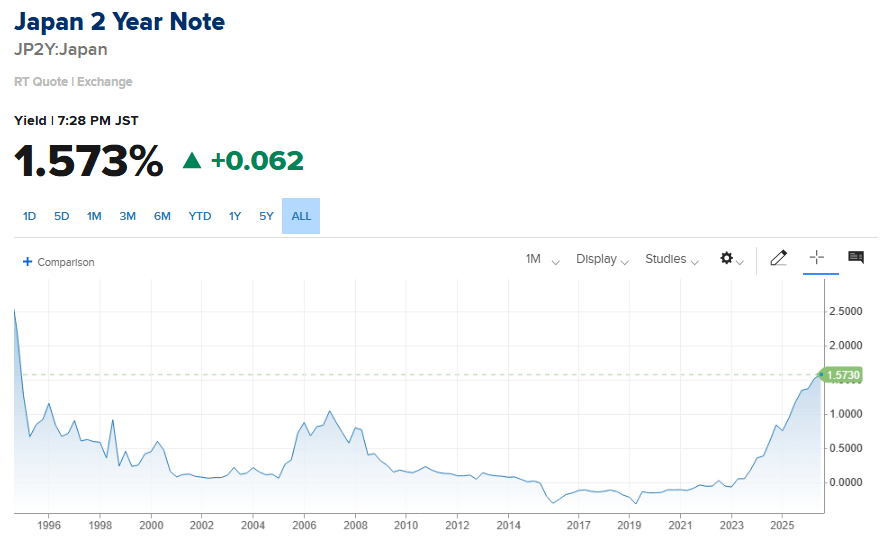
Those moves could support the yen by narrowing the interest-rate gap with the United States. They could also accelerate the return of Japanese capital from foreign markets, tightening financial conditions beyond the currency market.
Washington also has a trade incentive to prevent the currency from falling further. A weaker yen reduces the foreign-currency price of Japanese exports, giving the country’s manufacturers an advantage over US competitors at home and in international markets.
The coordinated operation therefore carried more significance than another unilateral intervention by Tokyo. It showed that Washington viewed the yen’s decline as a potential source of both financial-market instability and trade pressure.
However, Japan could limit the immediate bond-market impact of future interventions by using the Federal Reserve’s Foreign and International Monetary Authorities (FIMA) Repo Facility. The program would allow Tokyo to raise dollars against Treasuries held at the New York Fed rather than selling the securities outright.
That option could reduce direct pressure on US bond prices, but it would not remove the broader threat created by rising Japanese yields.
Even without forced Treasury sales, more attractive domestic returns could encourage Japanese institutions to reduce overseas investment, weakening demand for US bonds and other global assets.
Japanese bond yields become Bitcoin’s key warning signal
The same rise in Japanese yields that could pull capital away from overseas bonds may also pressure Bitcoin through yen-funded carry trades.
The strategy relies on borrowing at relatively low rates in Japan and deploying the proceeds into higher-yielding bonds, equities, currencies and other risk assets abroad. It becomes vulnerable when the yen appreciates, because investors need more foreign currency to repay their yen-denominated liabilities.
Higher Japanese interest rates add another source of pressure by increasing funding costs and narrowing the return advantage available in overseas markets.
Jake Kennis, senior research analyst at Nansen, told CryptoSlate that a disorderly yen rally could force leveraged investors to close positions and sell risk assets, including Bitcoin.
A gradual stabilization would create less liquidation risk while Japanese rates remained below those in the United States, he said.
Kennis noted:
“So far, BTC’s initial dip has recovered, suggesting the intervention has produced a short-term volatility event rather than a confirmed change in trend.”
He said traders should focus on the speed of yen appreciation, changes in foreign-exchange volatility and shifting interest-rate expectations rather than any single dollar-yen level.
“At this stage, the data does not support a strong directional conclusion,” Kennis added.
Taran Dhillon, head of digital assets at Kula, also told CryptoSlate that investors were drawing comparisons with August 2024, when a BOJ rate increase coincided with a roughly 20% weekly decline in Bitcoin.
Dhillon said:
“Every asset manager in this market lived through August 2024, so the instinct to price in a carry trade unwind is understandable.”
He explained that the present relationship appears different because Bitcoin has recently moved alongside a strengthening dollar rather than falling solely in response to yen appreciation.
“I’d be watching Japanese bond yields over the next few sessions more closely than the BOJ headlines,” Dhillon said.
Rising JGB yields could encourage Japanese banks, insurers and pension funds to keep more capital at home, reducing the liquidity available for overseas risk assets. They could also narrow the return advantage that made yen-funded positions attractive in the first place.
He added:
“If Japanese government bonds keep climbing despite the intervention, that tells you more about where this goes next than another joint statement from Washington and Tokyo will.”
Bitcoin recovery weakens the immediate crash case
However, Bitcoin’s brief recovery above $64,000 suggests the first currency shock has not developed into a broad carry-trade unwind.
That leaves a more conditional risk.
A controlled yen stabilization could reduce one-way speculative positions without forcing investors to abandon overseas markets at once. A faster rally accompanied by rising Japanese yields would create a greater threat by increasing funding costs and encouraging leveraged traders to reduce exposure.
André Dragosch, European head of research at Bitwise, said tighter Japanese financial conditions could still weigh on global liquidity in the near term.
Higher domestic yields may encourage Japanese investors to return capital from overseas markets, while repeated currency interventions can tighten funding conditions.
A deeper decline in equity or Treasury markets could eventually increase pressure on the Federal Reserve to cut rates or provide additional liquidity, Dragosch said.
Such a response could become supportive for Bitcoin after an initial period of tighter financial conditions. Before then, higher real yields and weaker global liquidity would remain sources of downside risk.
Bitcoin’s recovery shows that the most bearish outcome has not yet materialized. The next signal will come from Japanese government-bond yields and whether their rise begins to pull capital away from global risk assets.
The post Why Bitcoiners should care that Washington joined a $96B yen rescue to shield over $1 trillion in US Treasuries appeared first on CryptoSlate.
The United States joined Japan’s effort to support the yen after preliminary central-bank data indicated Tokyo may have deployed almost $96 billion over two days, putting Bitcoin traders on alert for a possible unwind of positions financed with cheap Japanese capital. On Aug. 3, Japan’s Ministry of Finance confirmed that it purchased yen in coordination
The post Why Bitcoiners should care that Washington joined a $96B yen rescue to shield over $1 trillion in US Treasuries appeared first on CryptoSlate. Featured, Macro, Market, Bitcoin, Japan, US, yen
This articles is written by : Nermeen Nabil Khear Abdelmalak
All rights reserved to : USAGOLDMIES . www.usagoldmines.com
You can Enjoy surfing our website categories and read more content in many fields you may like .
Why USAGoldMines ?
USAGoldMines is a comprehensive website offering the latest in financial, crypto, and technical news. With specialized sections for each category, it provides readers with up-to-date market insights, investment trends, and technological advancements, making it a valuable resource for investors and enthusiasts in the fast-paced financial world.