Crypto companies in Europe must remove existing exposure to non-MiCA-compliant stablecoins by January 8, 2027. The European Securities and Markets Authority (ESMA) gave national financial authorities 90 days to supervise the process in an opinion published on October 8.
The restrictions might lead to trading moving away from the European markets, but it wouldn’t mean that the global demand for dollar-based tokens is reduced.
According to an ADAN-Ipsos survey, which interviewed users in six European countries regarding euro stablecoins, 53% of the participants had experience with euro-denominated stablecoins. This suggests there is interest in euro stablecoins. However, whether this would translate into sufficient trading activity in order to maintain liquidity in Europe is still a question.
What the opinion actually covers
The limitations imposed by ESMA extend beyond the domain of exchange listings. They also extend to various monetary processes such as trading, custody, transfer, investment advice and overall management of a portfolio. Regulatory bodies of respective countries must ensure that the companies with MiCA certificates stop providing access to any form of non-compliant stablecoins and restrict their clients from growing their holdings of these stablecoins.
Any current investments must be addressed “as soon as possible and no later than three months after the publication of the opinion.” In the meantime, providers can continue offering limited services, including liquidation, conversion, withdrawal, transfer and safekeeping, to help customers exit their positions.
Not a ban on holding your own coins
Private users can keep USDT. The opinion just prevents one from using it via a licensed EU service provider.
As reported by the European Banking Authority (EBA), there were 39 issued e-money tokens in line with MiCA by September 1, 2026, while no asset-referenced tokens had been approved yet. The regulator is calling for a clearer classification of crypto-assets and better protection of stablecoins issued by multiple issuers.
What the last delisting wave showed about liquidity
Past restrictions illustrate that trading may persist even when exchanges have delisted stablecoins. Instead, the bulk of trading has shifted to other exchanges.
A study by Nicola Borri and Kirill Shakhnov published in July 2026 revealed that USDC accounted for a larger share of the combined trading of USDT and USDC, increasing from 17.70% to 18.24% around April 1, 2025.
The shift was especially evident across exchanges catering to European clients, where USDC’s share reportedly increased by about 6%. At the same time, while USDT trading was approximately 20% lower across all venues worldwide, USDC’s trading remained stable.
The data indicate that traders shifted their trades away rather than stopped using USDT altogether. As stated in a previous Cryptopolitan article, a number of exchanges, including Binance, Coinbase, Kraken, and OKX, have removed USDT trading pairs for European clients under MiCA but continue to allow the compliant USDC by Circle.
Euro coins grow, dollar tokens still dwarf them
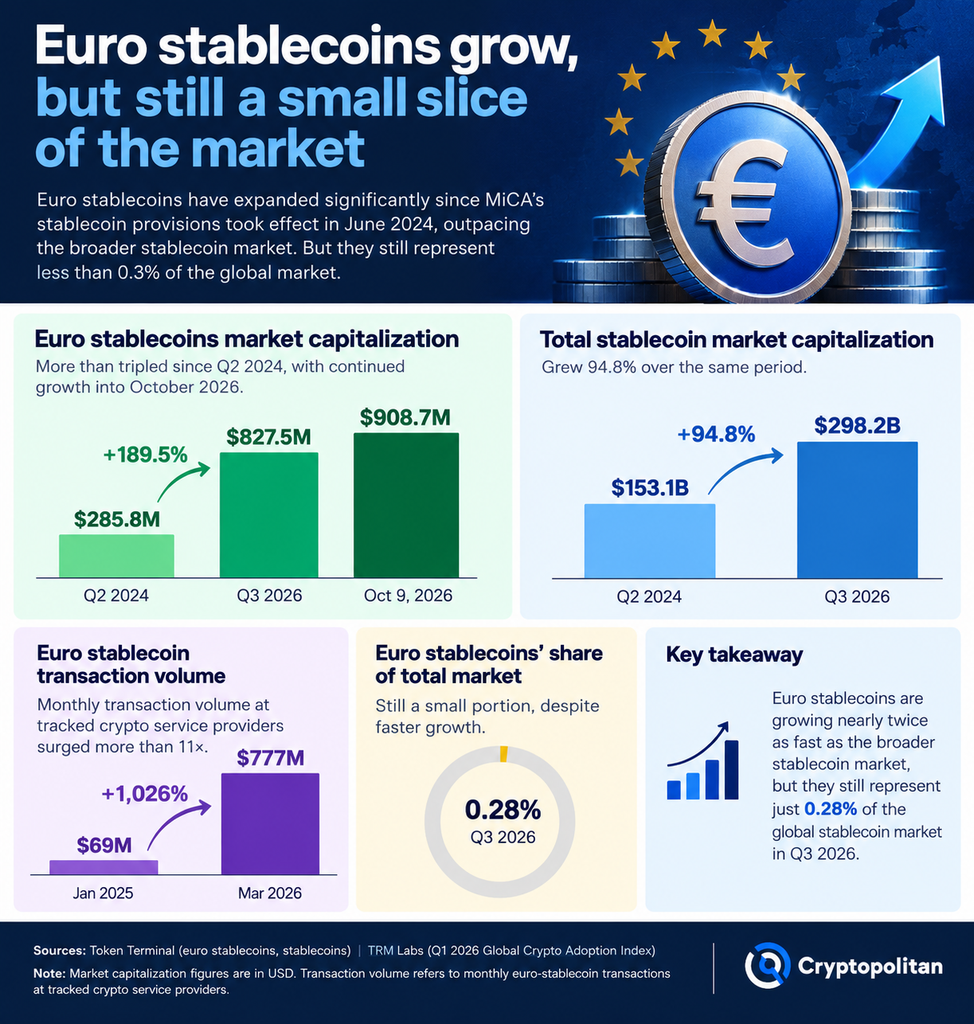
Euro stablecoins have grown significantly since MiCA’s stablecoin regulation became applicable in June 2024. It has outpaced the entire stablecoin market.
According to Token Terminal, their market capitalization climbed from $285.8 million in Q2 2024 to $827.5 million in Q3 2026, a rise by 189.5%. During the same period, the entire stablecoin market grew 94.8%, from $153.1 billion to $298.2 billion. The euro-stablecoin market capitalization continued to rise, approaching $908.7 million as of October 9.
The increase has gone beyond just market value. According to TRM Labs, the monthly euro-stablecoin transaction volume at various crypto service providers has risen from $69 million in January 2025 to $777 million in March 2026.
Still, euro-pegged tokens make up a very small percentage of the global market. Although they are growing at a rate almost double that of the entire stablecoin sector, euro-pegged tokens account for a mere 0.28% of the entire stablecoin market capitalization as of Q3 2026.
The transatlantic gap
According to a CEPS analysis, Europe risks becoming the most strictly regulated among the seven major stablecoin jurisdictions. Meanwhile, the US GENIUS Act creates a federal regulatory framework for payment stablecoins.
As for Europe, it needs to find the answer to whether stricter regulation will help limit the influence of non-compliant stablecoins or cause more trading to move offshore. Cases of previous delistings indicate that the second option remains a real possibility.
If you’re reading this, you’re already ahead. Stay there with our newsletter.
This articles is written by : Nermeen Nabil Khear Abdelmalak
All rights reserved to : USAGOLDMIES . www.usagoldmines.com
You can Enjoy surfing our website categories and read more content in many fields you may like .
Why USAGoldMines ?
USAGoldMines is a comprehensive website offering the latest in financial, crypto, and technical news. With specialized sections for each category, it provides readers with up-to-date market insights, investment trends, and technological advancements, making it a valuable resource for investors and enthusiasts in the fast-paced financial world.