
On November 13, the FBI warned about hackers using ARTEX. ARTEX is an open-source framework designed for AI-powered penetration testing. The primary targets of the hackers are banks, technology firms, and their suppliers.
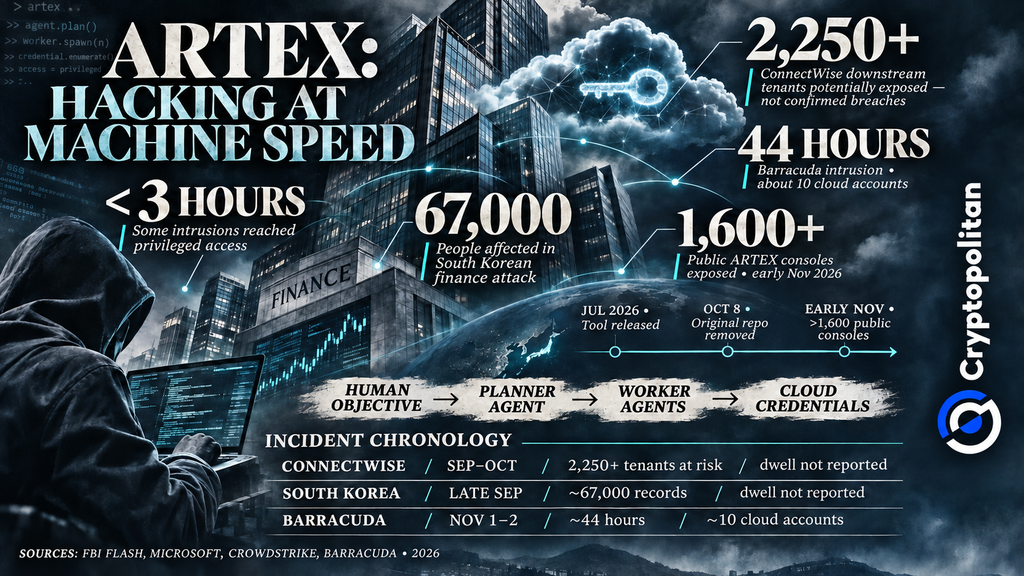
In some cases, the attackers gained privileged access less than three hours after choosing a target. Government agencies and organizations in healthcare, energy, and semiconductors were also among those targeted.
The issue is not due to the emergence of new malware but due to the automation of attacks. ARTEX helps find out various vulnerabilities very quickly. This leaves cybersecurity teams not enough time to respond to attacks.
How the agents chain an intrusion
ARTEX was built using the Go programming language. It uses external AI models (e.g., Claude, GPT and DeepSeek) to guide automated hacking agents. A human operator sets the goal.
A “planner” agent decides what to do next. “Worker” agents, on the other hand, search for security weaknesses, collect credentials and try to access other systems. The agents share their findings through a common map, as Barracuda explained. Human operators can still intervene at key points.
The developers of ARTEX took down the original project from GitHub on October 8. This was after they heard reports of the project being misused. However, copies of ARTEX were already shared in other platforms.
Besides the original, modified versions of ARTEX were also shared online. By the start of November, the number of ARTEX control panels found online was more than 1,600. However, it does not necessarily mean that all of them were being used for cyberattacks.
A supply chain breach that reached 2,250 tenants
One case involved ConnectWise Cloud Backup. Microsoft linked the compromise to Storm-0940, a China-state-aligned hacking group. The group had been using ARTEX since September to speed up attacks on organizations worldwide.
The attackers exploited already approved applications to access Microsoft 365 environments without going through authentication procedures. From there, the attackers made attempts to change log-in credentials and expand their access.
The FBI has reported that this breach made access possible to more than 2,250 downstream customers. However, this does not imply that all the aforementioned organizations suffered a security incident or any form of data loss.
From Seoul’s banks to a borrowed cloud key
ARTEX has also been implicated in cyberattacks targeting South Korea’s financial institutions between late September and early October. CrowdStrike found ARTEX files and AI session logs on the attacker’s servers.
The cybersecurity firm believes the attacker was financially motivated and likely spoke Chinese, although its confidence was moderate. The FBI reported the theft of personal information belonging to roughly 67,000 people.
Barracuda faced a different intrusion. The company had issued a cloud access key to an AI contractor but never revoked it. Hackers later found the key after breaching the contractor’s system.
Between November 1 and 2, the attackers accessed about ten cloud accounts over 44 hours. They searched for credentials and cryptocurrency wallets, but Barracuda found no wallet material.
The incidents involved separate operations, reflecting the wider misuse of ARTEX covered in earlier Cryptopolitan reporting.
What rising automation could cost defenders
One supplier breach can put many customers at risk. The OECD warns that shared technology providers can spread disruption across financial markets.
Verizon’s 2026 report put system intrusion behind 61% of breaches. Meanwhile, PwC found that 84% of security and finance leaders expect higher cyber budgets, although only 22% of surveyed leaders would allow fully autonomous AI defenses. Google also reports faster, increasingly automated attacks.
Why AI attacks can also backfire
Speed is no guarantee of skill. Speaking at Dublin’s IRISSCON conference on November 11, Proofpoint researcher Selena Larson said AI-generated malware sometimes fails, while phishing emails can contain glaring mistakes.
She pointed to the noisy BlueMoon browser exploit chain, Infosecurity Magazine reported. Her message was straightforward: AI can make attacks easier to launch without making them more sophisticated.
If you’re reading this, you’re already ahead. Stay there with our newsletter.
This articles is written by : Nermeen Nabil Khear Abdelmalak
All rights reserved to : USAGOLDMIES . www.usagoldmines.com
You can Enjoy surfing our website categories and read more content in many fields you may like .
Why USAGoldMines ?
USAGoldMines is a comprehensive website offering the latest in financial, crypto, and technical news. With specialized sections for each category, it provides readers with up-to-date market insights, investment trends, and technological advancements, making it a valuable resource for investors and enthusiasts in the fast-paced financial world.