Investment in AI has become an anchor for the world’s biggest economy, a trend which has now been noted by the Fed in its own evaluation of local economic activity.
According to the Beige Book published on September 2, the Fed reported that U.S. economic activity showed only slight uptick in activity until the end of August, while consistently emphasizing the importance of data centers and AI for the overall demand when other segments of the economy have been slowing down.
This is of great significance beyond Washington. The various hyperscalers that are financing the expansion of data centers, such as Amazon and Microsoft, are setting the trend in the world concerning capacity for AI.
If the money, spent on building data centers is helping boost manufacturing and construction in the U.S. economy, the investors have one more reason to regard the AI surge as an economic phenomenon rather than just a tech-sector trend.
What the Beige Book actually flagged
According to the report, which Reuters said includes qualitative readings from all the twelve Federal Reserve regional banks, there has been only a minor increase in employment and moderate increase in prices, based on the available information up to August 24. Businesses expressed cautiousness and cited higher energy costs, uncertainty pertaining to policies, and international conflicts.
Given that background, AI-related activity was particularly prominent. The Fed reported both positive and negative consequences of AI on labor demand, while the manufacturing sector benefited from the orders associated with data centers and defense. The non-residential construction was also increasingly focused on data center-related activities.
One contact quoted in the Chicago Fed’s district report captured the divide:
Without data centers, construction would be in a recession.
This observation also highlights the extent to which sections of the construction industry have become reliant on data-center expenditure, which would raise the stakes should investment from hyperscalers begin to fall off.
The numbers behind the global buildout
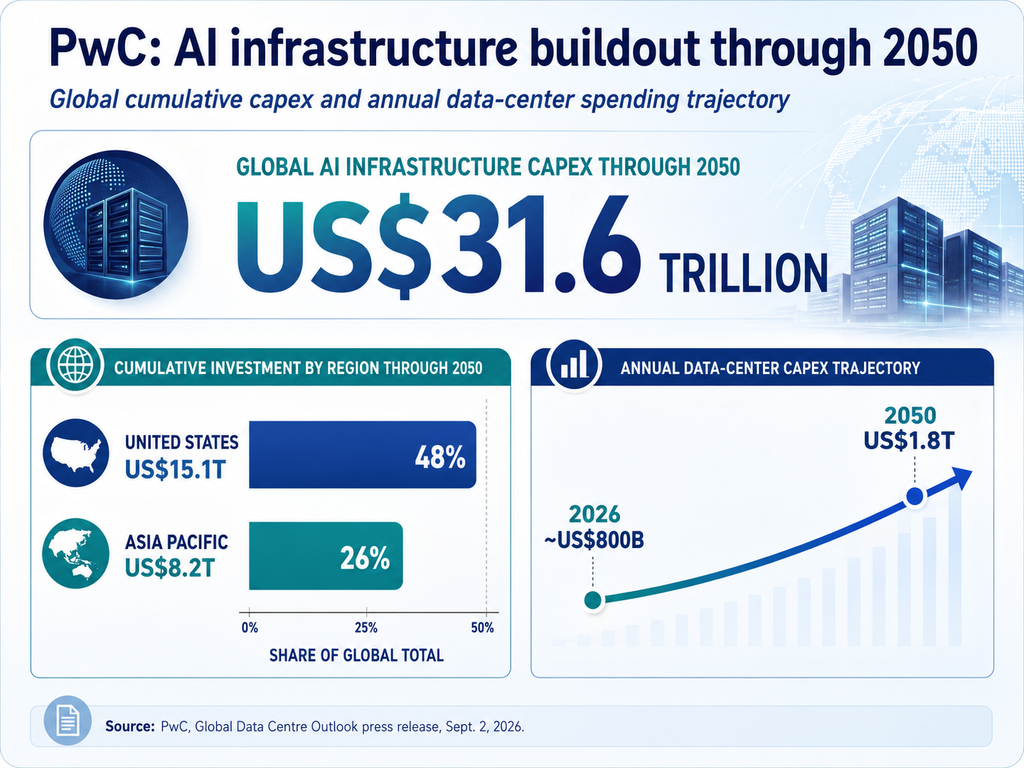
The enormity of the investment became more evident later in the same week. According to PwC’s Global Data Centre Outlook issued on September 2, global AI infrastructure capital expenditures (capex) will reach a total of $31.6 trillion by 2050. In the forecast, annual capex in data centers increase from about $800 billion in 2026 to $1.8 trillion in 2050.
According to projections, almost half of that amount, or $15.1 trillion, will be invested in the U.S. while the region of Asia Pacific is expected to seize $8.2 trillion from the overall investments, with China and India being the leaders in this regard. PwC highlights that the lack of affordable, reliable, and low-carbon electricity are the biggest constraints on where that investment can go.
The same issues are being observed by Wall Street. As stated in the report of Goldman Sachs Research published on the 19th of August, the increase in spending by hyperscalers, better performance of servers and models, and opposition to data center establishment in the U.S. question the potential of the ongoing cycle.
Why the timing cuts both ways
The Beige Book arrives ahead of the Fed’s September 15-16 meeting, with the rate outlook still unsettled. As of September 2, Reuters reported that markets were pricing roughly a 65% probability of a rate hike, compared with 35% for another hold.
The shift followed Fed Chair Kevin Warsh’s August 28 Jackson Hole remarks. Warsh did not commit to a hike, but said policymakers would have “work to do” if underlying inflation failed to move clearly and quickly enough toward the 2% target.
As Warsh said in his Jackson Hole speech:
The Fed’s predominant focus right now should be on prices.
That is where the AI boom becomes double-edged. Data-center spending is supporting construction and manufacturing, but it is also increasing competition for electricity, materials, skilled workers and capital. The Beige Book reported elevated input-price pressure in construction and manufacturing, especially for energy, transportation, metals and petrochemicals.
The scale is already visible in investment-bank forecasts. Morgan Stanley’s March 2026 outlook projects about $2.9 trillion in global data-center construction costs through 2028 and estimates AI-related investment could account for roughly 25% of U.S. GDP growth in 2026.
In its previous coverage, Cryptopolitan reported that capital expenditure for hyperscalers, according to another Morgan Stanley report, could go from $805 billion in 2026 to $1.1 trillion in 2027.
If the Fed continues to tighten amid this investment tsunami, financing would become more costly just as businesses, utilities, and government scramble to acquire the computing, power, and infrastructure they require. This makes the September rate decision important not just for American growth, but also for how fast the global growth of AI can continue.
The smartest crypto minds already read our newsletter. Want in? Join them.
This articles is written by : Nermeen Nabil Khear Abdelmalak
All rights reserved to : USAGOLDMIES . www.usagoldmines.com
You can Enjoy surfing our website categories and read more content in many fields you may like .
Why USAGoldMines ?
USAGoldMines is a comprehensive website offering the latest in financial, crypto, and technical news. With specialized sections for each category, it provides readers with up-to-date market insights, investment trends, and technological advancements, making it a valuable resource for investors and enthusiasts in the fast-paced financial world.