

At a glance
Expert’s Rating
Pros
- Panther Lake CPU with advanced 18A manufacturing process in a mini PC
- Large Arc B390 iGPU with decent gaming performance
- 64GB LPDDR5X RAM with a wide 256-bit memory interface
- Blazing-fast NVMe SSD with high transfer rates
- Plenty of ports, including OCuLink, USB4, and 10-Gigabit LAN
Cons
- High purchase price
- Pre-installed local AI software feels a bit unpolished in places
Our Verdict
The GMKtec EVO-T2S demonstrates what Intel’s new Panther Lake platform is capable of. The CPU, graphics unit, and memory work well together, and even games run smoothly at reduced settings. It’s probably too pricey for the average user. But for those looking to run local AI models or seeking a compact workstation with plenty of headroom, this is a future-proof device.
Price at the time of review
This value will show the geolocated pricing text for product undefined
Best Price Today
Best Prices Today: GMKtec EVO-T2S
High-performance mini PCs with integrated graphics suitable for gaming have been rare until now. The GMKtec EVO-T2S changes that: It features Intel’s Core Ultra X7 358H from the Panther Lake family, complemented by the powerful Arc B390 iGPU. This positions the compact device well above standard office mini PCs. We’ll examine whether the combination of performance and price makes sense for users. By the way: GMKtec lists the model with the Intel Core Ultra X9 388H as the EVO-T2. However, it is currently out of stock.
GMKtec EVO-T2S design and build quality
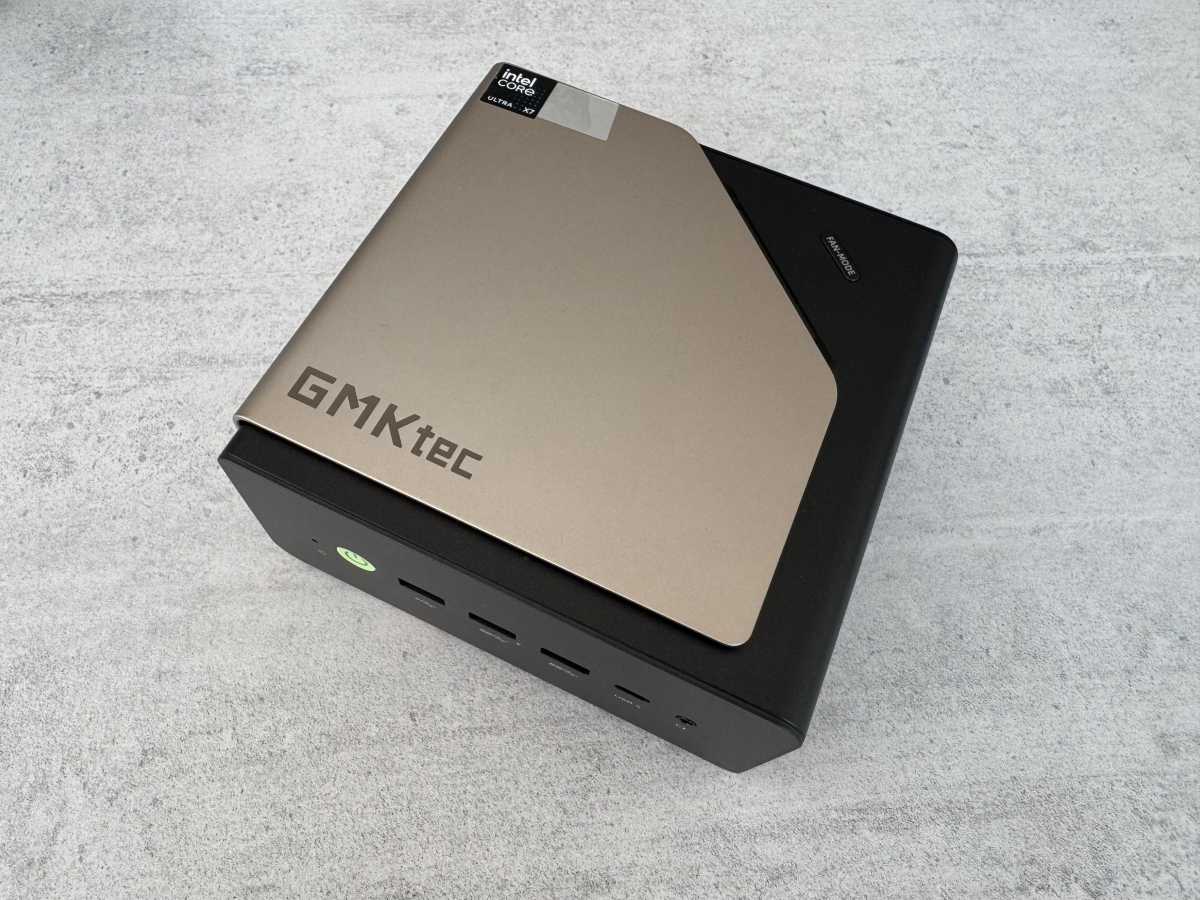
The EVO-T2S comes in a case that is barely any larger than a thick paperback. With a volume of around 1.7 liters and dimensions of 6.0 × 5.9 × 2.8 inches (W × D × H), it is one of the more compact mini PCs, yet offers enough space for effective cooling. The lid is made of brushed aluminum in a bronze-colored finish and features the GMKtec logo.
Christoph Hoffmann
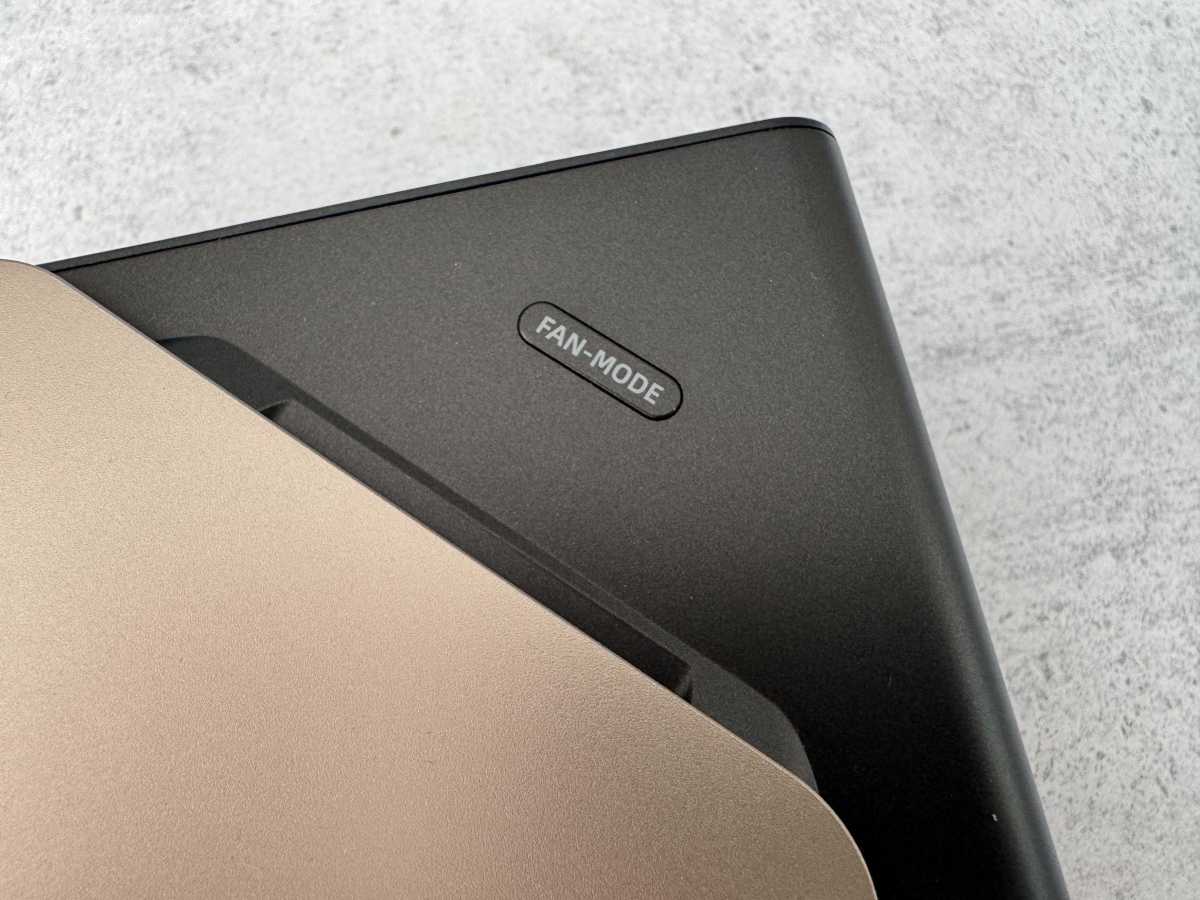
For cooling, GMKtec relies on a vapor chamber solution with two fans. The second, comparatively large fan is situated directly beneath the metal cover on the top and features switchable RGB lighting. The button next to it, labelled ‘Fan Mode,’ therefore does not control the fan speed, but only the lighting. Such a dual-fan design is unusual for a mini PC of this size.
Christoph Hoffmann
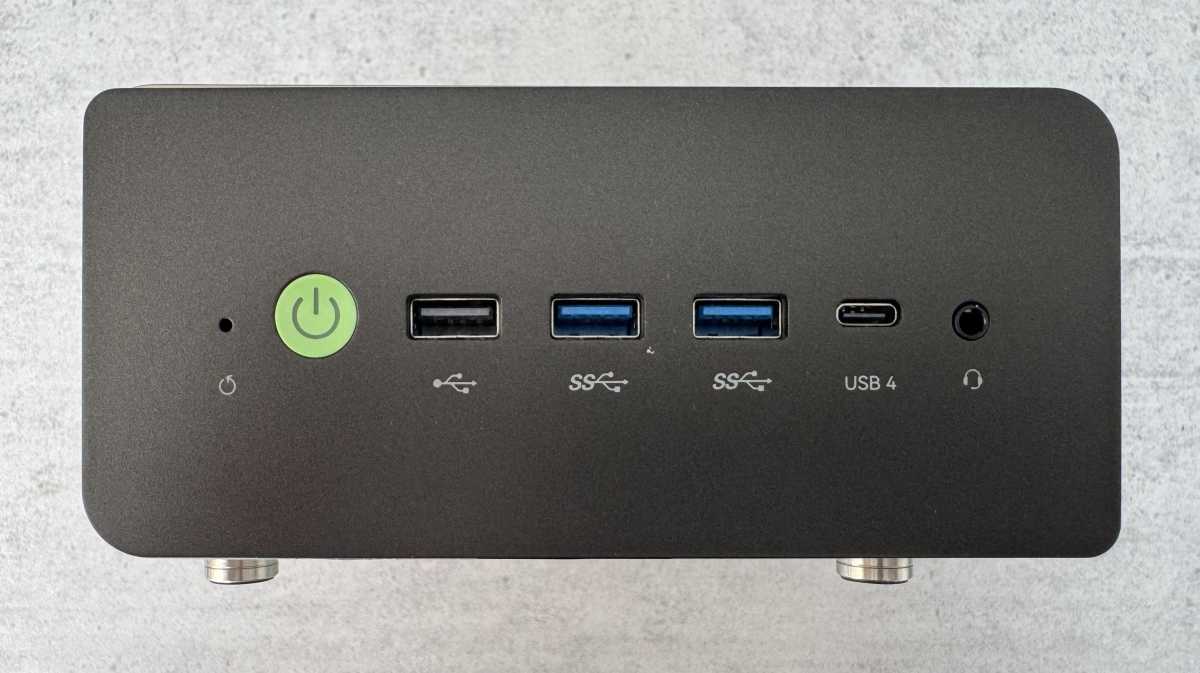
The port layout follows a clear logic: The ports that users frequently plug devices into and out of are at the front, while the permanent connections are at the rear. On the front panel, you’ll find the illuminated power button, a USB 2.0 port, two USB 3.2 Type-A ports, a USB4 Type-C port, and a headphone jack.
Christoph Hoffmann
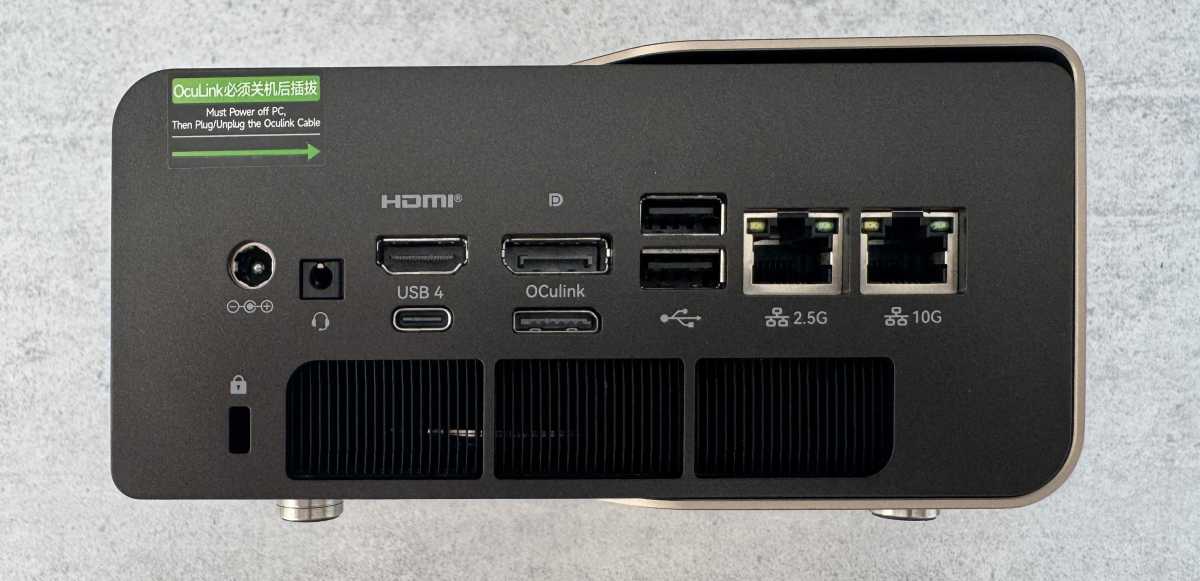
The rear panel is significantly more generously equipped: Alongside the round plug for the external power supply, there is an HDMI and a DisplayPort output, an OCuLink port for external graphics cards, two further USB 2.0 ports, and two network sockets offering 2.5- and 10-gigabits per second, respectively.
Christoph Hoffmann
Both USB4 ports support data rates of up to 40Gbit/s, DisplayPort, and Power Delivery for charging compatible devices at up to 100 watts, making them suitable for fast external SSDs or docking stations.
Up to four monitors can be operated simultaneously via HDMI, DisplayPort, and the two USB4 ports — according to the manufacturer, even at resolutions of up to 8K. A Kensington lock slot rounds off the well-designed port layout.
OCuLink is an external PCIe interface that allows, for example, a desktop graphics card in a separate eGPU enclosure to be connected with significantly lower signal loss than via USB4. On the EVO-T2S, the connection operates at PCIe 4.0 x4, offering a theoretical bandwidth of just under 8GB/s. This is particularly useful if the integrated Arc B390 iGPU no longer proves sufficient or if the mini PC is to be upgraded for GPU-accelerated applications. However, the port does not support hot-plugging; eGPU enclosures should therefore only be connected or disconnected while the system is switched off.
The build quality appears high, the gaps are uniform, and the weight also gives a solid feel without making the computer unwieldy.
GMKtec EVO-T2S specifications
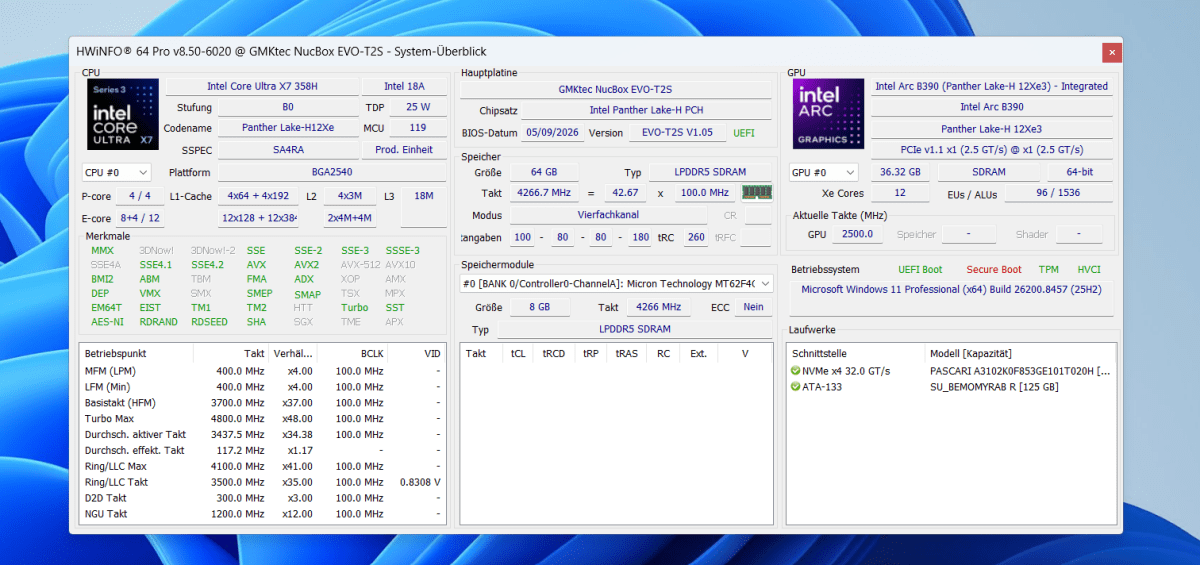
At the heart of the EVO-T2S is Intel’s Core Ultra X7 358H from the Panther Lake generation, manufactured using the Intel 18A process. The processor combines four performance cores with eight efficiency cores and four particularly energy-efficient low-power E-cores. In total, it offers 16 cores and 16 threads, as well as 18MB of Intel Smart Cache. The performance cores run at a base clock speed of 1.9GHz and a turbo clock speed of up to 4.8GHz. The eight efficiency cores reach up to 3.5GHz, while the four low-power E-cores reach up to 3.3GHz.
Christoph Hoffmann
GMKtec offers three power profiles: 35 watts in Silent mode, 45 watts in Balanced mode, and 54 watts in Performance mode; short-term peaks of up to 60 watts are possible. Our test unit ran in the middle Balanced profile.
The processor features Intel’s large Arc B390 iGPU with 12 Xe3 cores. It represents a significant improvement over previous Intel iGPUs. The GPU has 12 Xe3 cores, clocks at up to 2.5GHz, and supports ray tracing as well as Intel’s XeSS upscaling technology.
For system memory, the manufacturer has opted for a generous 64GB of soldered-on LPDDR5X, connected via a wide 256-bit memory interface. This benefits not only the CPU but also the graphics unit via the shared memory pool.
A Phison PASCARI A3102K0F853GE101T020H is used for mass storage, which GMKtec refers to as the Phison aiDAPTIV AI SSD. The storage configuration comprises a 768GB system drive for Windows and applications, as well as a separate 85GB AI storage area. Together, these make up the stated total capacity of 853GB. The additional storage area is intended for Phison’s AI functions and is not available as a regular data drive.
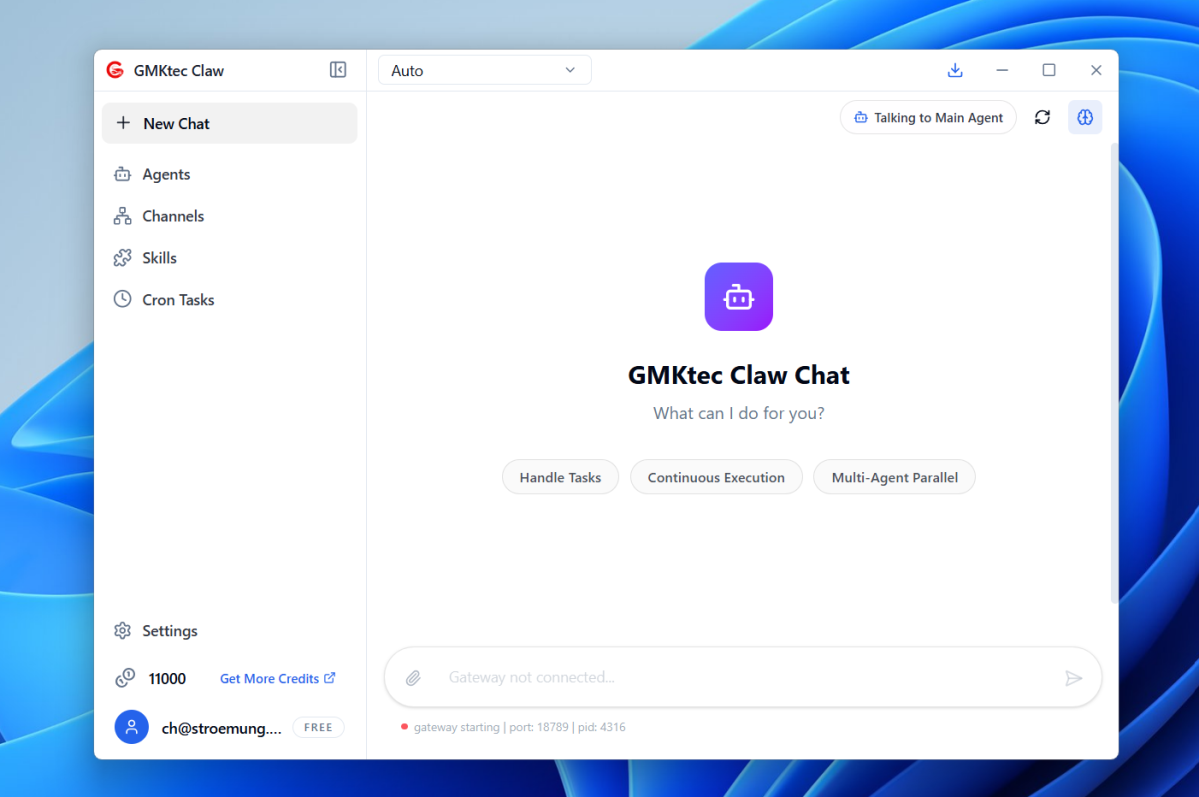
Speaking of AI: GMKtec supplies the computer with its own local software environment. A Claw Assistant can process tasks independently and control multiple agents in parallel, while an associated model hub provides dozens of open-source language models such as Qwen, Gemma, or GPT-OSS for local download. For those who prefer not to use cloud services, this provides a useful tool.
Christoph Hoffmann
The integrated NPU achieves up to 50 TOPS; according to Intel and GMKtec, the CPU, GPU, and NPU combined deliver AI computing power of up to 180 TOPS. This makes the EVO-T2 particularly well-suited for local AI applications, Retrieval-Augmented Generation (RAG), or running larger language models directly on your own computer. However, the pre-installed software does not yet seem fully mature in some areas.
In terms of connectivity, the mini PC impresses with Wi-Fi 7 and network ports offering speeds of 2.5- and 10-gigabits per second. The 10Gbit port is particularly useful for use with a suitably fast NAS, such as a Ugreen model with a 10-gigabit connection.
Large files, backups, media archives, or project folders can be transferred much faster than via conventional Gigabit LAN. This also makes it more practical to edit large photo, video, or AI data sets directly on the network storage. The additional 2.5Gbit port can be used in parallel for a standard home or office network.
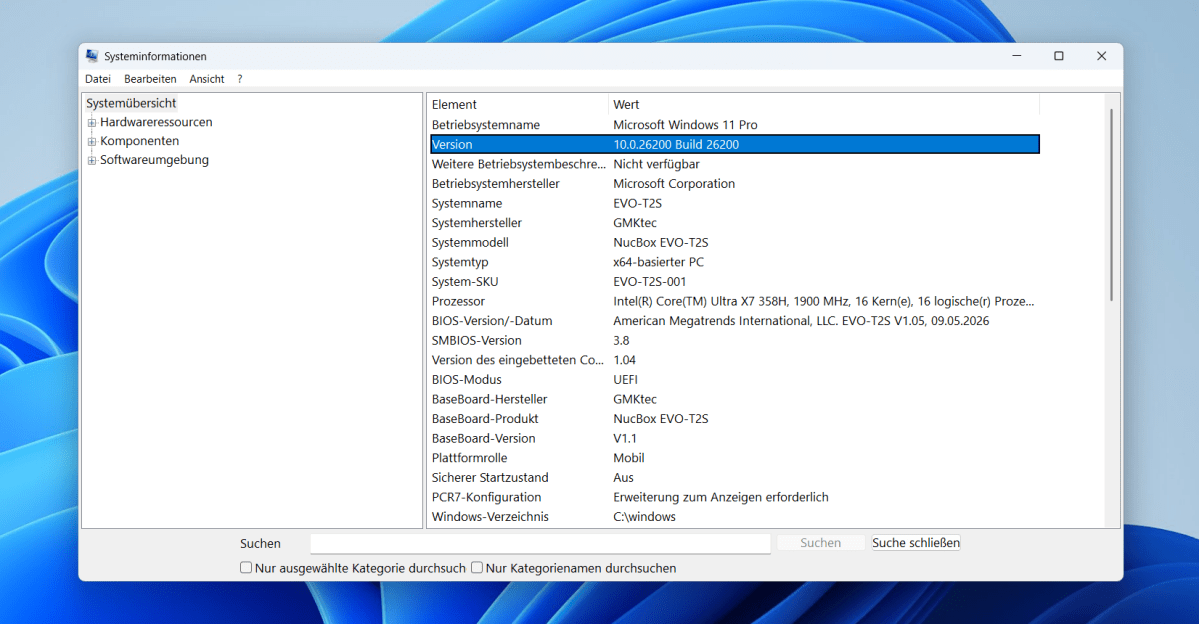
Windows 11 Pro (Build 10.0.26200) comes pre-installed, and the mini PC is ready for use immediately after initial setup. Compared to the Home edition, Windows 11 Pro offers, among other things, BitLocker encryption, Hyper-V virtualization, Remote Desktop, and domain connectivity. All drivers were already correctly configured on our test unit, so no manual reinstallation was required.
Christoph Hoffmann
The EVO-T2S’s expansion options leave a mixed impression. Although there is another M.2 slot available next to the system drive for an additional NVMe SSD, access to it is unnecessarily fiddly: To reach it, you have to remove four screws on the underside, which are hidden beneath the adhesive rubber feet.
GMKtec could have handled this more elegantly. Once the base plate is removed, however, the expansion slot is exposed and can be easily fitted with a second SSD. The 64GB LPDDR5X RAM, on the other hand, is fully soldered in place and cannot be upgraded. However, as GMKtec offers the EVO-T2S exclusively with this memory configuration, this drawback is hardly noticeable in practice.
GMKtec EVO-T2S computing performance
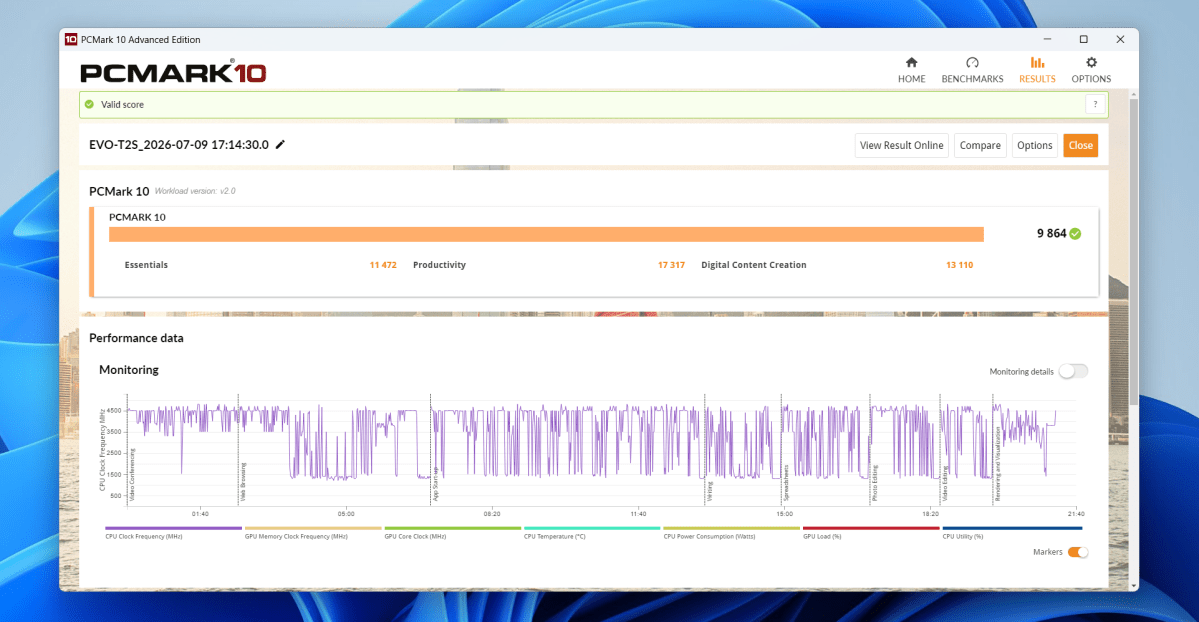
In PCMark 10, the EVO-T2S scores 9,864 points, broken down into 11,472 for everyday tasks, 17,317 for productivity, and 13,110 for content creation. These figures place the mini PC well ahead of traditional office mini PCs with Core i5 or Ryzen U processors and on a par with compact workstations that rely on HX or H processors with a higher core count.
Christoph Hoffmann
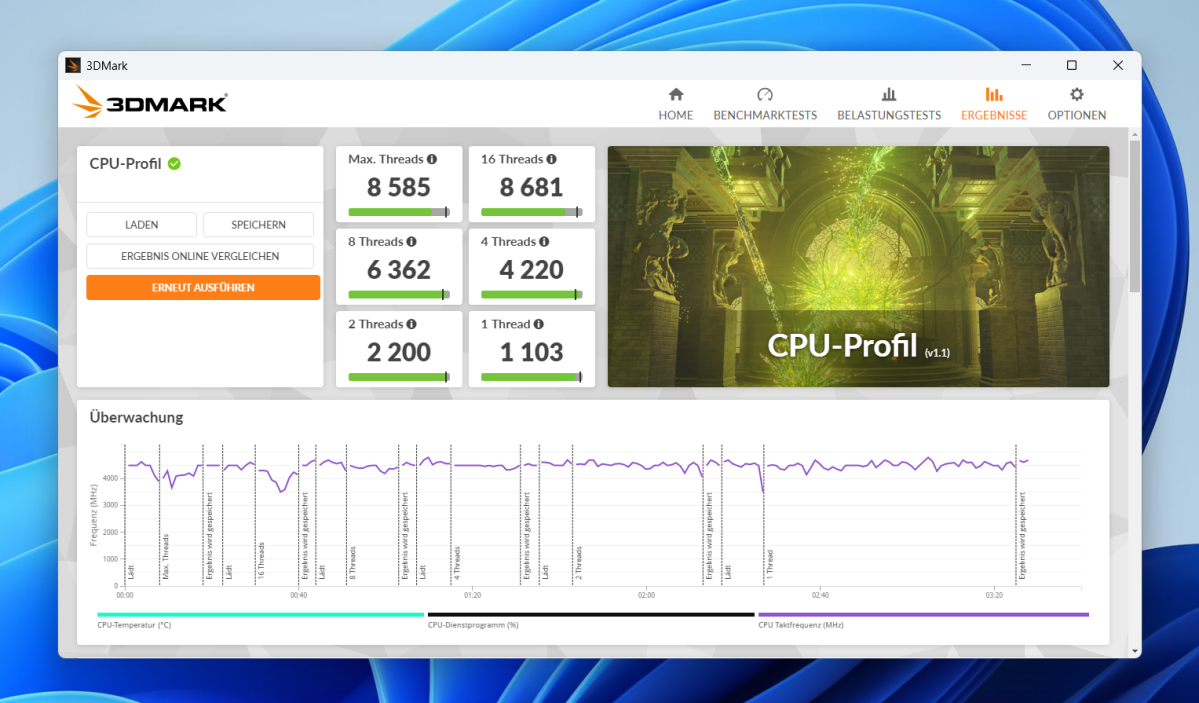
In 3DMark’s CPU Profile, the processor scores 8,585 points in the Max Threads test and 8,681 points in the 16-thread test. Even in the single-core test, the score of 1,103 points is on a par with that achieved by high-end laptop processors. The combination of four powerful and 12 efficient cores therefore pays off in both multi-core and single-core workloads.
Christoph Hoffmann
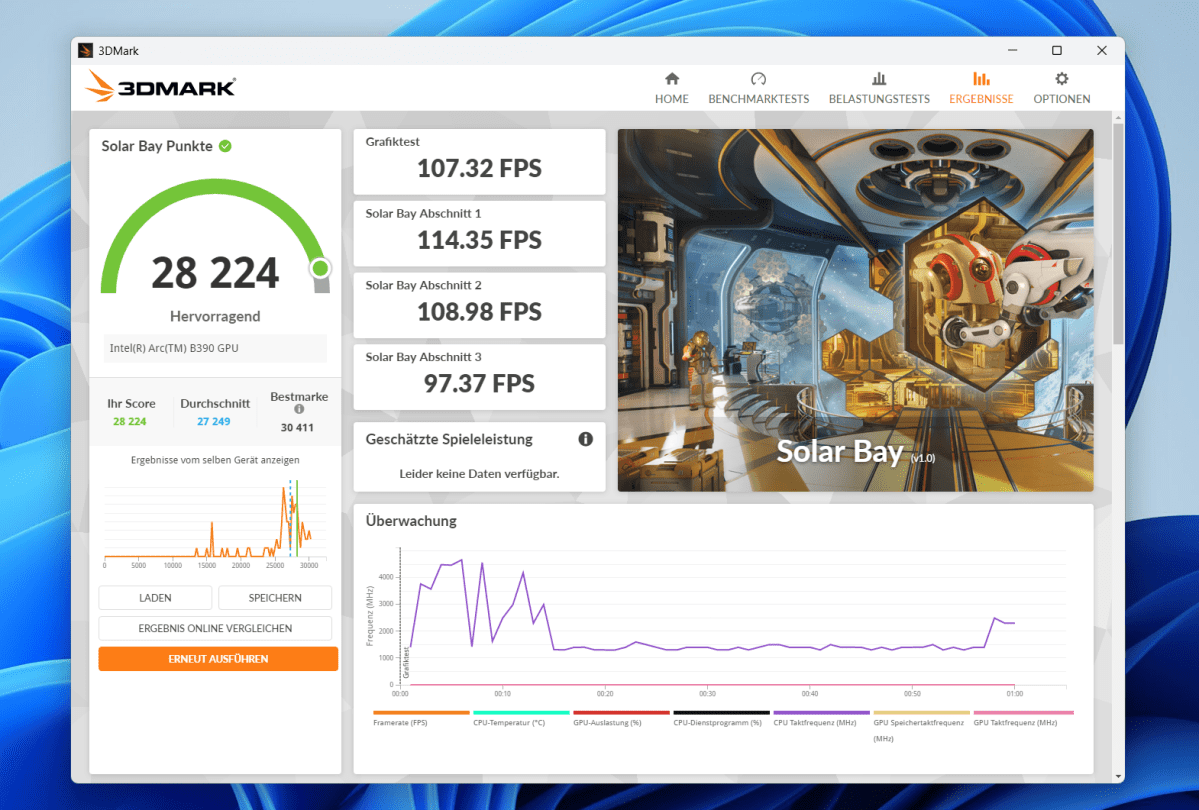
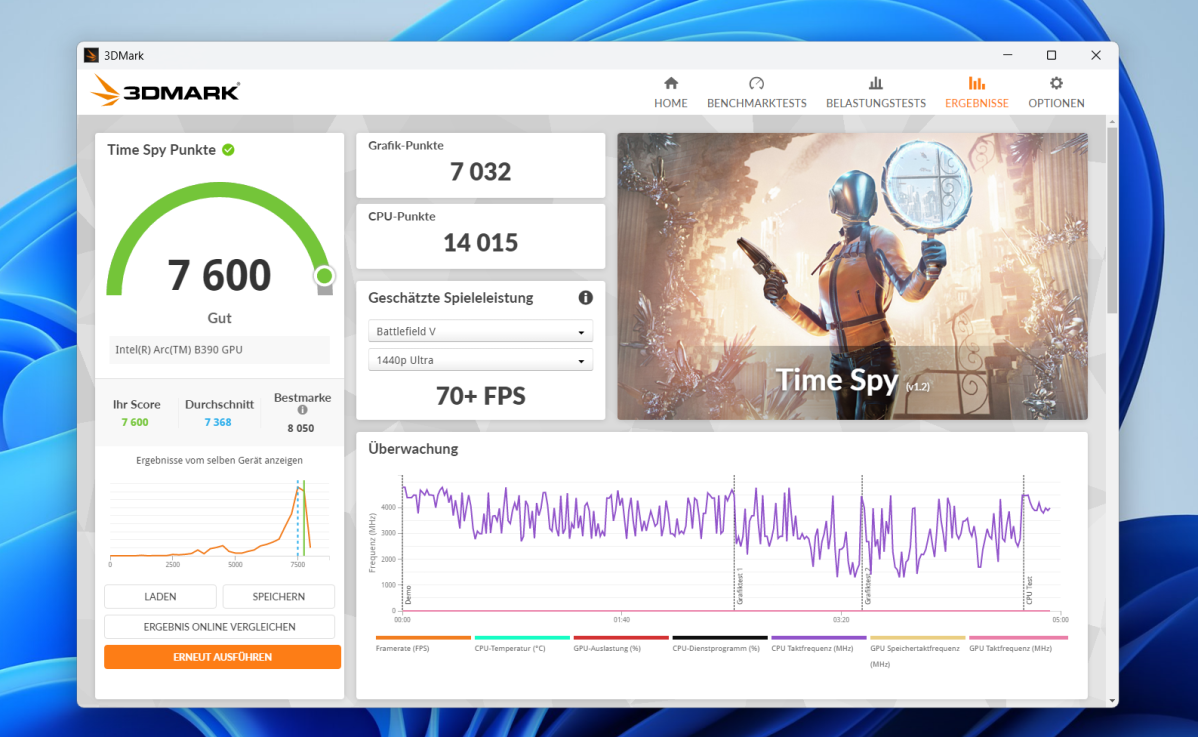
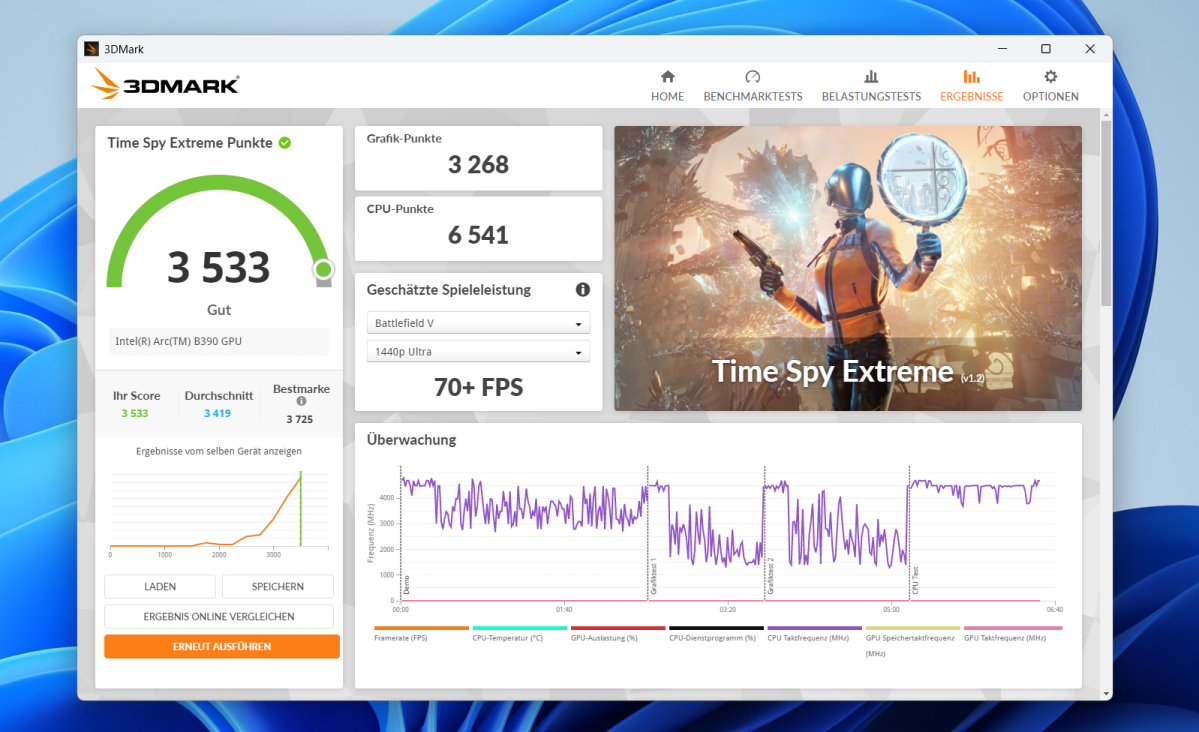
In terms of graphics performance, the Arc B390 proves itself to be exactly what it’s meant to be: one of the fastest integrated graphics solutions currently available. In the Solar Bay ray-tracing benchmark, the mini PC scored 28,224 points at over 107 frames per second, a result that is significantly higher than that of pure Intel Iris Xe or AMD Radeon 780M solutions, such as those found in many office mini- PCs. Even in the more demanding Time Spy benchmark, it scores 7,600 points, and 3,533 points in the Extreme variant — figures that place the EVO-T2S on a par with older entry-level graphics cards for desktop PCs.
Christoph Hoffmann
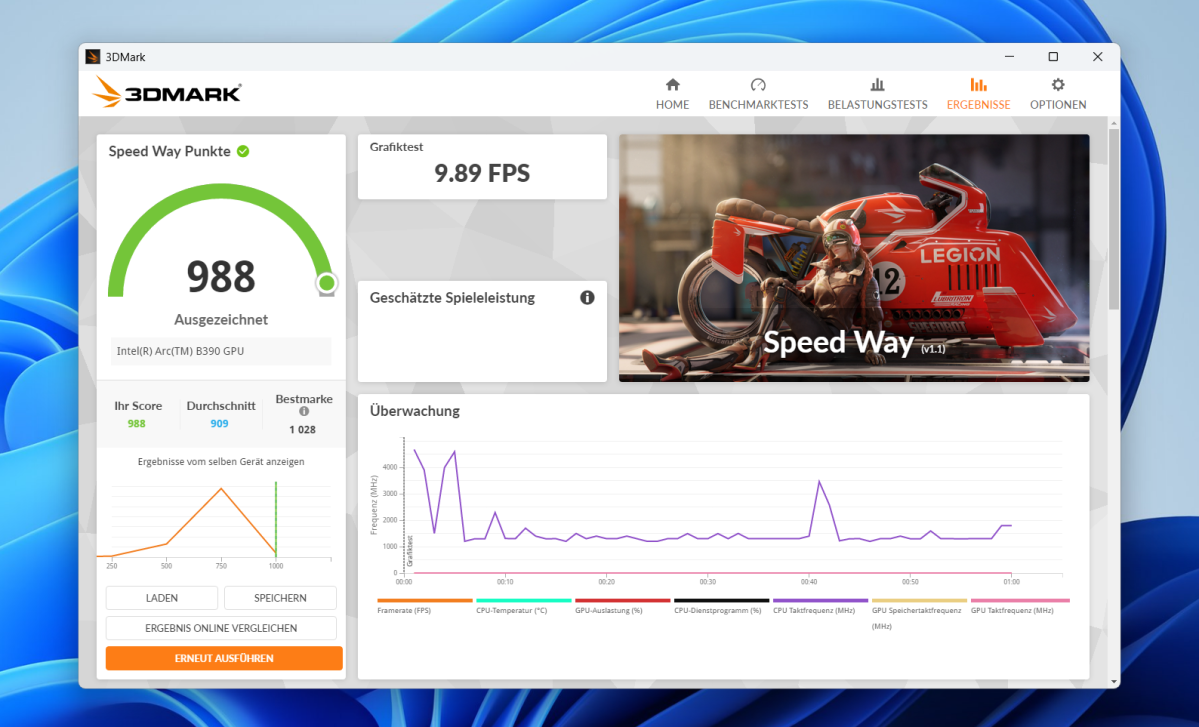
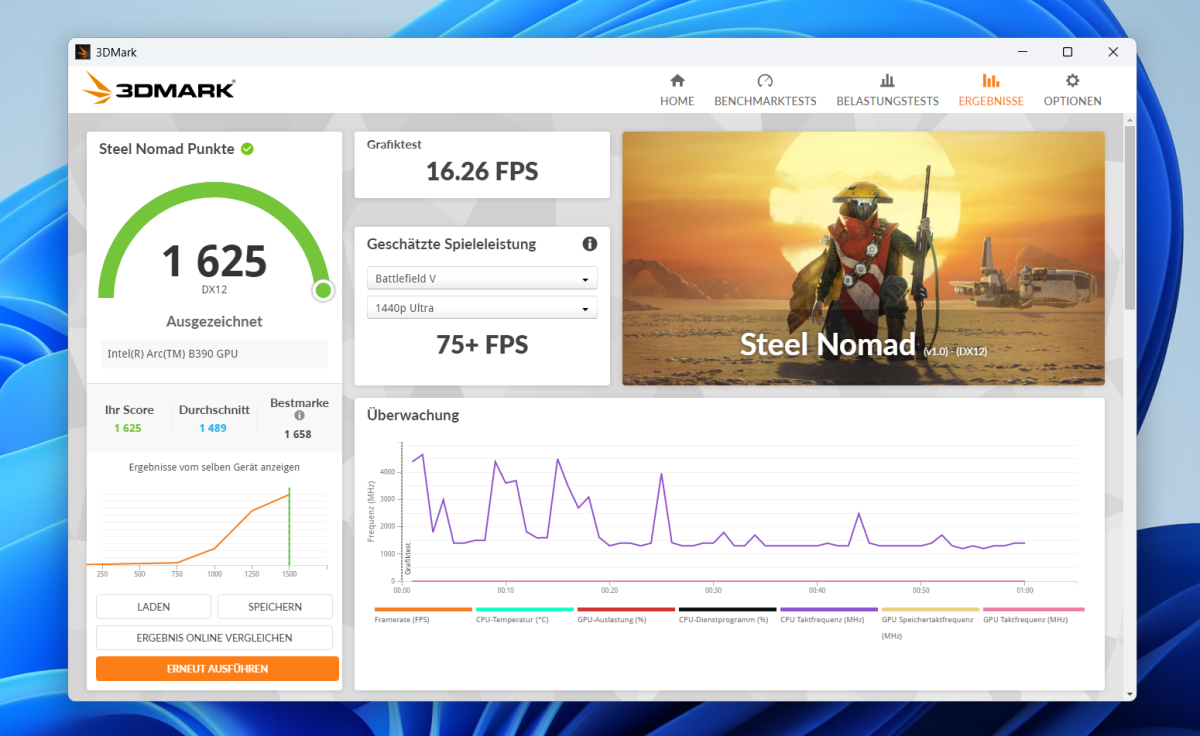
In ray-tracing-heavy tests such as Speed Way and Steel Nomad, the frame rate drops, as expected, to single-digit or low double-digit figures, which is understandable given the compact design and the shared memory interface.
For many current games, the performance is sufficient in Full HD with reduced detail and XeSS, as suggested by the frame rate of over 70 frames per second in Battlefield V, as extrapolated by 3DMark.
In actual gameplay, the new Xe3 architecture performs surprisingly well: A demanding title such as Cyberpunk 2077 runs at an average of 48 FPS in Full HD resolution (1080p) with medium detail settings. If you also enable Intel’s XeSS upscaling technology in the ‘Balanced’ profile, the frame rate climbs to an extremely smooth 64 FPS — for an integrated graphics solution in a mini PC format, this is a remarkably good result for a mini PC without a dedicated graphics card.
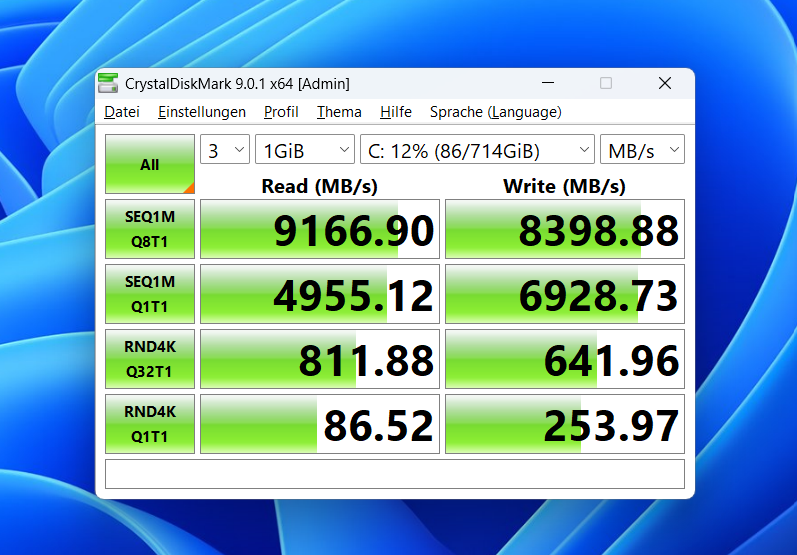
The 768GB system drive achieves sequential transfer rates of up to 9,167MB/s for reading and 8,399MB/s for writing in CrystalDiskMark, complemented by high random access figures. This puts the storage performance on a par with current high-end SSDs and, together with the 64GB of LPDDR5X RAM, ensures short loading times for applications, games and AI models.
Christoph Hoffmann
A notable feature is the storage design: CrystalDiskInfo also identifies a separate 85GB AI storage drive as a standalone NVMe 2.0 drive with a PCIe 5.0 x4 connection. Together, this results in the total capacity of 853GB specified by the manufacturer.
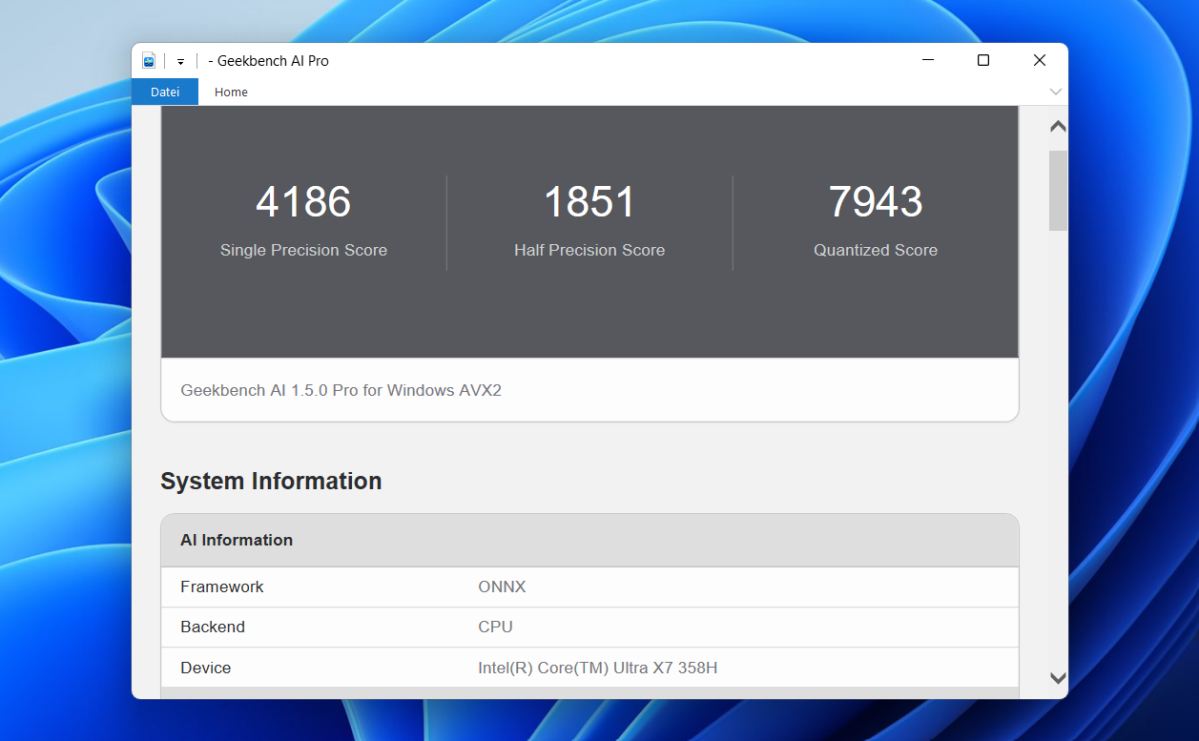
The processor also delivers solid performance in AI tasks: In Geekbench AI’s CPU test, the Core Ultra X7 358H scored 4,186 points for single-precision and 7,943 points for quantized precision. This puts the EVO-T2S well ahead of older mini PCs featuring Intel Meteor Lake or AMD Ryzen 8000 processors.
Christoph Hoffmann
In practice, the mini PC runs smoothly, without stuttering and without any noticeable drops in performance under sustained load.
Noise levels and power consumption
In everyday use, the two fans usually operate at low speeds and are barely audible from a normal seating distance. Only under sustained CPU and GPU load do the fan speeds and noise levels increase noticeably, though they remain within acceptable limits for a mini-PC in this performance class.
In our tests, the cooling system kept clock speeds stable even under prolonged sustained load; we did not observe any significant thermal throttling. This is in line with the manufacturer’s specifications, which state that the dual-fan cooling system is designed to deliver consistently high performance even in 54-watt performance mode. The included 148-watt power supply is generously rated for the maximum possible power consumption and offers sufficient headroom.
Should you buy the GMKtec EVO-T2S?
The GMKtec EVO-T2S is not a computer for the masses. The purchase price of nearly $2,000 puts off casual users, and standard Windows tasks can be handled just as well by a significantly cheaper mini-PC.
However, for those who wish to run local AI models, perform compact rendering tasks, or occasionally enjoy a recent game at reduced detail settings, the combination of a Panther Lake processor, a powerful Arc B390 iGPU, and 64GB of RAM delivers a device that is ahead of its time.
The wide range of connectivity options and the well-designed cooling system round off the positive impression. Anyone prepared to dig deep into their pockets for this technology will currently get one of the most powerful mini-PCs based on Intel’s Panther Lake platform.
Technical specifications
- Processor: Intel Core Ultra X7 358H (Panther Lake, Intel 18A process), 4 P-cores at 1.9 to 4.8 GHz, 8 E-cores at 1.5 to 3.5 GHz and 4 LP-E-cores at 1.5 to 3.3 GHz, totalling 16 cores and 16 threads
- Power profiles: 35 watts (Silent), 45 watts (Balanced), 54 watts (Performance), up to 60 watts for short periods
- Graphics: Intel Arc B390 (integrated), 12 Xe3 cores, up to 2.5 GHz
- RAM: 64 GB LPDDR5X, soldered in, connected via a 256-bit memory interface
- Storage: Phison PASCARI A3102K0F853GE101T020H, AI SSD with a 768 GB system drive and additional 85 GB AI storage
- Connectivity: Wi-Fi 7, Bluetooth 5.4, 2.5 Gbit and 10 Gbit LAN
- Front ports: 1 × USB 2.0 Type-A, 2 × USB 3.2 Type-A, 1 × USB4 Type-C, headphone jack, power button
- Rear ports: HDMI, DisplayPort, OCuLink (PCIe Gen4 x4), 2 × USB 2.0 Type-A, power socket, Kensington lock
- Operating system: Windows 11 Pro (pre-installed)
- Dimensions: 6.0 × 5.9 × 2.8 inches (W × D × H), volume approx. 1.7 liters
- Power supply: 148 watts (19 V / 7.8 A)
This articles is written by : Nermeen Nabil Khear Abdelmalak
All rights reserved to : USAGOLDMIES . www.usagoldmines.com
You can Enjoy surfing our website categories and read more content in many fields you may like .
Why USAGoldMines ?
USAGoldMines is a comprehensive website offering the latest in financial, crypto, and technical news. With specialized sections for each category, it provides readers with up-to-date market insights, investment trends, and technological advancements, making it a valuable resource for investors and enthusiasts in the fast-paced financial world.