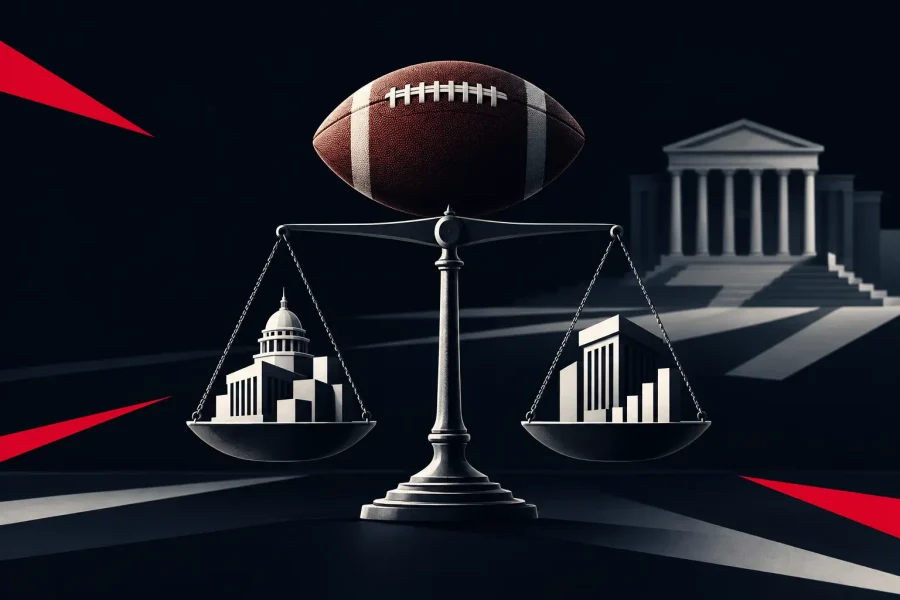

The NFL has filed an amicus brief backing New Jersey’s petition for Supreme Court intervention, asking the justices to clarify whether states can regulate sports prediction contracts or whether federal oversight prevails, as reported by The Independent.
The dispute puts Kalshi and other prediction-market operators at the center of a jurisdictional fight with direct consequences for where and how their sports contracts can be offered. The question of whether state gambling laws apply to Kalshi contracts is the same one the NFL wants the court to resolve.
League argues states are better placed to oversee sports contracts
Prediction markets let users trade contracts tied to the outcomes of future events. The NFL argues that state authorities already responsible for legal sportsbooks are better equipped to oversee sports-related contracts under the current regulatory landscape.
The CFTC claims exclusive federal jurisdiction over these markets. States counter that binary, yes-or-no contracts on sports outcomes function like traditional gambling and should fall under state oversight, rather than escaping state rules because they trade on a prediction-market platform.
In its filing, the NFL warns that operators are exploiting a gap between federal and state regulation, putting consumers and the integrity of sports events at risk. The league cited the scale of football trading: on the opening Sunday of the current season, $1.8 billion of $3.3 billion in prediction-market volume was tied to NFL games, according to figures in its brief.
The league also argues that the court should not delay resolving the dispute, saying delay would increase consumer harm and create further risks to game integrity. That concern is part of the NFL’s case for a ruling that would establish which regulator has authority over sports-related contracts.
State and federal approaches remain in conflict
Ohio filed a brief urging the justices to support New Jersey and preserve state authority over prediction markets alongside casino gambling and sports betting. A bipartisan coalition of 38 states joined Ohio’s filing, including attorneys general from California, New York, Pennsylvania, Illinois, Missouri, Arkansas and South Carolina.
About 20 states are involved in lawsuits over prediction markets, and federal appeals courts have reached conflicting conclusions. The 6th and 9th U.S. Circuit Courts of Appeals backed states seeking regulatory authority, while the 3rd Circuit ruled for Kalshi earlier this year.
The NFL says the 6th and 9th Circuits reached the right result given the current landscape. Those contrasting rulings have heightened the prospect of Supreme Court review, although the question of who ultimately governs sports event contracts remains unresolved. New Jersey’s petition fits into a wider state-level effort to bring the dispute before the justices.

Kalshi and Polymarket favor federal rules
Kalshi spokesperson Elisabeth Diana said market integrity is the company’s primary focus and pointed to partnerships with Major League Baseball, the NHL and other sports bodies. She said the CFTC is actively policing sports-related markets and that its ongoing rulemaking addresses many of the NFL’s concerns.
That position reflects the broader industry argument that a national market needs a consistent federal framework rather than a patchwork of state requirements. The split between appellate courts over state authority is a major reason the Supreme Court dispute matters to prediction-market operators.
A Polymarket spokesperson said the company shares the NFL’s commitment to game integrity but supports a harmonized federal framework instead of disconnected state laws. The CFTC did not respond to the request for comment described in The Independent’s report.

The NFL also questioned whether the CFTC has enough staff to oversee sports contracts alongside its other responsibilities, noting that the agency has 543 employees supervising a broad range of financial derivatives. The league argued that insufficient staffing could limit meaningful oversight and enforcement, even if regulations are in place.
The league has previously asked the CFTC and prediction-market operators to prohibit certain wagers it considers dangerous to game integrity and to raise the minimum participation age from 18 to 21; those proposals were turned down. Diana said Kalshi had tried to work directly with the NFL on integrity measures but received no reply.
The Supreme Court is being asked to settle whether sports-related prediction contracts fall under federal commodities oversight alone or can also be regulated by states as gambling. With conflicting appellate rulings and state filings on the issue, the operating rules for Kalshi and other platforms remain unsettled.
The post NFL Flags Sports Integrity Risks in Prediction Market Dispute appeared first on ReadWrite.
This articles is written by : Nermeen Nabil Khear Abdelmalak
All rights reserved to : USAGOLDMIES . www.usagoldmines.com
You can Enjoy surfing our website categories and read more content in many fields you may like .
Why USAGoldMines ?
USAGoldMines is a comprehensive website offering the latest in financial, crypto, and technical news. With specialized sections for each category, it provides readers with up-to-date market insights, investment trends, and technological advancements, making it a valuable resource for investors and enthusiasts in the fast-paced financial world.