With the big AI providers cracking down on usage limits for their most powerful agentic features, it’s tempting to kiss our ChatGPT, Claude, and Gemini subscriptions goodbye and go all-in with local AI–and it’s certainly doable, if you’re willing to pay for it.
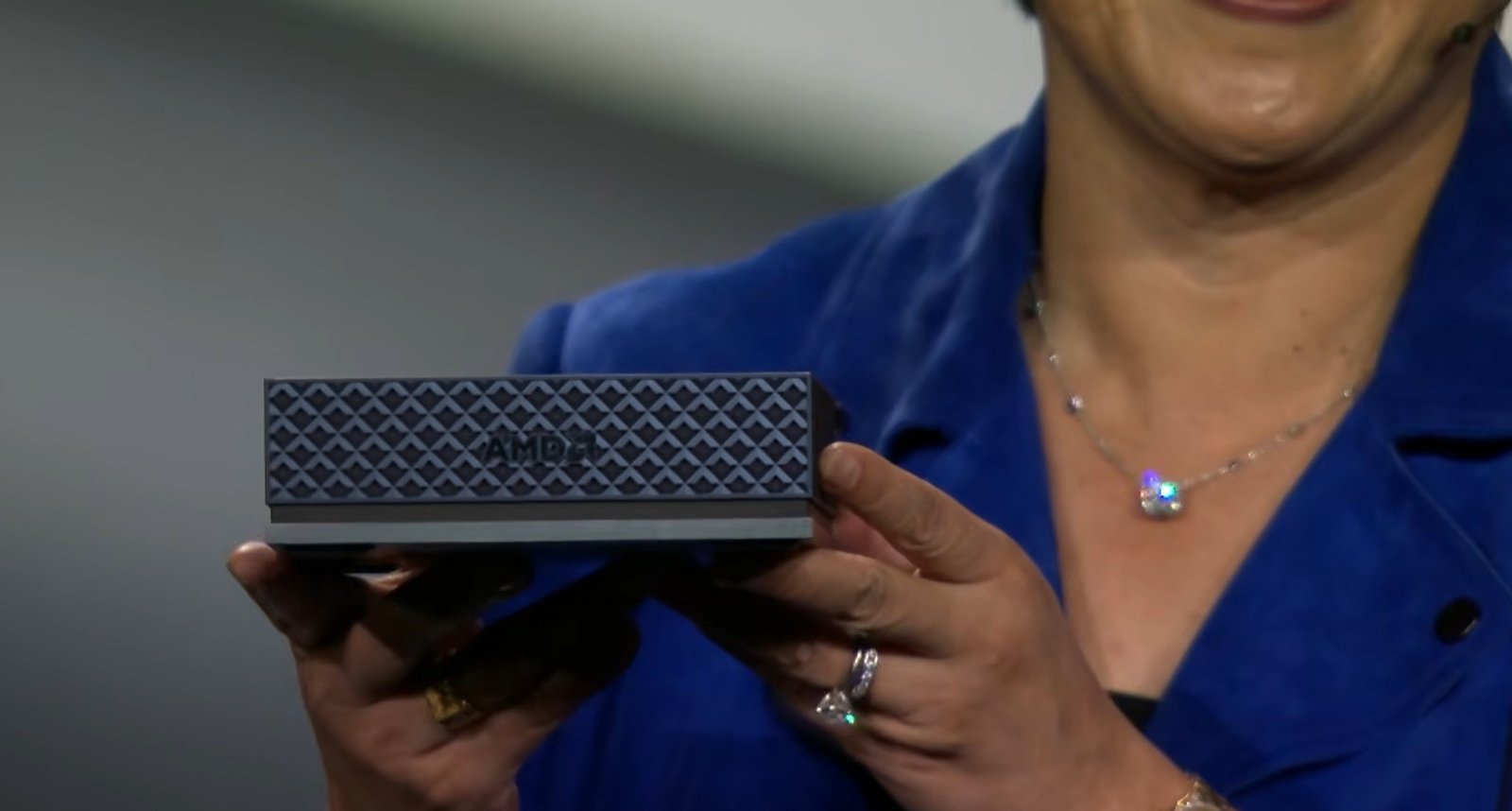
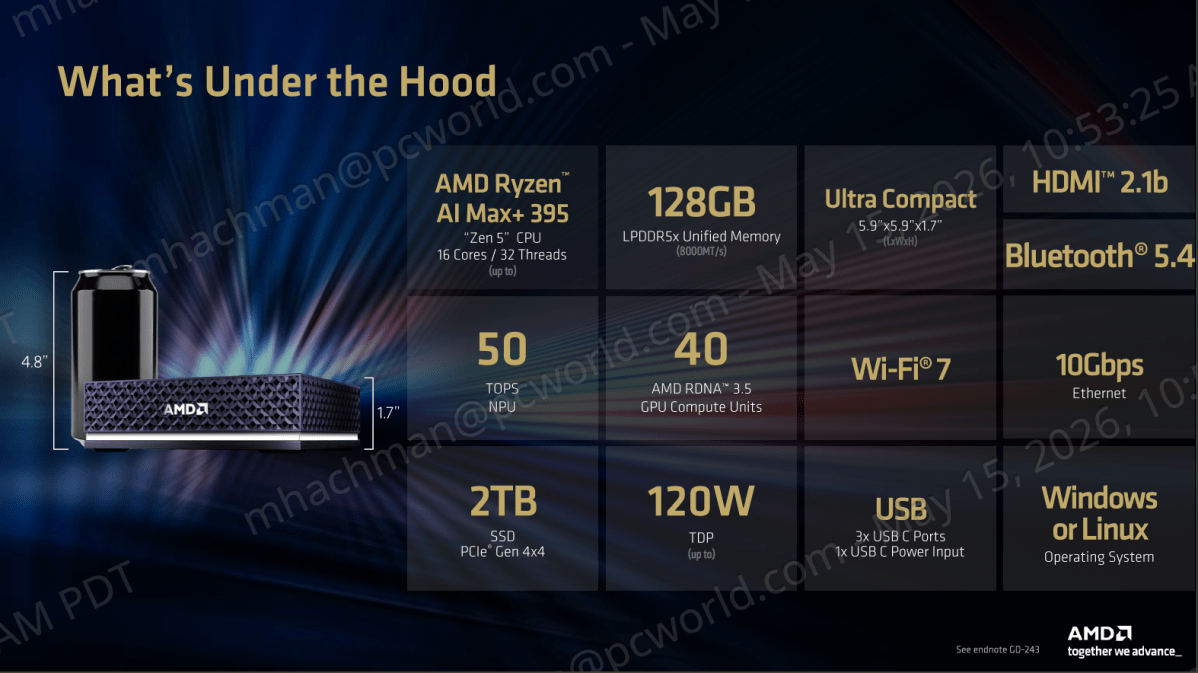
AMD is the latest to step up to the plate with a local AI solution, a mini PC dubbed “Ryzen AI Halo.” At first blush it looks mighty appealing: a Mac mini-sized form factor, a powerful AMD Ryzen AI Max+ 395 processor with 16 Zen 5 CPU cores and 32 threads (upgradable to the bleeding-edge Ryzen AI Max+ 400 series), a whopping 40 Radeon 3.5 GPU compute units, and–most important of all–128 GB of unified LPDDR5x memory.
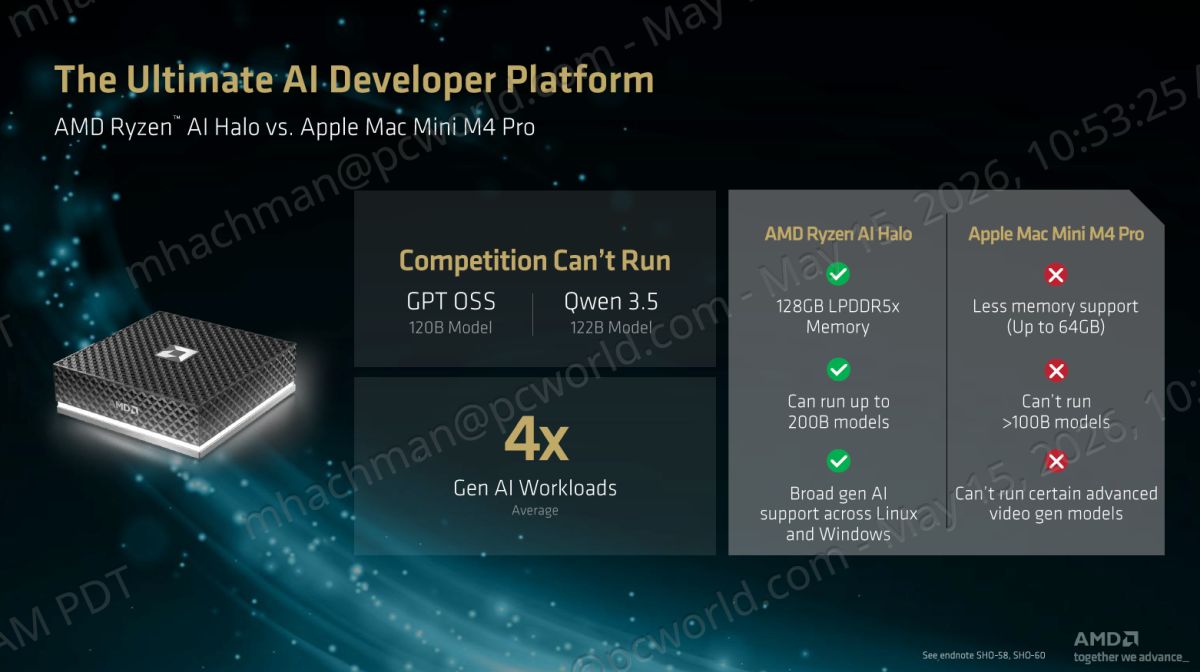
That final specification is the key one. Memory is everything when it comes to AI inference (perhaps you noticed the ongoing RAM shortage), and without enough RAM, your system will struggle with large local LLMs like OpenAI’s 120-billion parameter GPT OSS, not to mention RAM-hungry video-generation models like LTX 2.3.
With its support for unified memory–that is, a shared high-speed pool of system RAM and VRAM–the 128GB AMD Ryzen AI Halo (which was initially teased back in January during CES) boasts a crucial advantage over discrete GPUs, which are limited by their separate VRAM stashes, generally in the 16GB, 32GB, or (if you can afford it) 48GB range.
That unified memory aspect helps explain the popularity of the Mac mini amongst the OpenClaw-slash-personal AI agent crowd, as the pint-sized, always-on Mac mini M4 boasts up to 64GB of unified RAM–only half of what the AMD Ryzen AI Halo has at its disposal, but still nothing to sneeze at.
Of course, both the Mac mini and the AMD AI Ryzen Halo face serious AI-generation hurdles due to a critical missing feature: support for Nvidia’s CUDA platform. Short for Compute Unified Device Architecture, CUDA (an acronym that always makes me think of barracudas) is the secret sauce that allows AI software to work hand-in-hand with Nvidia GPUs for speedy AI inference.
As such, most AI developers take a “CUDA-first” approach to their tools, treating other architectures (like Apple Metal and AMD’s ROCm platform, which plays a CUDA-equivalent role in terms of connecting software applications to its GPUs) as an afterthought.
Still, AMD is seeking to overcome its CUDA shortcomings with a stacked deck of hardware capable of 50 TOPS NPU (a measure of the processor’s theoretical AI throughput; 50 TOPS is a healthy figure) and packing 40 AMD RDNA 3.5 GPU compute units (massive for an integrated GPU). Again, though, it’s that 128GB of unified RAM that makes the difference, allowing the AMD Ryzen AI Halo to keep up with Nvidia-based systems.
Which brings us to the price tag: a cool $3,999, and that’s the entry-level price for a Ryzen AI Max+ 395-powered system. (It’s worth noting that AMD is only supplying the developer specifications for the Ryzen AI Halo; it’ll be up to third-party manufacturers to ship the actual hardware). AMD hasn’t revealed the sticker price for Ryzen AI Halo boxes running on the step-up Ryzen AI Max+ Pro 495 processor.
So, whoa, right? For individuals, certainly. For a small business? Maybe not so bad.
AMD has done the math, calculating the break-even point for the Ryzen AI Halo purchasers who are ditching cloud AI, and they’re saying you’ll hit that mark in six months…assuming you’re currently spending $773 a month for cloud services. That’s a lot of AI cash for everyday users, but perhaps not so much for small- to medium-size businesses leaning heavily on AI usage.
The other factor to consider is the jaw-droppingly fast pace of AI development, meaning that today’s hot-rod AI hardware might not be a hot-rod in, say, two years. For its part, AMD is pitching its AI Developer Platform as a way for the Ryzen AI Halo to keep pace in the months and years ahead.
Still, the AMD Ryzen AI Halo could be a one-box solution for small-scale enterprise users looking to cut loose with AI development without going bankrupt, or without fear that their AI provider will give them the squeeze on usage limits or API costs. For the rest of us? It’s probably overkill.
This articles is written by : Nermeen Nabil Khear Abdelmalak
All rights reserved to : USAGOLDMIES . www.usagoldmines.com
You can Enjoy surfing our website categories and read more content in many fields you may like .
Why USAGoldMines ?
USAGoldMines is a comprehensive website offering the latest in financial, crypto, and technical news. With specialized sections for each category, it provides readers with up-to-date market insights, investment trends, and technological advancements, making it a valuable resource for investors and enthusiasts in the fast-paced financial world.