Breaking
October 7, 2026

SpaceX seeks $40 billion for Nvidia chips as orbital AI race heats up Micah Abiodun | usagoldmines.com

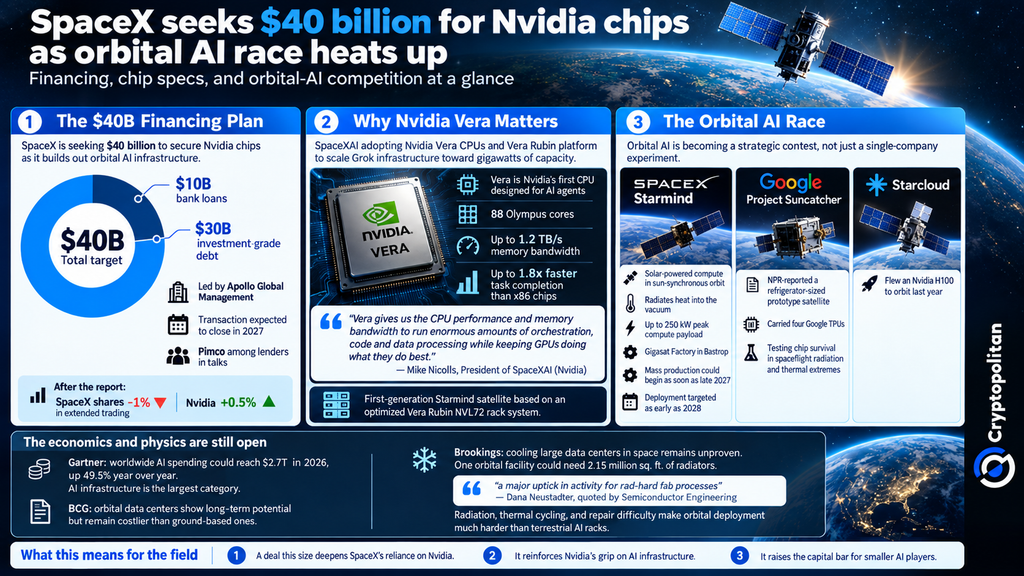
Vera gives us the CPU performance and memory bandwidth to run enormous amounts of orchestration, code and data processing while keeping GPUs doing what they do best.

— Mike Nicolls, president of SpaceXAI, in Nvidia’s announcement

SpaceX is not alone off the planet

According to SpaceX, the Starmind satellites would harness solar energy in sun-synchronous orbit and let off heat into space. Each satellite has a peak processing capacity of 250 kilowatts.

A similar experiment is being conducted by Google as reported by NPR. The prototype of the Project Suncatcher carried four TPUs to see how the chips with AI capability would withstand the radiation and the extreme temperatures of outer space.

SpaceX and Google are not the only companies venturing in this direction. Starcloud has successfully launched an Nvidia H100 into orbit. This makes orbital AI appear less like a science experiment and more like a budding competition for computing power.
SpaceX $40B Nvidia Chip Deal: Financing, Vera Specs and the Orbital AI Race

The economics and physics are still open

Gartner projects that worldwide spending on AI is likely to reach $2.7 trillion in 2026, reflecting a 49.5% increase, which will be attributed to infrastructure costs.

Currently, the economics of placing that infrastructure into orbit are still very complicated, as BCG estimates that orbital data facilities will cost 2.5 to 3 times more than ground facilities.

Cooling is another issue. Brookings has estimated that one orbital data center would require 2.15 million square feet of radiators.

However, heat is not the only engineering problem. Chips in space must also withstand radiation. This has led semiconductor companies to put more effort into designing chips that are radiation-hardened (rad-hard).

We have seen a major uptick in activity for rad-hard fab processes.

— Dana Neustadter, senior director at Synopsys, via Semiconductor Engineering

Radiation, temperature fluctuations, and complicated repairs all make space computing much more difficult than using the same equipment on Earth.

What the deal does to the field

The financing strengthens Nvidia’s position while making the race more expensive for smaller rivals. Reuters cites Morgan Stanley’s estimate that AI infrastructure will need $1.5 trillion in outside financing by 2028. Those pressures are already showing up as power constraints complicate the broader AI buildout.

Vera gives us the CPU performance and memory bandwidth to run enormous amounts of orchestration, code and data processing while keeping GPUs doing what they do best.

— Mike Nicolls, president of SpaceXAI, in Nvidia’s announcement

SpaceX is not alone off the planet

According to SpaceX, the Starmind satellites would harness solar energy in sun-synchronous orbit and let off heat into space. Each satellite has a peak processing capacity of 250 kilowatts.

A similar experiment is being conducted by Google as reported by NPR. The prototype of the Project Suncatcher carried four TPUs to see how the chips with AI capability would withstand the radiation and the extreme temperatures of outer space.

SpaceX and Google are not the only companies venturing in this direction. Starcloud has successfully launched an Nvidia H100 into orbit. This makes orbital AI appear less like a science experiment and more like a budding competition for computing power.

SpaceX $40B Nvidia Chip Deal: Financing, Vera Specs and the Orbital AI Race

The economics and physics are still open

Gartner projects that worldwide spending on AI is likely to reach $2.7 trillion in 2026, reflecting a 49.5% increase, which will be attributed to infrastructure costs.

Currently, the economics of placing that infrastructure into orbit are still very complicated, as BCG estimates that orbital data facilities will cost 2.5 to 3 times more than ground facilities.

Cooling is another issue. Brookings has estimated that one orbital data center would require 2.15 million square feet of radiators.

However, heat is not the only engineering problem. Chips in space must also withstand radiation. This has led semiconductor companies to put more effort into designing chips that are radiation-hardened (rad-hard).

We have seen a major uptick in activity for rad-hard fab processes.

— Dana Neustadter, senior director at Synopsys, via Semiconductor Engineering

Radiation, temperature fluctuations, and complicated repairs all make space computing much more difficult than using the same equipment on Earth.

What the deal does to the field

The financing strengthens Nvidia’s position while making the race more expensive for smaller rivals. Reuters cites Morgan Stanley’s estimate that AI infrastructure will need $1.5 trillion in outside financing by 2028. Those pressures are already showing up as power constraints complicate the broader AI buildout.