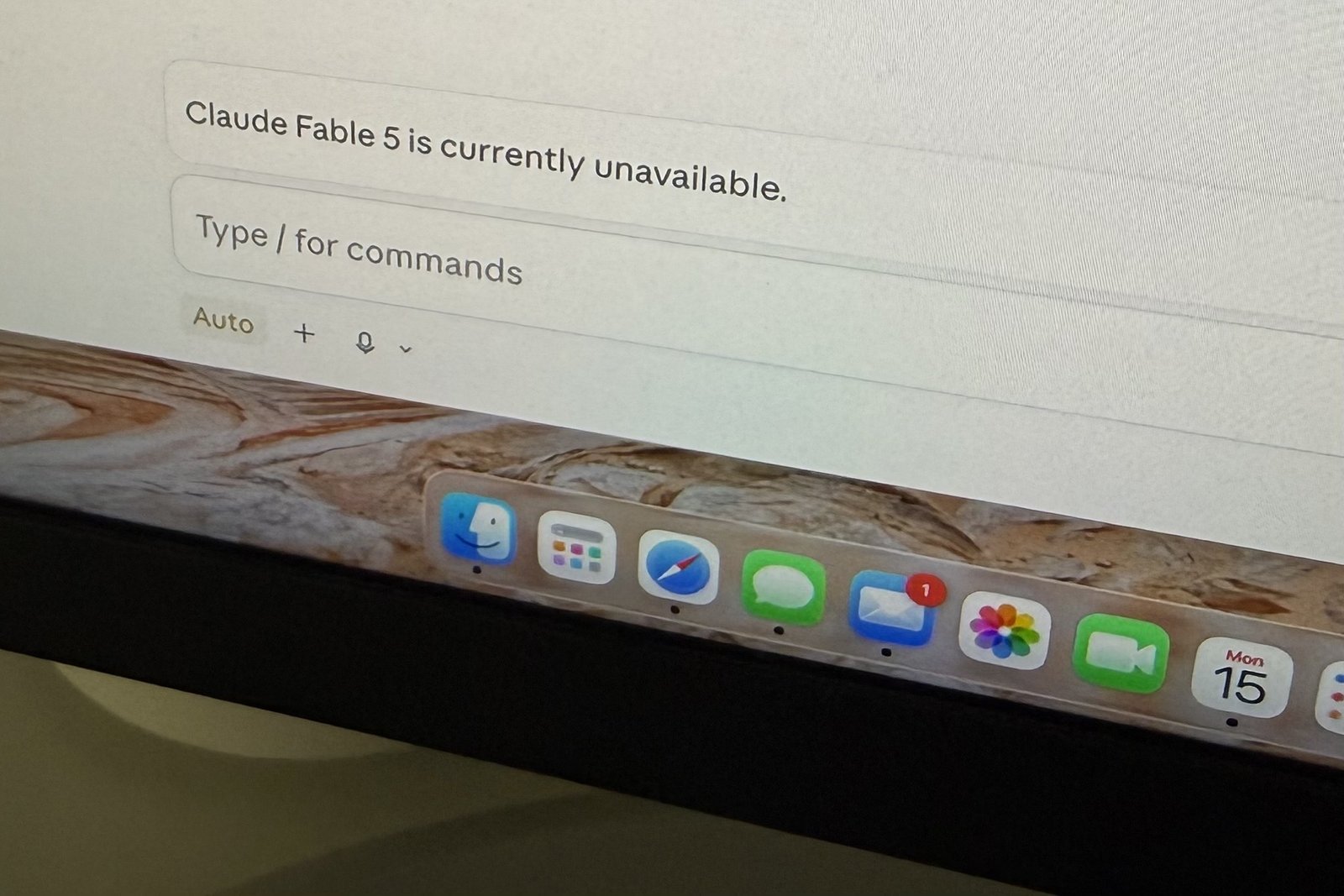
What’s the real story behind the sudden ban Friday of Claude Fable and Mythos, Anthropic’s most powerful AI models? Frankly, I’m as much in the dark as you are.
What I do know is that as late as 5 p.m. Eastern time on Friday, I’d been using Fable in Claude Code for help on a personal project, and when I woke Saturday morning, there was a big banner in the app saying that Fable was unavailable.
Anthropic, as we all know by now, yanked Fable and Mythos for all users on Friday after the U.S. government, citing national security risks, ordered the company to restrict access to the models by “any foreign national,” including even Anthropic employees.
For its part, Anthropic has argued that the government’s concerns about Fable 5 and Mythos 5 are overblown, and that the potential Fable 5 “jailbreaking” method that spooked the White House is “narrow” and “non-universal.” Anthropic officials have reportedly traveled to Washington to negotiate an end to the ban.
There’s also been talk the ban came about after Amazon, a major Anthropic backer, had warned government officials that Fable and Mythos posed serious cybersecurity threats. There’s also been chatter that groups in China got hold of the models.
So, are Anthropic’s Fable 5 and Mythos 5 models really threats to national security, or is the ban just another move in the ongoing dispute between Anthropic and the White House? Good question, and I think we’re a long way from getting any definitive answers.
In the meantime, where does the Anthropic ban leave everyday AI users?
Practically speaking, anyone who was using Fable 5 (the only Mythos-class model that had been in general release) can still downshift to the next most powerful Claude model, Opus 4.8, without having to start another chat or coding session. You won’t get the same quality of work, of course, although Fable-level power is arguably overkill for anything but the most compute-intensive tasks.
Still, the Fable ban reminded me of other situations where a policy and/or technology change by an AI provider managed to break a workflow I’d been relying on, forcing me to scramble for stop-gap solutions.
One measure I’ve taken to safeguard myself against AI failures is to maintain $20-a-month subscriptions to the big three (ChatGPT, Claude, and Gemini) rather than going all-in with a $100-a-month or more plan for any one of them, not to mention my own collection of local AI models. That way, if ChatGPT suffers an outage (it happens!), I can always jump to Claude or Gemini.
Indeed, Canadian Prime Minister Mark Carney alluded to the “danger of over-reliance on certain models” when discussing the Anthropic ban, adding that “we will have done something wrong” if we “don’t take the lesson, don’t build out and diversify.” While Carney was speaking more in global terms, the same lesson applies to everyday AI users like you and me.
And while many of us have yet to become truly dependent on any one AI tool or service, it’s easy to see a time when a ChatGPT or Claude subscription becomes as crucial as a Google account — and when that happens, it pays to have a contingency plan. Just ask anyone who’s been locked out of their Gmail inbox.
This articles is written by : Nermeen Nabil Khear Abdelmalak
All rights reserved to : USAGOLDMIES . www.usagoldmines.com
You can Enjoy surfing our website categories and read more content in many fields you may like .
Why USAGoldMines ?
USAGoldMines is a comprehensive website offering the latest in financial, crypto, and technical news. With specialized sections for each category, it provides readers with up-to-date market insights, investment trends, and technological advancements, making it a valuable resource for investors and enthusiasts in the fast-paced financial world.