A regulated online casino asks you to trust a licence and an audit report you will never read. A crypto casino makes a different offer. It hands you the cryptographic values behind every round and invites you to check the result yourself. That shift changed how trust works in online gambling, and it also produced a label that plenty of operators now display without backing it up.
What provably fair means
Provably fair is a cryptographic verification system that lets a player confirm a game result was generated according to the stated algorithm and was not altered after the bet was placed. The casino commits to a hidden value in advance, the player adds an input of their own, and the round can be recomputed afterwards.
The model came out of the first Bitcoin gambling sites around 2012. Those operators had no licence, no regulator and no audit firm willing to work with them. They needed something to replace the certificate, so they published the maths instead. The idea spread from dice sites to the in-house game libraries that most crypto casinos now call Originals.
That original condition has not disappeared. Ontario runs a licensed market through the AGCO and iGaming Ontario, where a withheld payout has an escalation route. Coverage across the rest of Canada is uneven and most crypto-facing operators sit offshore, so players tend to start from independent reviews of online casinos in Canada rather than a regulator’s register. For anyone in that position, the cryptographic check is not a bonus feature. It is the only inspection available.
The word “proof” does a lot of work in that name. It covers less ground than most players assume, and a later section deals with exactly what it leaves out.
How provably fair works
Three values feed the calculation. Change any one of them and the result changes completely.
Server seed
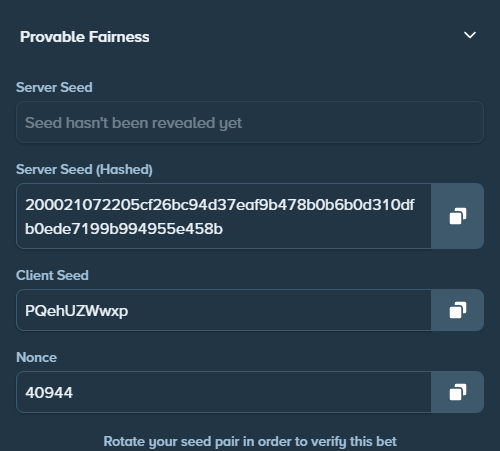
The casino generates a random string on its server before you start betting. It runs that string through SHA-256 and publishes the resulting hash. The string itself stays hidden until you rotate the seed pair.
Publishing the hash first is the whole point. A hash is a one-way function, so you cannot work backwards from the published value to the string that produced it. Change a single character in that string and the hash comes out completely different, with no resemblance to the original. Once the string is revealed, anyone can hash it again and check it matches what was published. The casino is locked in from the moment it publishes.
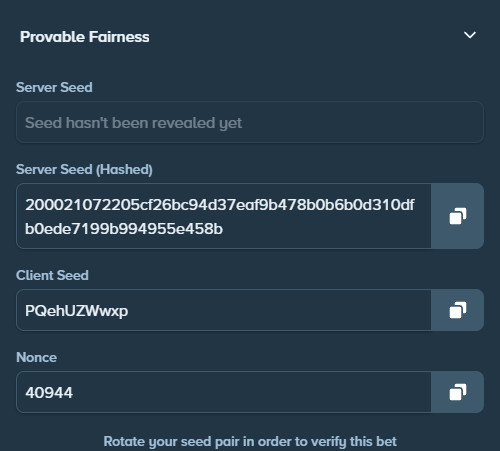
Note : The fairness panel attached to a bet: the server seed hash is published while the seed itself stays hidden until the pair is rotated
Client seed
You supply the second value. Some sites let you type your own string, others generate one in the browser and let you replace it whenever you want. Either way, the casino does not control it.
This input is what stops the operator from picking a favourable outcome. A server seed on its own would let the casino compute results in advance and choose which one to serve. Adding a value it cannot predict removes that option.
Nonce
The nonce is a counter that starts at zero and rises by one with each bet. It keeps the same seed pair producing a different result every round. Without it, a hundred bets on identical seeds would return the same number a hundred times.
Putting them together
Two families of implementation exist. The simpler one joins the three values into a single string and hashes it with SHA-256. The other uses HMAC-SHA256, with the server seed as the key and the client seed, nonce and a cursor as the message. The cursor is what lets a single round produce more than one number.
One correction worth making, because it appears in a lot of coverage. Provably fair is almost never on-chain. The commitment sits on the operator’s server and the verification happens in your browser. Blockchain settlement is a separate design decision, and what runs on-chain versus what stays off-chain at a crypto casino is worth understanding on its own terms. A site can be fully provably fair and still hold every cent in a custodial hot wallet.
A verified round, step by step
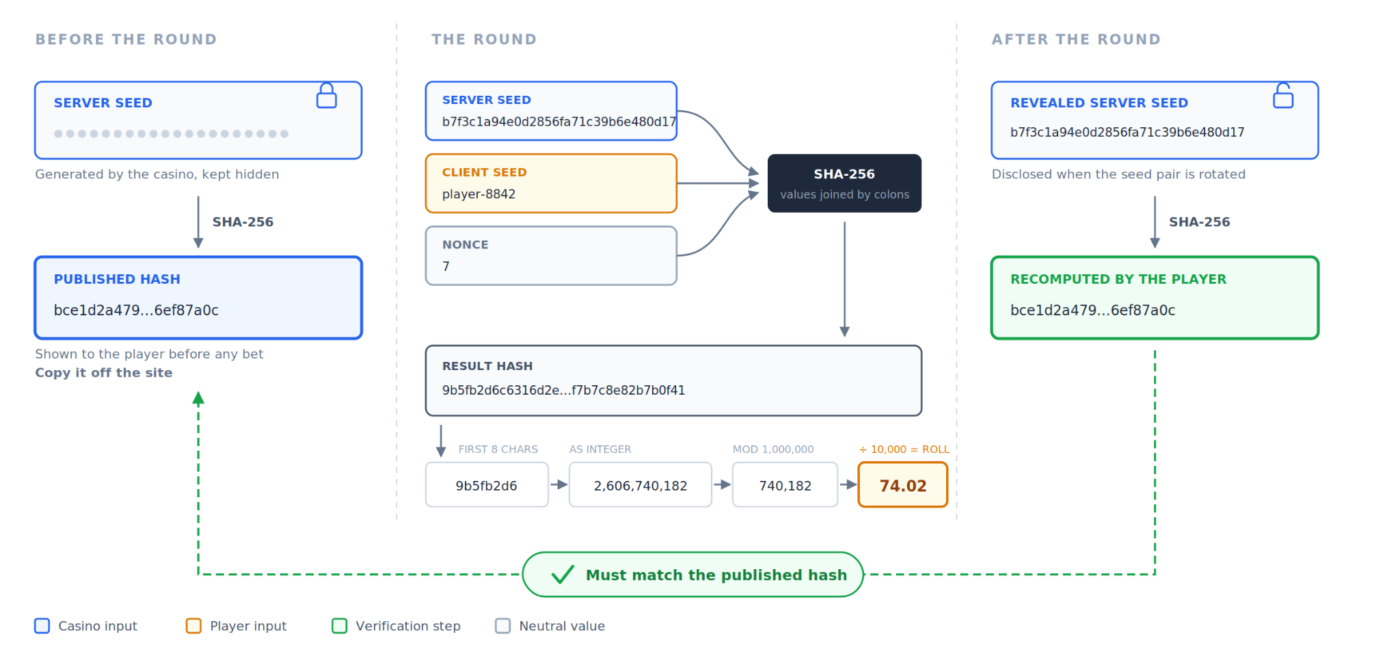
The check below uses the concatenation model on a dice game. The numbers are real, so you can reproduce every step with any SHA-256 tool.
At the start of the session, the casino publishes the hash of its server seed:
- bce1d2a4794947405a349df8411c4ab6e802ac7920a948660f03dfc16ef87a0c
- Copy that value somewhere outside the site. This matters, and the reason why comes up later.
Set your client seed. In this example it is player-8842.
Place your bets. The nonce starts at 0 and rises by one each time, so the eighth bet of the session runs on nonce 7. That is the round being checked here, and the site reported a roll of 74.02.
Rotate the seed pair. The casino now reveals the server seed it committed to:
b7f3c1a94e0d2856fa71c39b6e480d17
Check the commitment. Hash that revealed seed with SHA-256. The output is bce1d2a479…, matching what you copied at the start. The seed was not swapped mid-session.
Rebuild the round. Join the three values with colons and hash the result:
input b7f3c1a94e0d2856fa71c39b6e480d17:player-8842:7
output 9b5fb2d6c6316d2ed3224c07a4d4899ce265b04b16ca8afdf7b7c8e82b7b0f41
Convert to a number. Take the first eight hex characters, 9b5fb2d6, and read them as an integer. Eight hex characters cover four bytes, so the value falls somewhere between 0 and 4,294,967,295. Here it comes out at 2,606,740,182.
Map to the game range. A dice roll needs a figure below 100. Take the integer modulo 1,000,000, then divide by 10,000:
2,606,740,182 mod 1,000,000 = 740,182
740,182 / 10,000 = 74.0182
Displayed to two decimals, that is 74.02. It matches what the site reported, so the round holds up.
Different games use different mappings. A crash multiplier and a card position come out of the same hash by different arithmetic. The operator has to publish which formula it applies, and a site that does not is asking you to trust an unstated step in the middle of a proof.
Most casinos put all of this behind a tab labelled Fairness or Provably Fair on each bet in your history, usually with a built-in verifier that runs the calculation for you. That is convenient and it is not proof. A verifier written by the operator can be written to always agree with the operator. Run one round through an independent SHA-256 tool to confirm the site’s calculator does what it claims.
Which games can be verified, and which cannot
Verification needs an outcome that can be derived from a number. That rules out more of the lobby than most players expect.
|
Game family |
What verification covers |
What it cannot cover |
|
Dice, limbo |
The rolled number, derived straight from the hash |
Nothing further, the number is the whole outcome |
|
Crash |
The multiplier at which the round ends |
Other players’ activity displayed on screen |
|
Plinko, mines, keno |
The path or the positions of hidden tiles |
Payout tables, which are set separately |
|
Hi lo, blackjack, roulette |
The shuffle order or the wheel position |
Side bet pricing on some builds |
|
Third-party slots |
Nothing |
The studio owns the RNG, the casino cannot commit to it |
|
Live dealer |
Nothing |
Physical equipment filmed in a studio |
The mechanics behind each row differ enough to be worth spelling out.
Dice and limbo
One hash, one number, one arithmetic step. This is the case worked through above, it takes seconds to check by hand, and it is why dice was the first provably fair game ever shipped.
Crash
The hash converts to a multiplier through a fixed formula, and that multiplier sets the point where the round ends. Because the value is fixed at commitment time, no amount of live betting activity can move it.
Plinko, mines and keno
One number is not enough here, so the implementation reads the same hash at successive offsets, one per step of the path. Each offset is deterministic, which means the full sequence is reproducible from the same three inputs.
Hi lo, blackjack and roulette
The committed value is an ordered list rather than a single figure, a deck order or a sequence of wheel positions. Checking one of these by hand takes longer, because you have to reproduce the whole ordering before you can confirm the card or pocket you were dealt.
Slots and live dealer
Neither can be provably fair, and any site claiming otherwise is misusing the term.
That distinction changes how you should read a game count. A casino advertising 9,000 games and provably fair Originals is telling you two unrelated things. The verifiable library is usually somewhere between a dozen and thirty in-house titles. Everything else runs on conventional certified RNG, which is not a flaw, just a different trust model.
Provably fair versus certified RNG
Both systems aim at the same goal from opposite directions.
A certified RNG is tested by an external lab such as eCOGRA, GLI or iTech Labs. The lab runs statistical analysis across millions of simulated rounds, checks the return to player figure against what the operator advertises, and issues a certificate. You cannot inspect any individual spin. You are trusting the lab, and behind the lab, the regulator that accredited it.
Provably fair inverts that. No statistical guarantee across the population of rounds, complete visibility on your own.
|
Certified RNG |
Provably fair |
|
|
Who checks |
An accredited testing lab |
The player, one round at a time |
|
Scope |
Statistical behaviour across millions of rounds |
A single specific round |
|
Covers RTP |
Yes, verified against advertised figures |
No |
|
Covers operator solvency |
Indirectly, through licence conditions |
No |
|
Dispute route |
Regulator complaints procedure |
None |
|
Geographic access |
Restricted to licensed markets |
Usually open |
The trade-off falls along regulatory lines. A licensed market hands you the lab, the certificate and a complaints body, and asks you to inspect nothing. Outside one, you get the opposite deal: full sight of every round, and nobody to appeal to. That is why the label deserves reading closely rather than being taken as a guarantee.
What provably fair does not prove
The label carries less weight than its marketing suggests. Four gaps are worth naming.
It says nothing about the house edge. A perfectly verifiable round can run at a 1 percent edge or a 5 percent edge, and the hash looks identical either way. Across published Originals libraries, dice and keno commonly sit near 1 percent, blackjack around 1.25 percent, and single-zero roulette at 2.7 percent. Some in-house titles run considerably worse. Verifiable and favourable are unrelated properties.
It says nothing about solvency. Nothing in the cryptography tells you whether player balances are segregated, whether the operator holds enough to cover them, or whether it is paying last month’s withdrawals out of this month’s deposits.
It does not guarantee payment. You can prove a win down to the byte and still be told your account is under review. Verification governs the outcome of the round. It has no bearing on whether the money leaves the platform.
The commitment is only as good as its timing. This is the technical gap, and it is the one that gets exploited. The hash has to exist before your client seed is fixed, and you have to hold a copy of it yourself, which is why the walkthrough above starts by telling you to copy it off the site. A site that only surfaces the hash alongside the result, after the round has settled, has given you nothing to compare against. The proof lives in the sequence, not in the presence of a hash somewhere on the page.
Checking that an implementation is real
Six signals to look for before treating a fairness claim as meaningful:
- The server seed hash is published and copyable before your first bet on that pair
- Seed pairs can be rotated whenever you choose, not only when the operator decides
- The full seed history is exportable, so old rounds stay checkable after you close the tab
- The mapping formula is documented, including the hash function and how the output converts to the game’s range
- Feeding deliberately wrong values into the site’s verifier returns a mismatch rather than a pass
- The verifiable game list is stated explicitly and excludes third-party slots and live tables
Failing one of these is a question worth asking support. Failing three means the label is decoration.
The post What does provably fair mean in crypto gambling? appeared first on Blockonomi.
This articles is written by : Nermeen Nabil Khear Abdelmalak
All rights reserved to : USAGOLDMIES . www.usagoldmines.com
You can Enjoy surfing our website categories and read more content in many fields you may like .
Why USAGoldMines ?
USAGoldMines is a comprehensive website offering the latest in financial, crypto, and technical news. With specialized sections for each category, it provides readers with up-to-date market insights, investment trends, and technological advancements, making it a valuable resource for investors and enthusiasts in the fast-paced financial world.