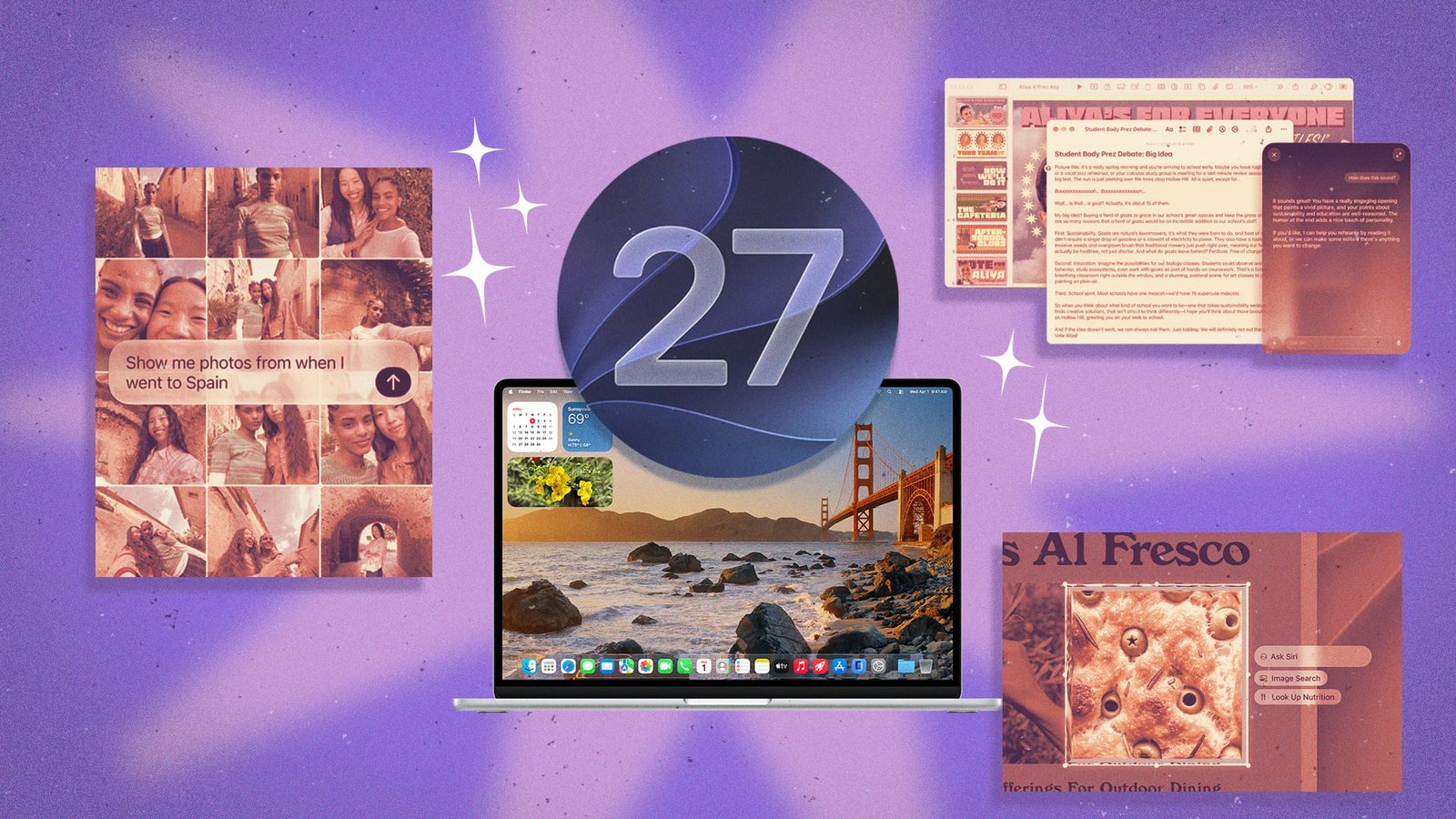
macOS 27 Golden Gate is now available for every Mac that runs Apple Silicon. As long as you don’t own a Mac with an Intel processor, you should be able to update to macOS 27. This update includes a bunch of new features, but Apple’s focus has been more on stability, bug fixes, and to some extent, fixing some design missteps from macOS 26. I’ve been running Golden Gate on my primary Mac for a few weeks now, and these are the 10 best macOS 27 hacks I’ve found:
Use this slider to reduce Liquid Glass effects
macOS 26 Tahoe introduced Liquid Glass animations, but that didn’t resonate with many users. Apple has walked back those changes since, and with macOS 27, you can use a slider to precisely control Liquid Glass effects. I think reducing Liquid Glass improves readability, so that’s what I’ve chosen. To make the change, click the Apple logo in the top-left corner of your Mac’s display, and select System Settings > Appearance. You can now use the slider in the “Liquid Glass” section. Move it to the right to reduce the effect.
Use this gesture to refresh pages like you would on iOS
Pull-to-refresh, developed by former Apple engineer Loren Brichter, is one of the iPhone’s most iconic gestures. This gesture has now arrived on the Mac, as some first-party apps now let you pull-to-refresh in macOS 27. You can try it on your MacBook (or iMac if you have a trackpad) by opening a webpage in Safari, and performing a two-finger swipe gesture. If you use natural scrolling, then you can use two fingers to swipe downwards. If not, then swipe upwards with two fingers. This will refresh the webpage. The gesture also works in Mail, Calendar, News, and Podcasts
Use this tool to draw and create art in Apple Notes and Freeform
There’s a new drawing tool in Apple Notes and Freeform in macOS 27, which you can use to create art and other drawings. To try it in Freeform, open the app, and click the pen icon in the toolbar up top. You can now use the trackpad or a mouse to draw on the board. Similarly, you can select a note (or create a new one) in Apple Notes, hit the pen icon, and start sketching.
Use the new Siri app to set timers, reminders, and answer your questions
macOS 27 has a dedicated Siri app, which you can use for all interactions with the virtual assistant. Once you open the app, you can speak or type your request, and Siri will handle the rest. If you disable “Hey Siri,” as I’ve done, opening the Siri app automatically shows a “Type to Siri” popover. You can then type your request, which I’ve been using to set timers and reminders. The Siri app can also answer your questions, and handle all the tasks that the virtual assistant used to do before macOS 27.
Take screenshots to access Visual Intelligence on Mac

Credit: Pranay Parab
If you’ve enabled Apple Intelligence on your Mac, you can use “Visual Intelligence” to learn more about things on your screen. To use it, go to System Settings > Siri, and ensure that Siri AI is enabled. Next, press Command-Shift-6, and select an area of your screen. Siri AI will analyze the image and show you these options: You can use the “Ask Siri” text box to find specific information about the image. Or, click “Image Search” to check the internet for other copies of the object or photo. Depending on what Siri AI finds in the image, you may see other options such as adding a phone number to contacts, or viewing an address in Apple Maps.
Use this Terminal command to AirPlay to your Mac in a resizable window
When you AirPlay to your Mac from another Apple device, the video takes up the entire screen. I prefer it if AirPlay opens in a window, as opposed to full-screen mode. In macOS 27, you can set this up via a Terminal command, as discovered by the user pdfu from MacRumors Forums. Use this command in Terminal:
sudo mkdir -p /Library/Preferences/FeatureFlags/Domain && sudo defaults write /Library/Preferences/FeatureFlags/Domain/ControlCenter APReceiverInWindow -dict Enabled -bool true
Now, restart your Mac. The next time you AirPlay from another device to your Mac, you’ll notice that the video opens in a resizable window. To restore default settings, use this command in Terminal, and restart your Mac after:
sudo defaults delete /Library/Preferences/FeatureFlags/Domain/ControlCenter APReceiverInWindow
Use this feature to organize related tabs in Safari
Safari in macOS 27 allows you to automatically organize related tabs. This feature is enabled by default, but I don’t like how it starts grouping tabs on its own. Instead, I prefer to receive Safari’s tab grouping suggestions and to group them myself. This is because I’ve found automatic tab organization sometimes misses a tab or two. Open Safari in macOS 27, and click the Safari menu at the top of the page. Go to Settings > Tabs, and click the drop-down menu next to “Organize tabs.” Select “Show Related Tabs,” and you’re good to go.
Use “Describe Extension” to create your own Safari extensions

Credit: Pranay Parab
Once you have Siri AI enabled, you can use “Describe Extension.” This feature uses AI to create Safari extensions for you, and all you have to do is type what you’re looking for. To try it out, open Safari on your Mac, load any website, and click the three-line button in the address bar. Here, select Describe Extension. You’ll see a pop-up with a text box, and some helpful prompts to get you started. You can make something as simple as an extension that automatically closes duplicate tabs, or more complex tasks such as changing the stylesheet of a website to add some holiday cheer to each page.
Use this Terminal command to disable the ‘Ask Siri’ menu item to clean up your right-click menu
Siri AI is helpful in macOS 27, but it also appears everywhere. I find it particularly annoying when I see the Siri AI button every time I right-click anywhere on my MacBook. Thankfully, there’s an easy way to remove it from the context menu, which I discovered on Reddit. Use the following Terminal command, and then restart your Mac:
codes=(soft apwn exit loca lock logo rlgo rcnt rrst rest rsdn shut slep spro syss) args=(-int 0) for code in $codes; do hex=$(printf %s "$code" | xxd -p -u) args+=(-int "$((16#$hex))") done defaults write -g NSAppleMenuAllowedItems -array "${args[@]}"
To restore default settings, use this command:
defaults delete -g NSAppleMenuAllowedItems
Use this Terminal command to control menu bar apps with your keyboard
If you prefer keyboard navigation, you’ll know you can use the arrow keys to switch between different menus at the top of your Mac’s screen. Once you select a menu item in any app, you can press the right arrow key to go to the next menu, eg: going from “File” to “Edit.” The left arrow key takes you to the previous menu item, however, this navigation stops with the last menu item, which is usually “Help.” In macOS 27, there’s a hidden feature that allows you to switch from the last app menu item to the first menu bar app using your arrow keys. You’ll have to enable this using Terminal, and restart your Mac for it to take effect. Use this Terminal command to enable the feature:
defaults write -g NSMenuEnableMenuBarAgent -bool true
defaults write -g NSMenuBarUseAgentNavigation -bool true
To disable the feature, use this command:
defaults delete -g NSMenuEnableMenuBarAgent
defaults delete -g NSMenuBarUseAgentNavigation
This articles is written by : Nermeen Nabil Khear Abdelmalak
All rights reserved to : USAGOLDMIES . www.usagoldmines.com
You can Enjoy surfing our website categories and read more content in many fields you may like .
Why USAGoldMines ?
USAGoldMines is a comprehensive website offering the latest in financial, crypto, and technical news. With specialized sections for each category, it provides readers with up-to-date market insights, investment trends, and technological advancements, making it a valuable resource for investors and enthusiasts in the fast-paced financial world.