One of the nice things about the weather is that even if it’s bad right now, it’ll definitely be changing soon and maybe even for the better. There is one exception to this rule, however, and that comes in the form of heat domes, which are weather systems whereby a region of air becomes isolated from the surrounding systems. This creates effectively a greenhouse, with hot air remaining trapped and moisture unable to get in.
Although until recently not very common, this weather phenomenon poses a major challenge to any flora and fauna that finds itself trapped in a heat dome. With nights being about as hot and stifling as the days with their blue skies unbroken by any cloud cover and no rain for potentially weeks on end, it poses severe hydration, cardiovascular, and other challenges to any affected lifeforms.
Hot Summers Vs Heat Domes
Although it can be easy to mix up hot summer weeks, heatwaves, and heat domes, these terms all have their own specific meaning and implications. Each season has its own typical weather patterns and associated minimum- and maximum temperatures. These exact values have also fluctuated over the centuries and millennia due to a variety of factors, but the important detail is whether this typical maximum temperature is exceeded in a significant manner.
A heat dome is, for instance, not just a heatwave. The exact definition of a heatwave is not universal, but in general it means at least a couple of days of day-time temperature excursions well above this average maximum. In the UK for example at least two days are required before it is officially termed a ‘heatwave’. These heatwaves have become more common as global surface temperatures have increased on account of anthropogenic climate change.
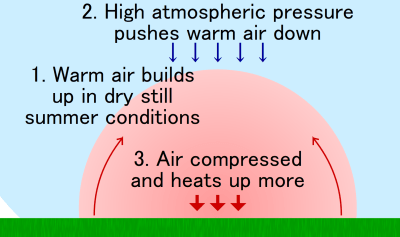
A heat dome requires two factors to form, the first being a period of calm, warm weather, the second being a large area of high pressure that remains in place for an extended period of time. As the hot air rises, the high pressure in the higher atmosphere layers pushes back on this air, compressing it and causing adiabatic heating.
This creates a cycle in which the increasingly warmer and drier soil is exposed to the relentless Sun in the cloudless sky, with even nights bringing barely any change. What keeps this stagnant air from dissipating an “atmospheric block”.
Weather Block
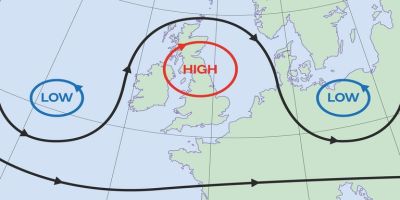
There are two types of blocks: omega and diffluent blocks. The omega block is commonly observed with heat domes, creating the Ω-shaped pattern from which it derives its name.
How long these blocks persist can differ wildly. The UK experienced a very hot Summer in 1976 when such a block persisted for months and thus drove up temperatures. Generally they last on the order of days to weeks.
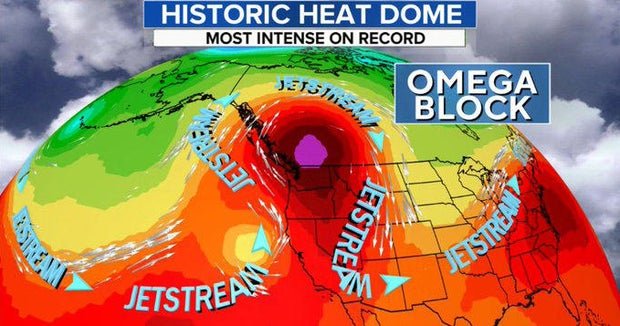
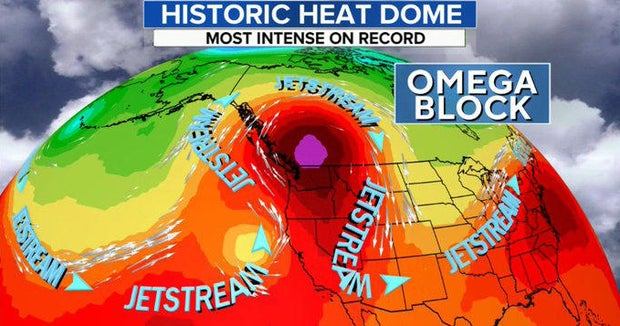
Because of how heatwaves and heat domes overlap without a clear distinction, once you add a blocking system the UK’s Met Office prefers to call them ‘persistent summer blocking highs’, as this is their most defining feature. This can also be seen pretty well on maps of the 2021 Western North America heat wave.
Pacific Heat 2021
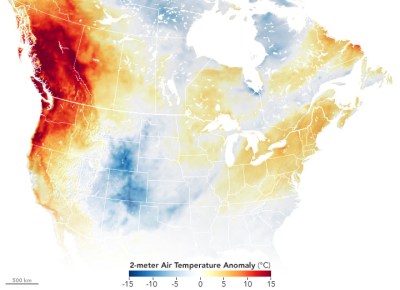
Affecting much of Western North America from late June through early July, this extreme heatwave broke many records, including the highest temperature ever measured in Canada, at 49.6 °C. Eventually classified as a heat dome, by the time it dissipated around 1,400 excess deaths among the human population were recorded, as well as countless more deaths among farm animals, in addition to the highly destructive Lytton wildfire and general damage to agriculture.
In this case a block ensured that this area of static hot air could not dissipate or otherwise experience some cooling air from the Pacific.
The formation of this block was predicted by meteorologists after they observed warm, moist air from torrential rains in China make its way across the Pacific with help from the jet stream. At this time the Southwestern US was already experiencing a drought, setting the stage for the heat wave by providing additional heat to the Pacific Northwest.
As can be seen in the below barometric chart of the time, this led to the air transported by the jet stream to become trapped in between low pressure areas, exerting downwards pressure on the area below that was already enjoying a warm summer.

A similar phenomenon occurred over Europe during the summer of 2026, with multiple heatwaves involving heat domes forming and persisting for weeks on end. Previous summers in Europe had already significantly warmer and drier than previously, creating the conditions for a record-breaking summer.
With the blistering 2025 European summer already causing many wildfires and excess mortality cases, the summer of 2026 was by all metrics more severe. This raises the awkward question of we can expect things to only get worse from here, not just in Europe but worldwide.
Heat In The System
Ultimately the mechanisms that drive the formation of heatwaves and heat domes become more effective when there is more thermal energy in the system. This means more torrential rains, a higher surface temperature, more droughts and so on.
Of all of Earth’s continents, Europe is the one that is warming up the fastest, with already 2.3 °C above preindustrial levels in 2022. Although there are ways to adapt to a drier, hotter climate, including for our thermal power plants, ideally we would reduce the amount of energy in the Earth’s weather systems.
Doing this means effectively reverting as much as possible of anthropogenic climate change by not adding greenhouse gases to the atmosphere, including SF6 which is still very common in switching gear, including that installed in wind turbines. Even as we build out our grids with more clean power, it’s of course essential to also keep an eye on grid stability.
Ultimately this increase in heatwaves, and worse, is largely a human-made phenomenon which fortunately means that we also have the power to make the planet cool down again. As fascinating of a meteorological phenomenon a heat dome is, it’s definitely one of those things that’s best enjoyed once every generation or less.
Overdone weather graphics from the 2021 Pacific Heat Dome from CBS News.
This articles is written by : Nermeen Nabil Khear Abdelmalak
All rights reserved to : USAGOLDMIES . www.usagoldmines.com
You can Enjoy surfing our website categories and read more content in many fields you may like .
Why USAGoldMines ?
USAGoldMines is a comprehensive website offering the latest in financial, crypto, and technical news. With specialized sections for each category, it provides readers with up-to-date market insights, investment trends, and technological advancements, making it a valuable resource for investors and enthusiasts in the fast-paced financial world.