Updated: October, 2026
Chargebacks can cost your business more than the original transaction. Along with lost revenue and chargeback fees, they take time to manage and can affect your ability to process payments.
Some chargebacks stem from genuine problems, such as unrecognized renewal, a billing issue, or a product that doesn’t meet expectations. Others happen because customers find it easier to contact their bank than to resolve the issue directly with you. In many cases, clear communication and an accessible support process can help prevent disputes before they escalate.
Here’s what causes chargebacks, why they matter, and what you can do to keep them under control.
What is a chargeback?
The diagram below illustrates the chargeback process a customer may follow to recover their money when a direct refund request to the vendor does not resolve the issue.
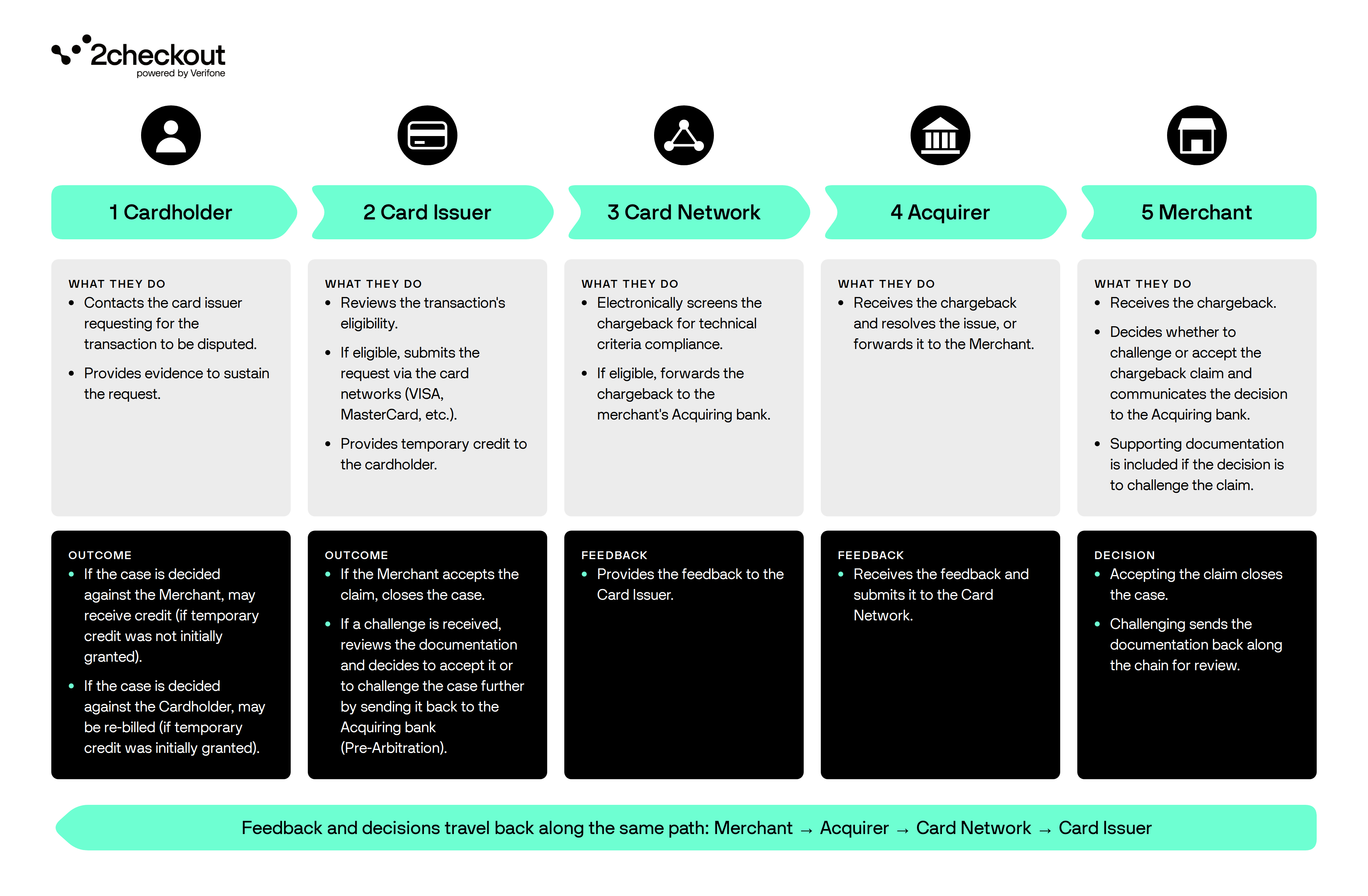
A chargeback happens when a customer asks their bank to reverse a payment, and the funds are taken back from the vendor. This may happen because a refund was declined, the customer could not resolve the issue directly with the vendor, or the customer believes the transaction was unauthorized.
For the vendor, the impact can go beyond losing the sale. The customer may keep access to the product or service, while the vendor may also face chargeback fees and the time required to respond to the dispute.
How does a chargeback work?
Chargebacks can happen for several reasons:
- The customer requested a refund, but the vendor declined it.
- The customer avoided contacting the vendor and worked directly with their bank instead (often linked to not having a clear path to contacting the vendor or requesting a refund).
- The transaction was not authorized by the customer (mostly linked to stolen card details).
- The customer does not recognize the charge on their statement, which can happen when automatic billing or upcoming renewals are not clearly communicated.
- The customer authorized the transaction but reported it as not authorized to recover the funds and keep the purchased goods (known as friendly fraud).
When a customer contests a purchase, their bank first reviews the claim. If it considers the request valid, it passes the dispute through the card network (such as Visa or Mastercard) to the vendor’s bank, which may debit the vendor for the transaction.
The vendor’s bank may accept the request or forward the case to the vendor. If the vendor contests the claim, they can submit supporting documentation through their bank and the card network. This stage is known as representment.
If the dispute remains unresolved, it may move to pre-arbitration, giving the customer’s bank and the vendor another opportunity to settle the case. Arbitration is the final review by the card network. The losing party may face fees that exceed the original transaction value (up to €500–€700).
In short, each stage offers another chance to resolve the dispute, but it can also add time and cost.
How can you prevent chargebacks?
You have more control than it may seem. While not every chargeback can be avoided, a few practical steps can help prevent disputes from escalating:
- Make customer support easy to reach, so customers have a clear way to ask questions or request a refund.
- Set a clear, fair refund policy. Strict or confusing policies can push customers toward their bank.
- Be transparent about upcoming charges, renewals, cancellation options, and how to request a refund.
Chargebacks take time
Compared with a straightforward refund, which may be resolved in a single interaction, a chargeback can involve several parties and multiple rounds of review.
Usually, a customer has up to 120 days to request a chargeback on a transaction, and up to 540 calendar days for merchandise-not-received disputes (provided by the fact that no more than 120 days from the expected delivery date has passed).
Once a chargeback begins, the vendor and their bank generally have 30 to 45 days, depending on the card network, to respond to the initial inquiry. If the vendor contests the request, the customer and their bank may have another 30 to 45 days to accept the response or continue the dispute.
A case that progresses through all stages up to pre-arbitration can take 90 to 120 days to complete.
Why is it worth keeping chargebacks low?
A chargeback here and there might not seem like a big deal. Unfortunately, there’s a little more to it than that. You’re not just getting hit with the chargeback, you:
- Lose the sale, while the customer may retain the product or service.
- Pay a chargeback fee.
- Spend time gathering evidence and responding to the dispute.
High chargeback levels can also bring additional scrutiny and costs through card-network monitoring programs. In some cases, businesses that remain above program thresholds risk losing the ability to process payments through the relevant card network.
Card networks monitor chargeback ratios through programs such as the following:
- Excessive Chargeback Merchant (ECM): Mastercard’s monitoring program.
- It is triggered when the chargeback count is at least 100 and the chargebacks-to-transactions ratio is equal to or exceeds 1.5%.
- The ratio will use the chargebacks from the current month vs the transactions from the previous month for calculation.
- Both thresholds need to be exceeded to consider a merchant non-compliant.
- The additional costs will be applied in the form of fixed monthly fines starting from $1,000 in the first months and up to $100,000 in extreme cases where a merchant maintains the non-compliant status for more than 19 months.
- For High Excessive Chargeback Merchant (HECM) status, where the chargeback count exceeds 300 and the ratio exceeds 3%, the fines will mostly be 2x the amount applied via ECM, as well as additional per case fees for everything that exceeds the count threshold.
- Visa Acquirer Monitoring Program (VAMP): Visa’s monitoring program that also has a merchant component.
- It is triggered when the combined count of chargebacks and fraud-reported transactions is at least 1,500 and the chargeback-and-fraud ratio is at least 1.5%.
- Pay particular attention to VAMP: a chargeback reported as fraud may count twice toward the thresholds, once as a chargeback and once as a fraud-reported transaction.
- Both thresholds must be met for a vendor to be considered non-compliant.
- Additional fees of $8 to $10 may apply for each chargeback and fraud-reported transaction.
Why do you get chargebacks anyway?
Understanding the reasons behind chargebacks is the first step toward reducing them. Common causes include:
- Agreed refund not processed: The vendor did not honor the customer’s refund rights (either money-back guaranteed policies or right of withdrawal).
- Authorization problem: The payment authorization failed and the customer is surprised to see that the charge went through.
- Canceled recurring: The customer claims the order was canceled, hence the payment should have not been processed.
- Duplicate order: The customer was charged twice for the same product.
- Fraud: The customer doesn’t recognize the charge and claims it was not authorized by them (often claiming stolen card/ card details).
- New or renewal order not recognized: The customer doesn’t recognize the charge appearing on the statement, but without reporting it as fraudulent.
- Order not fulfilled/delivered: The customer didn’t receive the product purchased or can’t access the service.
- Product(s) not as described or nonfunctional: The customer claims that the product, subscription or service doesn’t work or works differently than advertised.
Ways to keep the chargeback rate under control
We’ll go through 5 ways to lower your chargeback rate. They all revolve around clear communication, transparency, and honesty. If the vendor is easy to work with, the customer won’t go to their bank to file a dispute. Just issue a refund right off the bat.
- Be clear about pricing and recurring billing. Customers should know before checkout if a purchase includes recurring payments. Unexpected renewal charges can lead to disputes, especially when customers feel the terms were not clear. Explain the billing frequency and renewal terms upfront to set expectations and build trust.
- Keep customers informed about renewals. Send reminders at an appropriate time before a subscription expires or renews. Email notifications or in-app messages can help customers prepare for an upcoming charge. Where possible, make it easy for them to manage or turn off auto-renewal.
- Set clear product expectations. Explain what each product, plan, or package includes, as well as any limitations. Customers are less likely to dispute a purchase when what they receive matches what they expected.
- Make billing policy easy to understand. Customers may not connect a charge on their statement with a purchase made weeks or months earlier. Use a clear business or billing descriptor where possible, and explain to customers how the charge will appear on their statement.
- Have flawless customer service. If customers cannot find your contact details or do not receive a timely response, they may feel they have no option but to contact their bank. Make support channels visible, respond promptly, and approach each request with a helpful, respectful tone.
How do chargebacks work if a PayPal transaction is disputed?
If you’re using an eCommerce payment processing system, the dispute process can work a little differently, depending on the payment method. For example, customers who pay with PayPal can first open a dispute directly through PayPal rather than immediately contacting their bank or requesting a chargeback.
When a PayPal dispute is opened, PayPal may hold the disputed funds while giving the customer and the vendor an opportunity to resolve the issue directly. If the dispute remains unresolved after 20 days, it is automatically escalated to a claim. PayPal then reviews the case and makes a decision based on the information provided.
Vendors can appeal an unfavorable claim decision by submitting additional supporting information. Customers cannot appeal an unfavorable decision through the same PayPal process, but they may still be able to dispute the transaction through their bank.
In general, customers have several ways to challenge a purchase: they can request a refund directly from the vendor, open a dispute through PayPal, or contact their bank to initiate a chargeback.

eCommerce platforms help facilitate communication between customers and vendors, and disputes handled through these platforms are normally treated as refund requests. This gives both parties an opportunity to resolve the issue directly before it escalates into a chargeback.
Key takeaways
Chargebacks can affect a business in several ways. They reverse revenue, may generate additional fees, and take time away from other work. They can also point to issues with billing transparency, product expectations, customer support, or fraud prevention.
To reduce chargebacks, look for patterns in the disputes you receive and address the underlying causes. Clear billing information, straightforward refund and cancellation processes, and accessible customer support can help customers resolve issues directly with you.
If you use 2Checkout’s Merchant of Record model, our team can help you manage chargebacks. To support a dispute, share all available documentation for the disputed order within three days of receiving the dispute. Fraud and chargeback management is included across all 2Checkout tiers, and we act as a mediator between the bank, buyer, and vendor.
Want to learn how 2Checkout can help you manage disputes? Talk to our team.
The post Chargebacks and How to Keep Them Under Control appeared first on he 2Checkout Blog | Articles on eCommerce, Payments, CRO and more.
This articles is written by : Nermeen Nabil Khear Abdelmalak
All rights reserved to : USAGOLDMIES . www.usagoldmines.com
You can Enjoy surfing our website categories and read more content in many fields you may like .
Why USAGoldMines ?
USAGoldMines is a comprehensive website offering the latest in financial, crypto, and technical news. With specialized sections for each category, it provides readers with up-to-date market insights, investment trends, and technological advancements, making it a valuable resource for investors and enthusiasts in the fast-paced financial world.