At a glance
Expert’s Rating
Pros
- Five video inputs, one of which is USB-C with DisplayPort and 65 watts of power
- Good range of image-quality adjustment in on-screen menu
- Great contrast and accurate color performance
- Solid HDR brightness
Cons
- Stand design is too large and deep
- HDR brightness can’t be adjusted
- Lacks backlight strobing mode for enhanced motion clarity
Our Verdict
The Acer Predator X27 X1 is a solid choice if you want a 4K QD-OLED monitor at a more approachable price, though it lacks some features found on competitors.
Price When Reviewed
This value will show the geolocated pricing text for product undefined
Best Pricing Today
Price When Reviewed
$799.99
Best Prices Today: Acer Predator X27 X1

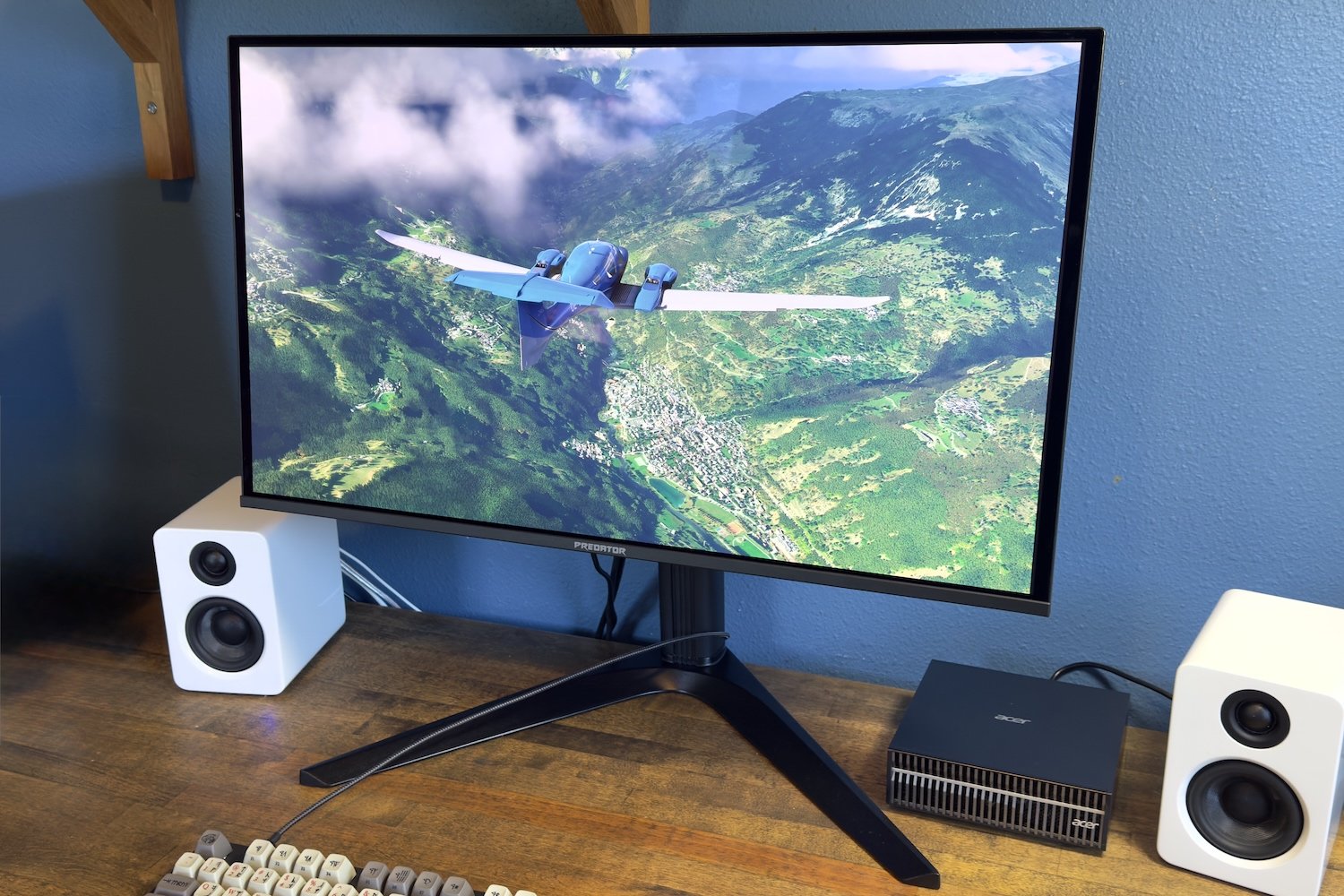
Acer’s Predator X27 X1 is a relatively affordable 27-inch 4K QD-OLED monitor with an MSRP of $799.99. To achieve that, Acer ditches some features that you’ll find on competitors, such as HDR brightness control. The company also seems to take a “parts bin” approach to design. Its MSRP is attractive, though, and the monitor still manages to deliver great SDR and HDR image quality.
Read on to learn more, then see our roundup of the best monitors for comparison.
Acer Predator X27 X1 specs and features
The Acer Predator X27 X1’s specifications are similar to other 4K QD-OLED monitors and position the monitor as a mid-range option. Offering 4K resolution with a refresh rate up to 240Hz puts the Predator X27 X1 a rung above budget 1440p QD-OLED displays, though the monitor lacks more exotic features like an ultra-fast refresh rate (some now exceed 500Hz).
- Display size: 26.5-inch 16:9 aspect ratio
- Native resolution: 3,840 x 2,160
- Panel type: QD-OLED
- Refresh rate: 240Hz
- Adaptive sync: AMD FreeSync Premium Pro
- HDR: HDR10, VESA DisplayHDR 400 Certified
- Ports: 2x HDMI 2.1, 2x DisplayPort 1.4, 1x USB-C with DisplayPort Alternate Mode and 65 watts of Power Delivery, 1x USB-B 3.2 upstream, 2x USB-A 3.2 downstream, 3.5mm headphone jack
- Audio: 2x 5-watt speakers
- Price: $799.99 MSRP
The lack of high-end features is reflected in the monitor’s modest $799.99 MSRP. A few competitors, such as the MSI MAG 272UP, offer a 4K OLED panel at a similar price, but most 4K OLED monitors have a higher MSRP.
Acer Predator X27 X1 design
The Acer Predator X27 X1 embraces a basic aesthetic that relies on matte black materials across every portion of the monitor, from the display panel to the bezel and the stand. It’s not a bad look, though, and it allows the monitor to fit in a variety of situations.
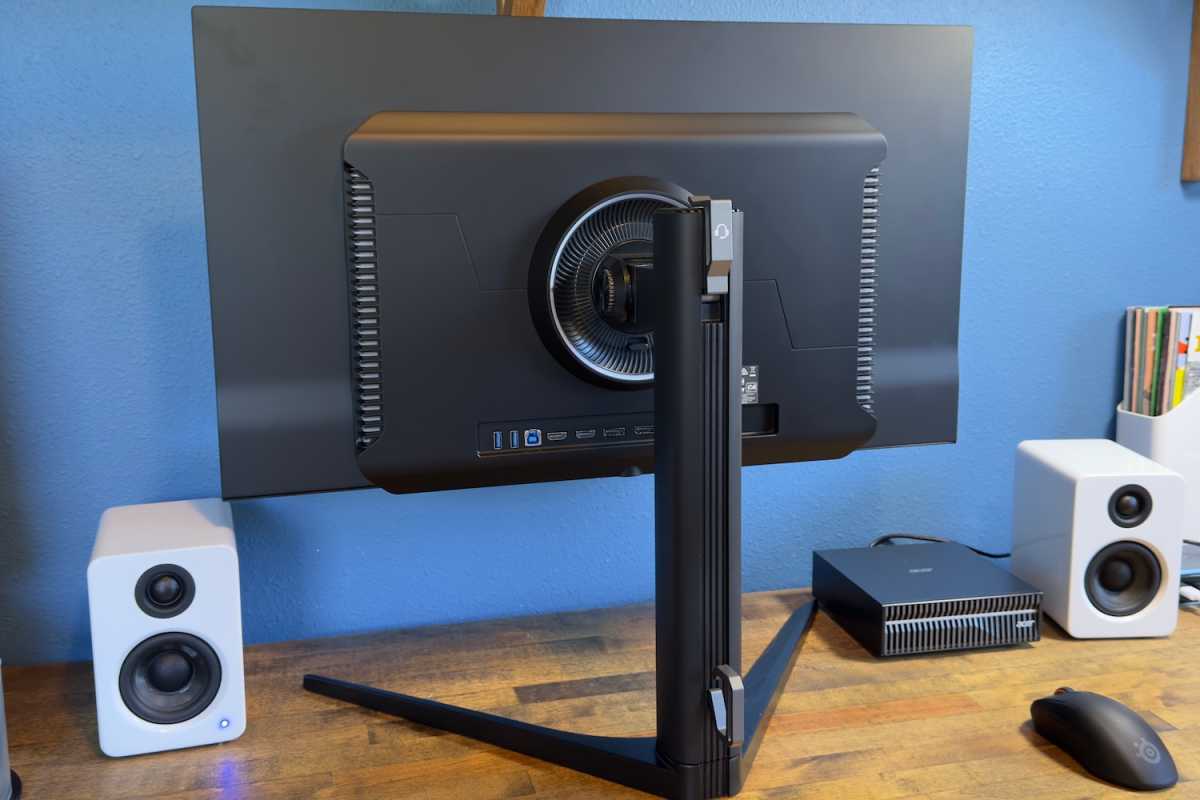
However, the design makes some mistakes that are common to Acer’s current monitor line-up. The wide, wing-like stand is larger than it needs to be. It also has a deep stand neck that makes the monitor hard to position properly on a desk. Personally, I felt the monitor stand was simply too large to achieve a comfortable viewing position on my desk, which is 26 inches deep. This is unusual for a 27-inch monitor.
Matthew Smith / Foundry
I noticed a semi-transparent loop on the rear of the display panel, surrounding where the stand attaches to the monitor. Monitors often use such a loop for RGB-LED lighting, but the Acer Predator X27 X1 doesn’t have this feature, so it’s an odd design choice. I suspect Acer is re-using components across multiple monitors to keep costs low. To be fair, Acer has achieved that goal, as the Acer Predator X27 X1 is inexpensive for a 4K QD-OLED monitor.
On the plus side, the stand offers a good range of ergonomic adjustment. This includes 120mm of height, 25 degrees of tilt, 40 degrees of swivel, and 90 degrees of pivot for rotation into portrait mode. A 75x75mm VESA mount is included for use with third-party monitor stands and arms.
Acer Predator X27 X1 connectivity
The Acer Predator X27 X1’s connectivity is among its best features. The monitor includes two HDMI 2.1 ports and two DisplayPort 1.4 ports, plus a USB-C port with DisplayPort Alternate Mode. That makes for five video inputs in total, which is a lot for a monitor at any price point, and great for a monitor that undercuts some competitors with its MSRP. The Acer Predator X27 X1 is an obvious choice for people who connect many PCs and game consoles to a single monitor.
A pair of downstream USB-A 3.2 ports are connected to the USB-C input, which makes the Predator X27 X1 a basic USB hub monitor. The monitor also has a USB-B upstream port, which is useful if you have a desktop or an older laptop that lacks USB-C. The monitor doesn’t advertise a KVM switch function, but it does have USB input auto-detect, which so far as I can tell does the same job.
A 3.5mm audio-out rounds out the connectivity.
It’s also worth mention that all of the ports face to the rear of the display panel. This isn’t rare, but most monitors have downward-facing ports. I prefer rearward-facing ports because they’re more visible when connecting or disconnecting devices. However, rearward-facing ports are troublesome if you plan to wall mount, as the wires will get in the way of your mount.
Acer Predator X27 X1 menus and features
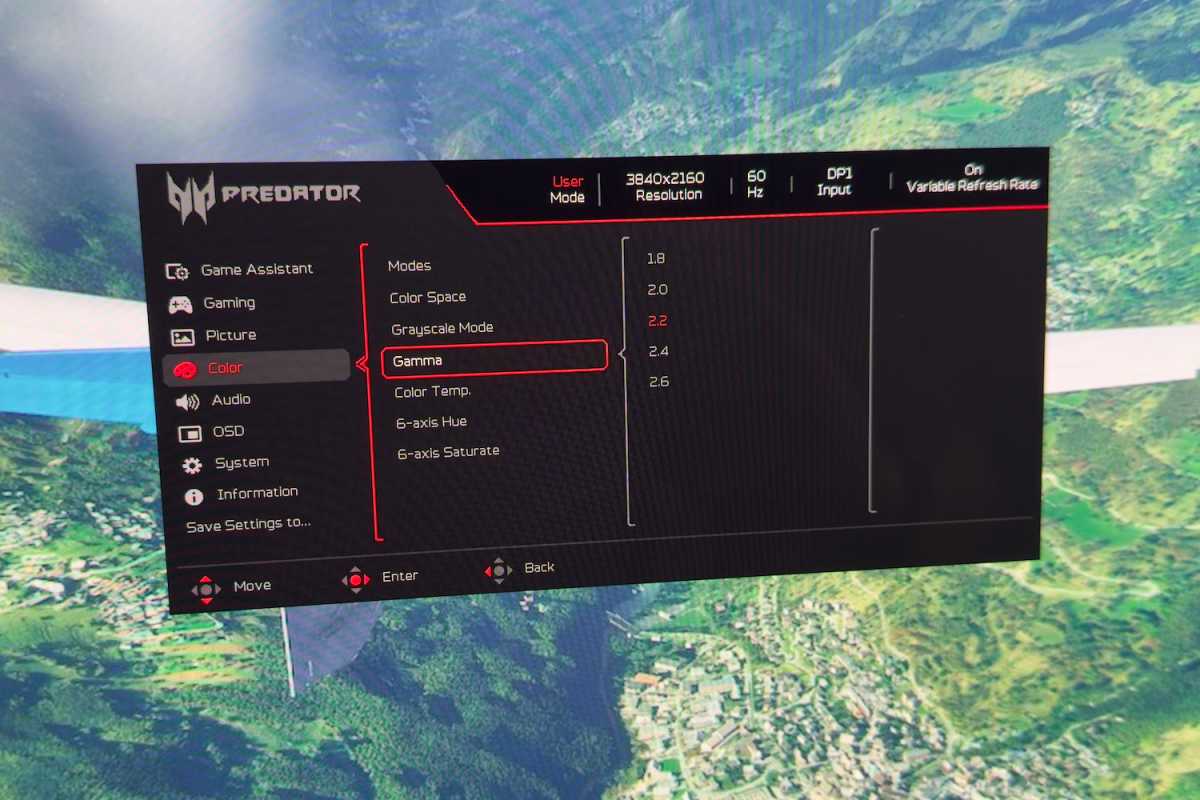
The Acer Predator X27 X1’s on-screen menu is controlled by a joystick on the bottom bezel. It’s responsive and intuitive to use. The on-screen menu system is logically arranged, but the font is rather small and doesn’t contrast well with the background, so it’s difficult to read.
Acer packs quite a few image quality features in the Predator X27. It has color space modes for sRGB, Rec.709, DCI-P3, and SMPTE-C. You’ll also find precise gamma adjustments and 6-axis customization for color hue and saturation. The only weakness is in color temperature, as the monitor provides vague presets (like “warm” and “cool”) instead of precise presets in degrees Kelvin. Still, the range of image quality adjustment is better than average for a gaming monitor.
Matthew Smith / Foundry
The monitor’s gaming features are more basic. You’ll find an on-screen crosshair and timer, a sniper mode (which zooms a portion of the display), and the option to see the current refresh rate. Like most OLED monitors, the Predator X27 X1 lets you restrict the visible display space to emulate a smaller monitor. This can be helpful for esports, because it keeps more of the action inside the center of your vision.
Most monitor features can be accessed with Acer Display Widget, which lets you change monitor settings within Windows. I don’t love the design of the app and prefer the alternatives from Asus and Dell, but Acer’s Display Widget does the job.
Acer Predator X27 X1 audio
A pair of 5-watt speakers are bundled in the Acer Predator X27 X1. This is a nice surprise for two reasons. First, most gaming monitors don’t even bother to include speakers. And second, the 5-watt speakers are better than average.
Don’t get me wrong; you’ll still absolutely want a headset for most games and movies. However, the speakers offer acceptable volume and a passable experience for podcasts, most YouTube videos, and games where the audio presentation isn’t important.
The Acer Predator X27 X1’s bundled 5-watt speakers are a nice surprise by being better than average.
Acer Predator X27 X1 image quality
As mentioned, the Acer Predator X27 X1 has a 4K QD-OLED panel manufactured by Samsung. Most 4K OLED monitors use such a panel, though some use LG WOLED panels. The Acer Predator X27 X1’s SDR image quality is basically identical to its QD-OLED competitors, which is to say it’s excellent.
Matthew Smith / Foundry
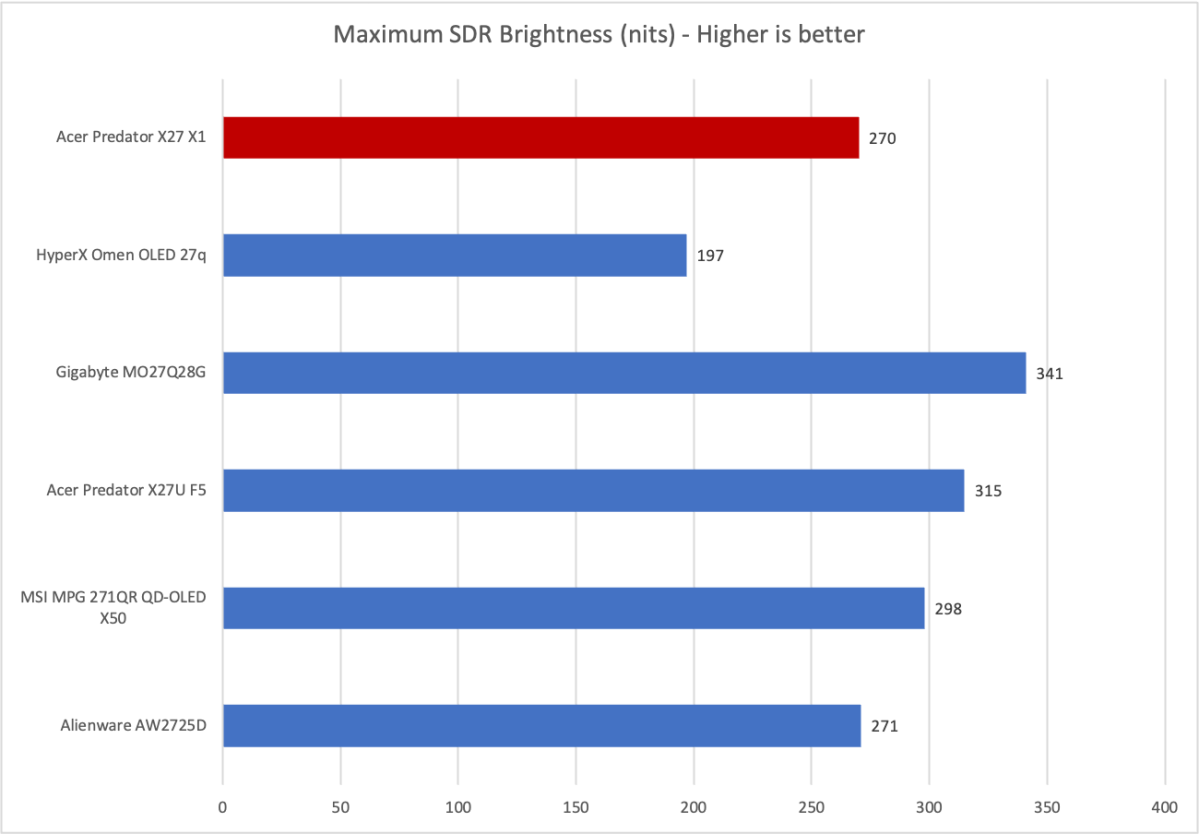
First up is brightness, where the Acer Predator X27 X1 hit a maximum sustained SDR brightness of 270 nits. As the graph shows, that is a respectable though mid-range result for a current OLED monitor.
Even so, 270 nits is bright enough for use in most situations. It will only look dim in a very bright room where you have no option to control the light. The monitor has a glossy finish, and while an anti-glare coat slightly diffuses light, glare will remain an issue if you have a bright light source sitting over your shoulder.
Matthew Smith / Foundry
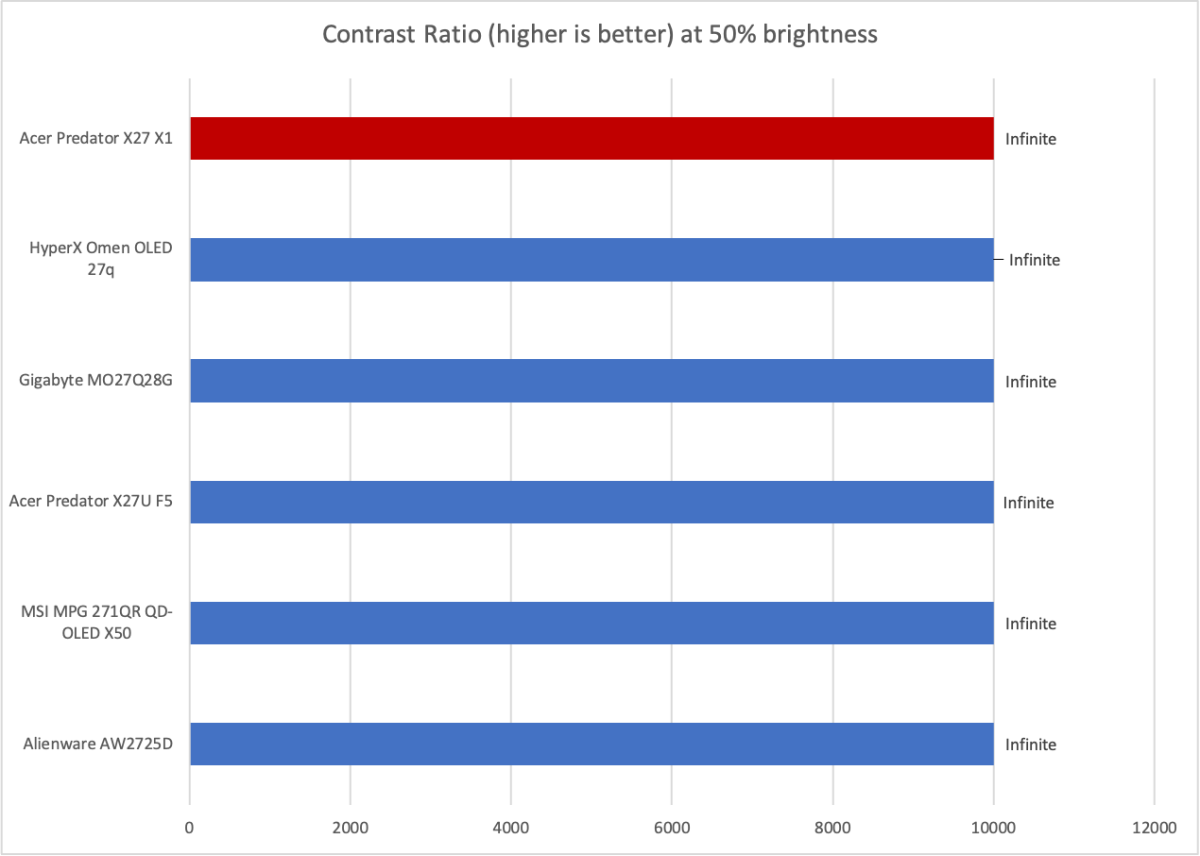
Contrast is OLED’s biggest strength. OLED monitors can turn every pixel on and off individually, which means they can deliver a perfect black level of zero nits and can provide this without light spilling over from nearby pixels. The result is an essentially perfect contrast experience that delivers a deep, immersive image.
All current OLED monitors achieve this, however, so the Predator X27 X1 has no advantage or disadvantage here.
Matthew Smith / Foundry
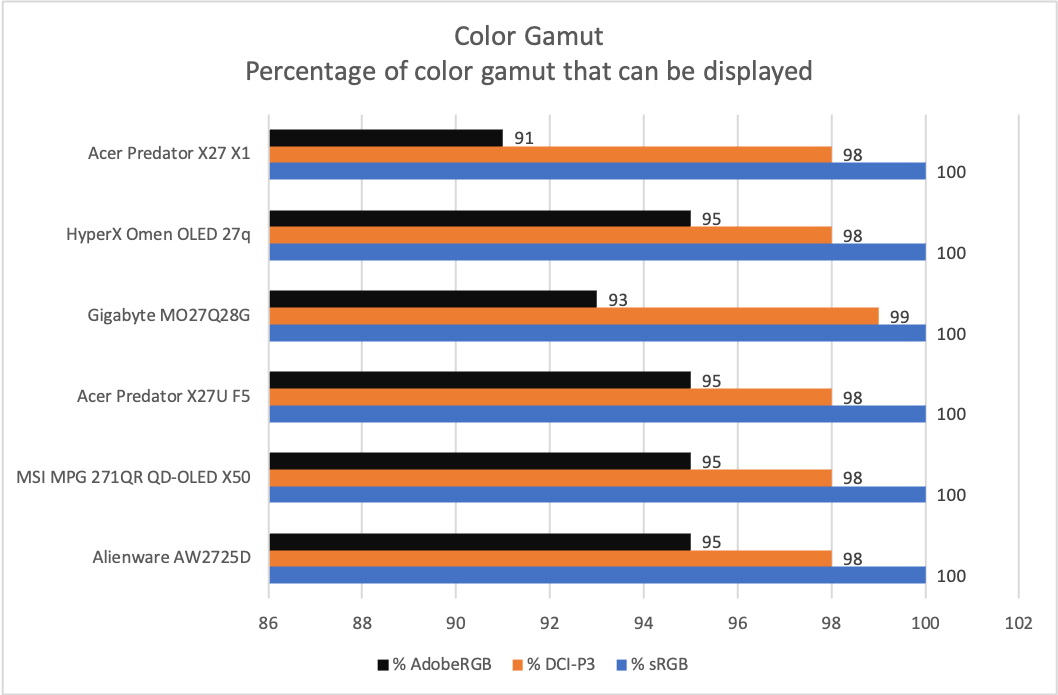
The Acer Predator X27 X1’s color gamut is ever-so-slightly more narrow than most QD-OLED monitors. It achieves 100 percent of sRGB and 98 percent of DCI-P3, but only 91 percent of AdobeRGB. This is a hair below most competitors, which tend to cover 93 percent to 95 percent of AdobeRGB.
However, I’m not sure you’ll notice unless you’re a creative pro who creates content adhering to the AdobeRGB standard. The color gamut is still extremely wide and provides a vivid, highly saturated image.
Matthew Smith / Foundry
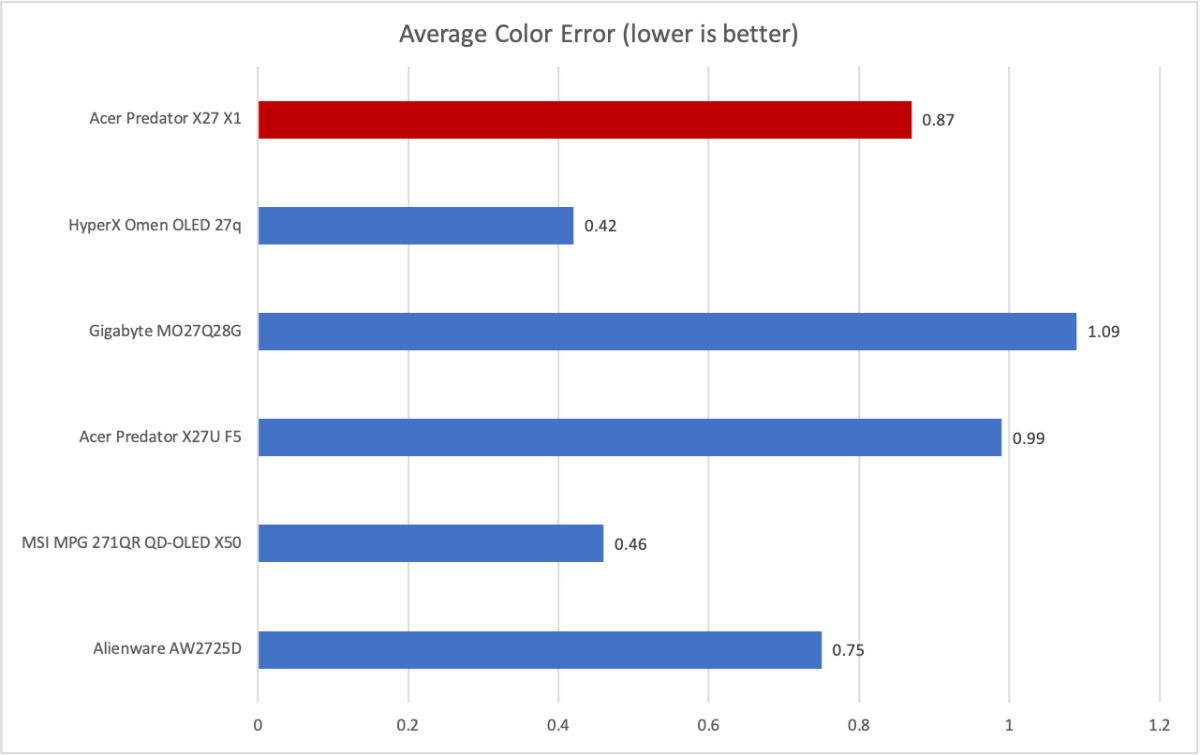
Color accuracy is good, too, with an average color error well below 1.0. The monitor also maintained this across all colors tested, meaning there were no serious outliers from the average. The image looks realistic and true to the creator’s intent.
The Acer Predator X27 X1 did well in gamma and color temperature tests. It achieved a gamma curve of 2.1, which is a tad off the target of 2.2. It also had a default color temperature of 6600K, just above the target of 6500K. Both deviations are minor, though, and I didn’t find them noticeable in use.
Sharpness is solid. The monitor’s 4K resolution across a 26.5-inch viewable surface works out to more than 160 pixels per inch. This isn’t as impressive as it once was, as 27-inch 5K monitors are now common (though none are OLED). Still, this pixel density is enough to provide a sharp image. Small fonts and fine interface details look smooth and crisp when viewed from a typical viewing distance of two to three feet away.
Acer Predator X27 X1 HDR image quality
The Acer Predator X27 X1 supports HDR10 and is VESA DisplayHDR 400 Certified. This is also true of most 4K QD-OLED monitors, but how does the Predator X27 X1 stack up in the real world?
Matthew Smith / Foundry
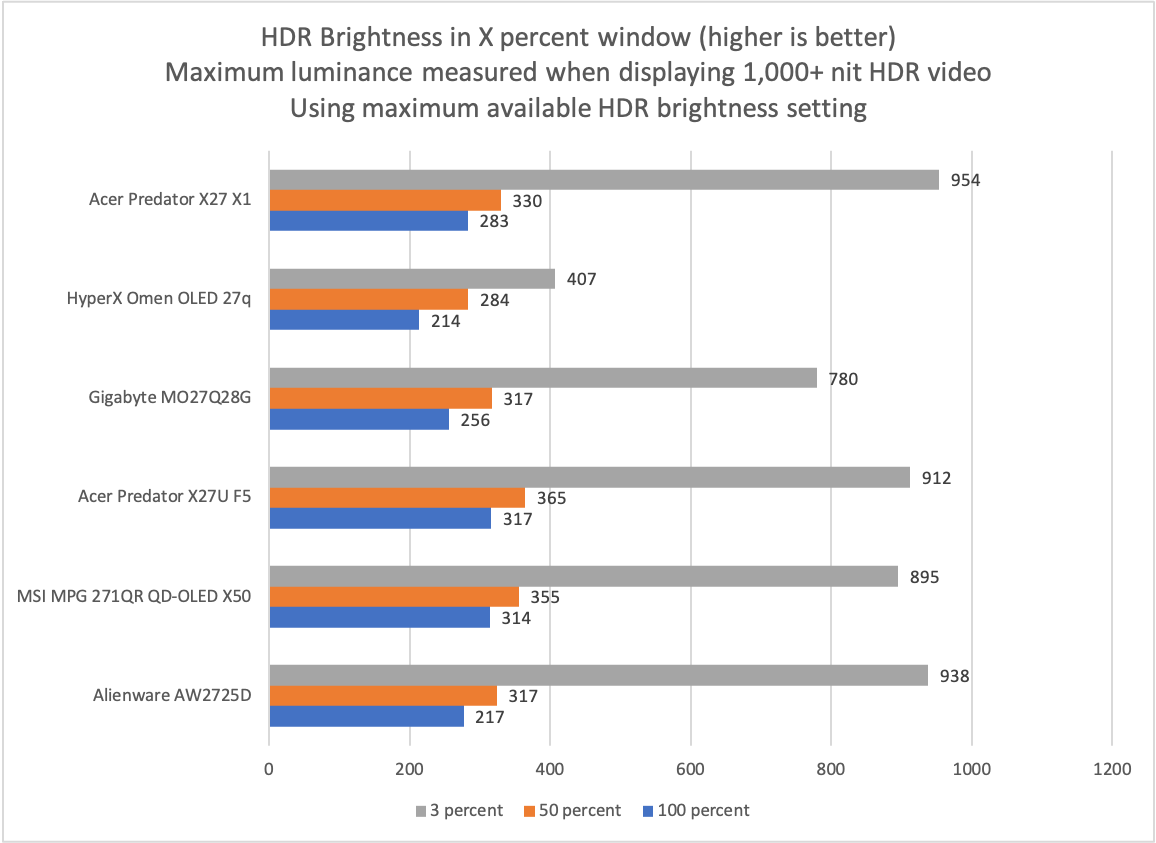
Rather well, actually. The monitor’s lower MSRP is not evident in its HDR brightness, as the monitor can achieve over 950 nits at best, and it generally performs the same as other recent 4K QD-OLED monitors.
That means it will be extremely bright when the display needs to be lit for a short period, or when a small portion of the display is bright. When the entire screen is bright, however, HDR brightness barely exceeds SDR.
Subjectively, I thought HDR content looked great. The monitor offers real eye-searing highlights; a recent personal favorite is Diablo 2: Resurrected, where fire spells look fantastic in HDR. The monitor’s HDR presentation also benefits from the panel’s amazing contrast and wide color gamut.
While the monitor’s HDR is solid, it doesn’t offer the option to adjust monitor brightness in HDR. This is a feature competitors like Asus and MSI have embraced. It can be useful on a monitor, as many movies and games present HDR with a television in mind and can seem overly bright on a monitor, especially if you game in a darkened room. Unfortunately, Acer doesn’t provide the tools to fix that issue if you find it distracting.
Acer Predator X27 X1 motion performance
Like most 4K QD-OLED monitors, the Acer Predator X27 X1 offers a refresh rate of 240Hz. This is more or less the standard in 2026. It’s a very good standard, though, and the Predator X27 X1’s motion performance is great. Fast-moving objects look crisp as they zoom across the display and fast camera pans in 3D games will preserve a lot of detail in the scene. The refresh rate is even helpful on the Windows desktop, as you can read scrolling text that would be illegible on a 60Hz monitor. All of the monitor’s five video inputs can handle 4K resolution at 240Hz.
Acer lists official support for AMD FreeSync Premium Pro, and I found it worked well in my testing. The monitor was detected by my AMD Radeon 7800 XT video card and frame pacing was smooth. I expect the monitor will also work with G-Sync, as most such monitors do, though I wasn’t able to test it in this case.
One feature is absent: a backlight strobing mode. This is a mode that quickly adds black, blank frames between normal frames. It sounds like a horrid idea but, thanks to the tricky ways our eyes work, it improves motion clarity. Asus and MSI are leaders here: Asus has ELMB and MSI has MPRT. Acer, though, has opted out. I don’t find this a deal-breaker, but it could be a downside for motion clarity purists.
That aside, the monitor’s overall motion clarity adheres to OLED’s usual standard of excellence. The Acer Predator X27 X1 isn’t significantly better or worse overall than the competition. However, because Acer undercuts competitors on MSRP, this arguably works to the Predator X27 X1’s advantage.
Should you buy the Acer Predator X27 X1?
Acer’s Predator X27 X1 isn’t perfect, but it’s a respectable choice if you find it at the right price. It benefits from a wide range of ports, high HDR brightness, and solid motion clarity. These perks are somewhat diminished by the monitor’s bulky design and absent features, like HDR brightness control. The monitor’s $799.99 MSRP is on the low end for a 27-inch 4K QD-OLED monitor, and it’s a respectable choice at that price.
This articles is written by : Nermeen Nabil Khear Abdelmalak
All rights reserved to : USAGOLDMIES . www.usagoldmines.com
You can Enjoy surfing our website categories and read more content in many fields you may like .
Why USAGoldMines ?
USAGoldMines is a comprehensive website offering the latest in financial, crypto, and technical news. With specialized sections for each category, it provides readers with up-to-date market insights, investment trends, and technological advancements, making it a valuable resource for investors and enthusiasts in the fast-paced financial world.