
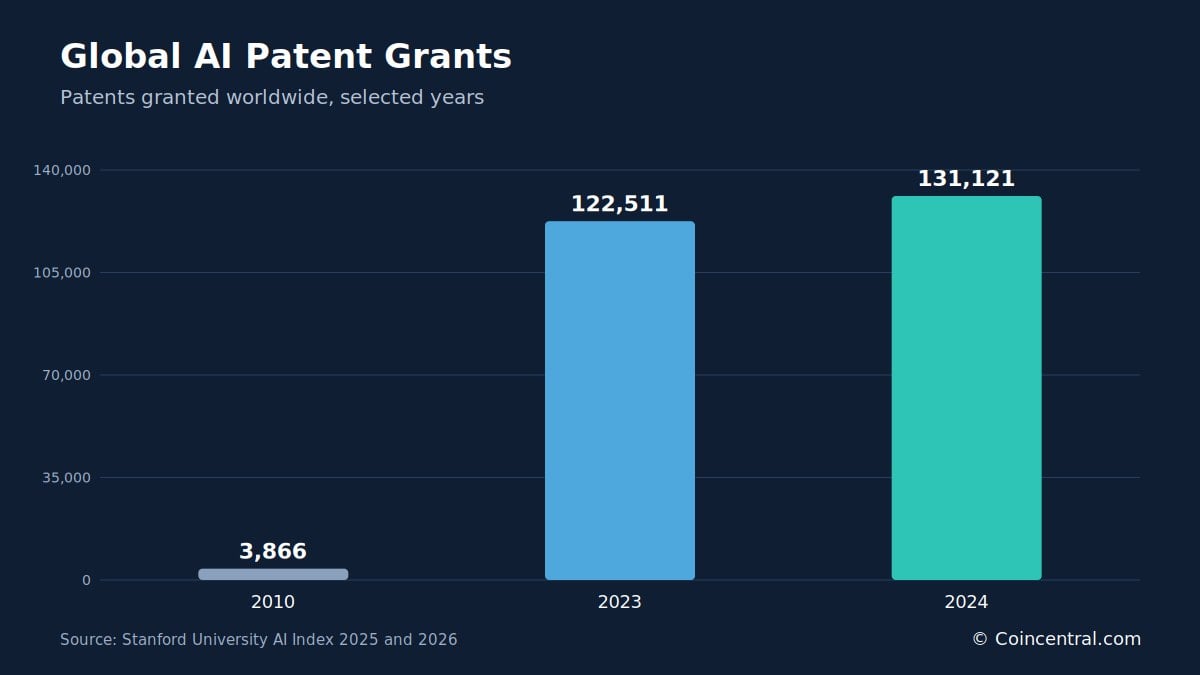
Artificial intelligence patent activity has grown faster than almost any other technology area in recent years. Stanford University’s 2026 AI Index reports that 131,121 AI patents were granted worldwide in 2024, up from 3,866 in 2010.
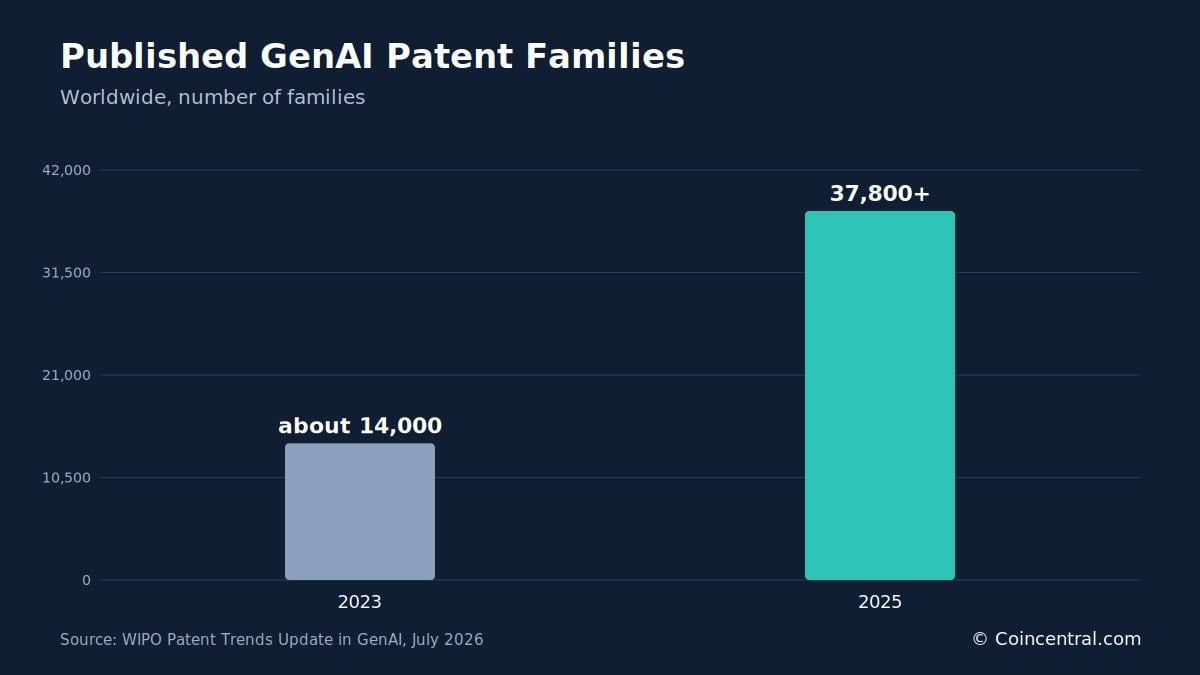
Generative AI is growing faster still. The World Intellectual Property Organization (WIPO) reported in July 2026 that published GenAI patent families rose from about 14,000 in 2023 to more than 37,800 in 2025.
China leads on volume, the United States leads on citations, and South Korea leads per person. SoftBank is now the largest owner of GenAI patent families. This article covers the main numbers, with tables and charts.
All figures here come from reports by Stanford University and WIPO. Where the two groups use different measures, the article says so.
The sections below move from global totals to country shares, then to generative AI, company rankings, technology types and the limits of the data.
AI Patent Statistics at a Glance
Stanford’s database counts 131,121 AI patent grants worldwide in 2024. That is the latest complete year available. In 2010 the number was only 3,866, so grants rose more than 33 times in 14 years.
Growth continues, though more slowly in percentage terms. Grants rose 8.2% between 2023 and 2024. The 2025 AI Index recorded 122,511 grants in 2023, a 29.6% rise from the year before.
Smaller yearly percentages are normal when the base is much larger. The table below lists the main figures covered in this article.
| Measure | Figure |
|---|---|
| AI patents granted worldwide, 2024 | 131,121 |
| AI patents granted worldwide, 2010 | 3,866 |
| Growth in grants, 2023 to 2024 | 8.2% |
| China’s share of 2024 grants | 74.2% |
| U.S. share of 2024 grants | 12.1% |
| Top country per capita (South Korea) | 14.31 per 100,000 people |
| GenAI patent families published, 2025 | More than 37,800 |
| GenAI share of AI patent families, 2025 | 8.7% |
| Largest GenAI patent owner | SoftBank (about 2,985 families) |
What Counts as an AI Patent?
There is no single global AI patent office. Researchers find AI patents by studying patent classifications, titles, abstracts and claims. Different studies draw the line in different places.
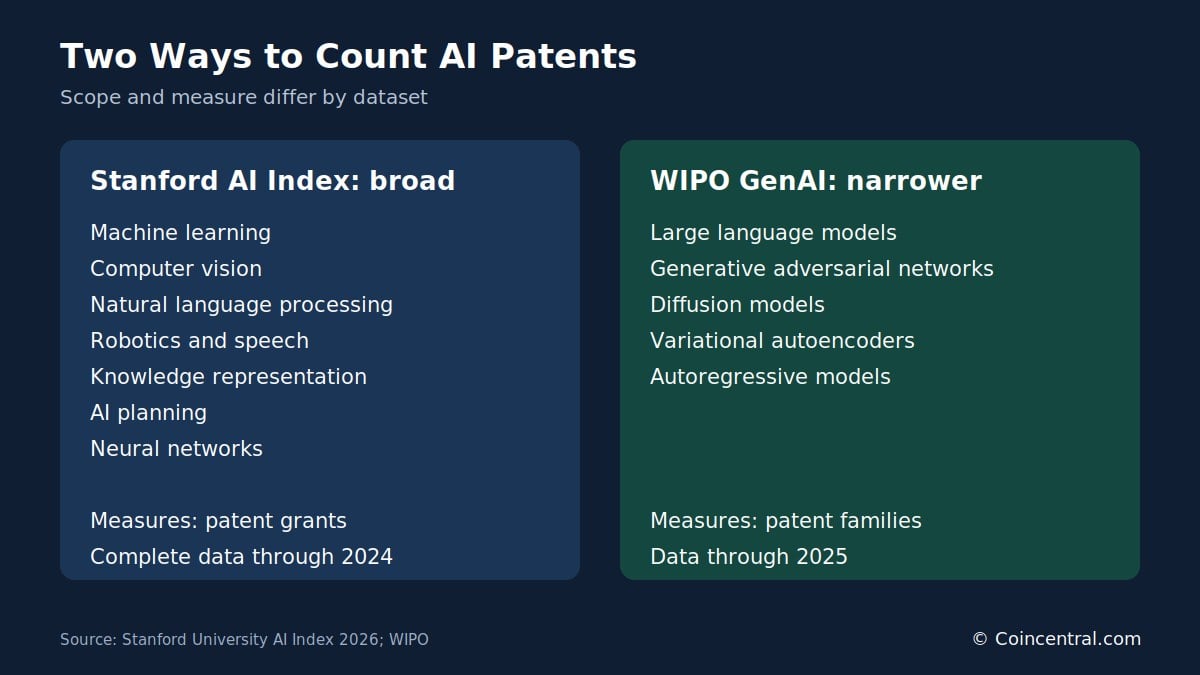
Stanford’s dataset is broad. It covers machine learning, computer vision, natural language processing, robotics, speech, knowledge representation, AI planning and neural networks.
WIPO’s generative AI dataset is narrower. It tracks large language models, generative adversarial networks, diffusion models, variational autoencoders and autoregressive models.
A patent family groups patents that cover essentially the same invention across one or more countries. One invention filed in China, Europe and the United States counts as one family, not three. Grants, applications and families are different measures and should not be mixed.
Because the definitions differ, the Stanford total of 131,121 grants and the WIPO total of 37,800 families cannot be compared directly. One is a broad count of grants. The other is a narrow count of families.
This matters when reading headlines. A figure from Stanford and a figure from WIPO can both be correct and still not match. They count different things over different periods.
Patent families help avoid double counting. They are better for comparing inventions than for comparing filings. Grant counts, by contrast, track what patent offices approved in a given year.
China Holds 74% of Global AI Patent Grants
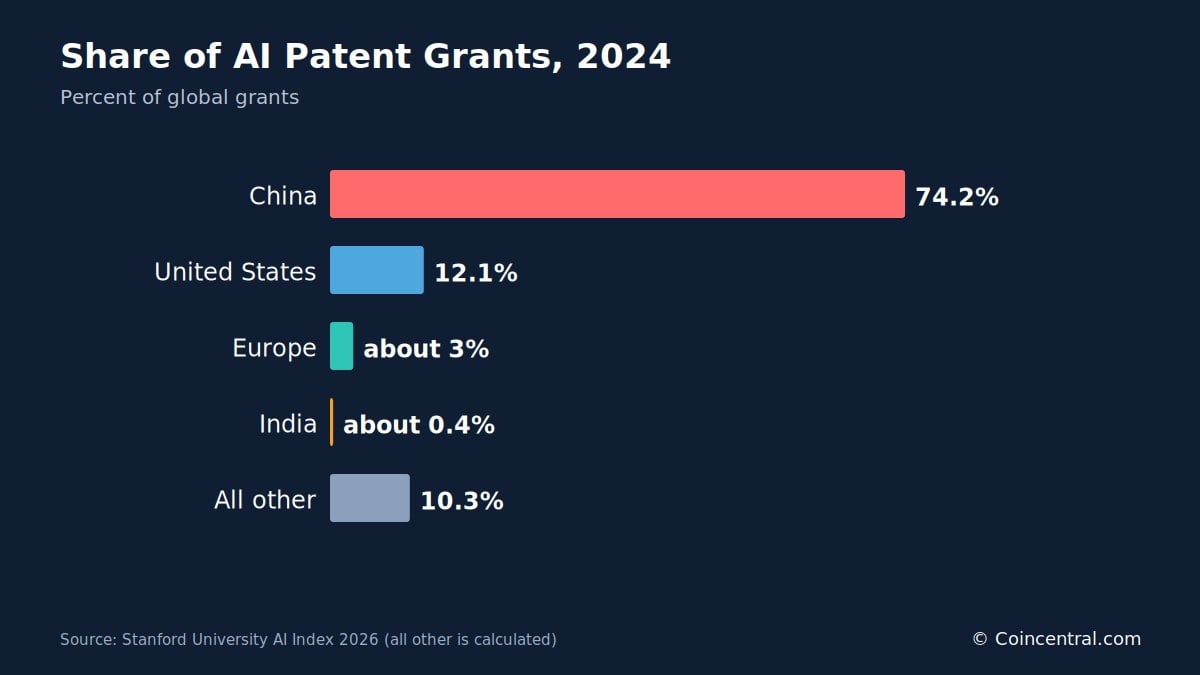
China accounted for about 74.2% of AI patents granted in 2024. The United States held 12.1%, or roughly 15,290 patents. Europe had about 3% and India about 0.4%.
The shift has been fast. In 2015 the United States held about 42.8% of worldwide AI grants, while China’s share was below 20%. By 2022 China had 61.1% and the United States 20.9%.
Two years later China was at 74.2% and the United States at 12.1%. China gained share even as the total number of grants grew.
For context, the United States held about 42.8% in 2015. A fall to 12.1% in 2024 means its share dropped by roughly 30 points in nine years.
Europe’s share of about 3% and India’s of about 0.4% are small next to the two leaders. All other countries together make up the remaining 10.3%, a figure calculated from the shares above.
China’s lead holds on grants and, as later sections show, on GenAI families. The U.S. position looks stronger on citations.
| Year | China’s share | U.S. share |
|---|---|---|
| 2022 | 61.1% | 20.9% |
| 2024 | 74.2% | 12.1% |
The U.S. Leads on AI Patent Influence
Stanford also tracks forward citations. A forward citation happens when a later patent refers to an earlier one. It gives a rough sign of how much an invention shaped later work.
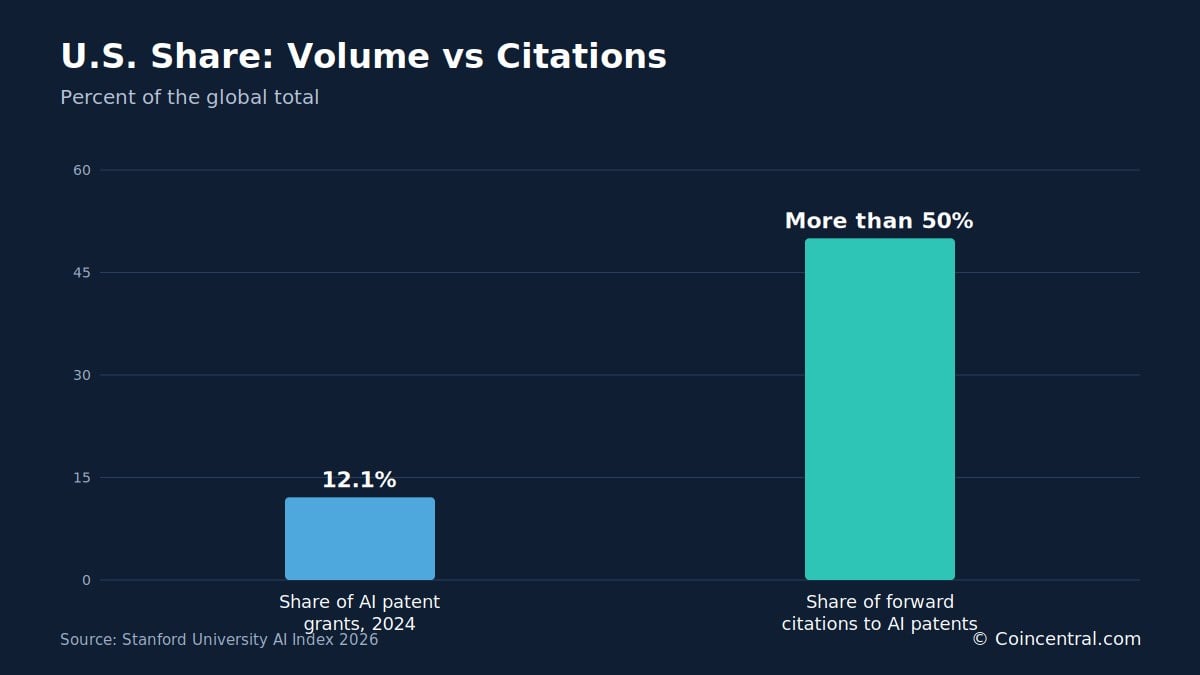
The United States receives more than half of all forward citations to AI patents. It produces only about 12% of the volume. China ranks second on citations.
So China leads on quantity, while the United States has more influence by this measure. Stanford warns that citation counts have limits. They show a strong home-country bias and are not a perfect gauge of patent quality.
These two measures point in different directions. Volume shows where filing activity is concentrated, and citations show where later inventors look for earlier ideas.
Citation counts are one input among several. They do not show whether a patent is used in a product or earns income. Researchers treat them as a rough signal.
The gap between volume and influence is why analysts avoid ranking countries on patent totals alone. A country can file many patents and still receive fewer citations from later inventors.
South Korea Leads AI Patents Per Capita
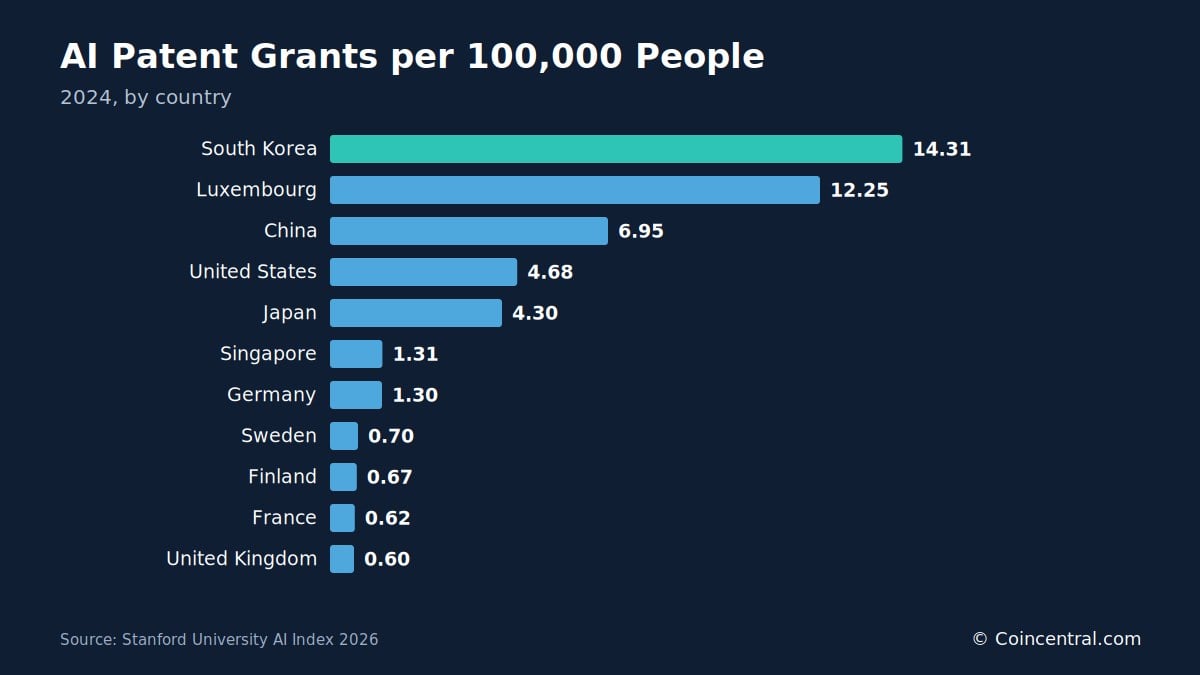
Big countries produce more patents, so population changes the picture. Stanford’s 2026 data shows granted AI patents per 100,000 people in 2024. South Korea leads with 14.31, followed by Luxembourg at 12.25.
China records 6.95 and the United States 4.68. South Korea therefore produces more than three times as many AI patent grants per person as the United States.
Japan is at 4.30. Singapore and Germany are close together at 1.31 and 1.30. Several other European countries sit below 1.
South Korea’s figure of 14.31 is more than twice China’s 6.95. It is just over three times the 4.68 recorded for the United States.
Adjusting for population favors smaller, highly patented economies. Luxembourg is the clearest case, ranking second ahead of both China and the United States.
The United Kingdom, France, Finland and Sweden all record between 0.60 and 0.70 per 100,000 people. That is far below the leaders. The data covers granted patents only.
| Country | AI patents per 100,000 people |
|---|---|
| South Korea | 14.31 |
| Luxembourg | 12.25 |
| China | 6.95 |
| United States | 4.68 |
| Japan | 4.30 |
| Singapore | 1.31 |
| Germany | 1.30 |
| Sweden | 0.70 |
| Finland | 0.67 |
| France | 0.62 |
| United Kingdom | 0.60 |
Generative AI Patents Nearly Tripled in Two Years
GenAI patent families rose from about 14,000 in 2023 to more than 37,800 in 2025, according to WIPO’s July 2026 update. That is almost triple in two years.
More than 56,000 families were published across 2024 and 2025. That is more than the whole 2014 to 2023 period combined.
GenAI is also taking a bigger share of all AI patent-family publications. It was 4.2% in 2017, 6.1% in 2023 and 8.7% in 2025.
Image and video inventions still form the largest GenAI data category, as a later section shows. Text patents are growing quickly because of large language models.
In plain numbers, the 37,800 families published in 2025 are about 2.7 times the 2023 count. The 2024 and 2025 total is larger than the output of the ten years before it.
Patent families are published after a delay, so the 2025 count reflects earlier filings. Even so, GenAI is a larger part of AI patenting than it was in 2017 or 2023.
| Year | GenAI share of AI patent families |
|---|---|
| 2017 | 4.2% |
| 2023 | 6.1% |
| 2025 | 8.7% |
Top Countries for GenAI Patents
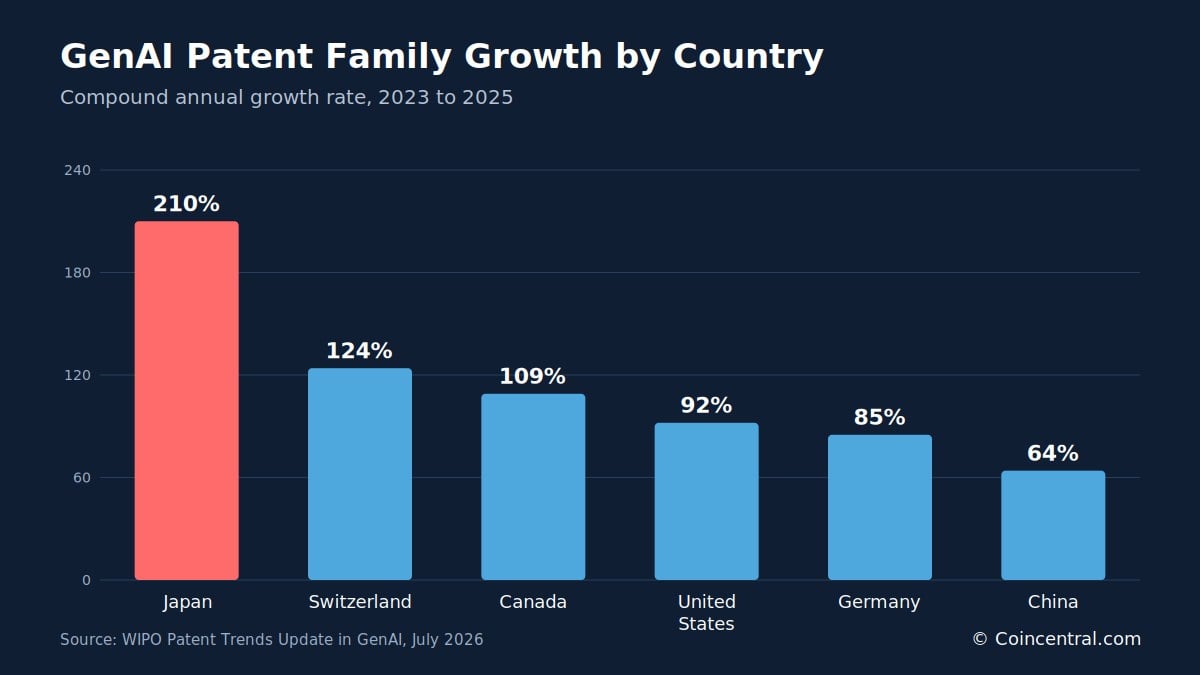
China is far ahead in GenAI. Its inventors published more than 43,000 GenAI patent families in 2024 and 2025 alone, more than the country’s total for the previous decade. Chinese families grew about 64% per year from 2023 to 2025.
China leads all five of WIPO’s major GenAI model categories. U.S. families rose from about 1,185 in 2023 to more than 4,380 in 2025, a yearly growth rate of about 92%.
Japan rose from 398 to 3,835, about 210% a year. It moved from fourth to third place, passing South Korea. Much of that rise came from one company, SoftBank.
Germany passed the UK as Europe’s largest GenAI patent origin, with growth of about 85% a year. Canada grew about 109% and Switzerland about 124%. Seven of the ten leading countries published more families in 2024 and 2025 than in the whole previous decade.
WIPO also found that China leads each of its five GenAI model categories. These are large language models, GANs, diffusion models, variational autoencoders and autoregressive models.
Germany’s growth of about 85% a year is below Canada’s and Switzerland’s, but its total is larger. That gives it the top European position ahead of the UK.
The 2025 top 10 also includes India, Canada, the United Kingdom, Israel and Switzerland. GenAI patenting is spread across several regions, though the volumes differ widely.
The U.S. count in 2025 was roughly 3.7 times its 2023 level. Japan’s was almost ten times its 2023 level. China’s growth rate was lower, but it started from a much larger base.
Alphabet, Microsoft, IBM and Nvidia are among the important U.S. patent holders. Their filings show commercial AI development turning into formal intellectual property.
| Rank | Country |
|---|---|
| 1 | China |
| 2 | United States |
| 3 | Japan |
| 4 | South Korea |
| 5 | India |
| 6 | Germany |
| 7 | Canada |
| 8 | United Kingdom |
| 9 | Israel |
| 10 | Switzerland |
SoftBank Is Now the Largest GenAI Patent Owner
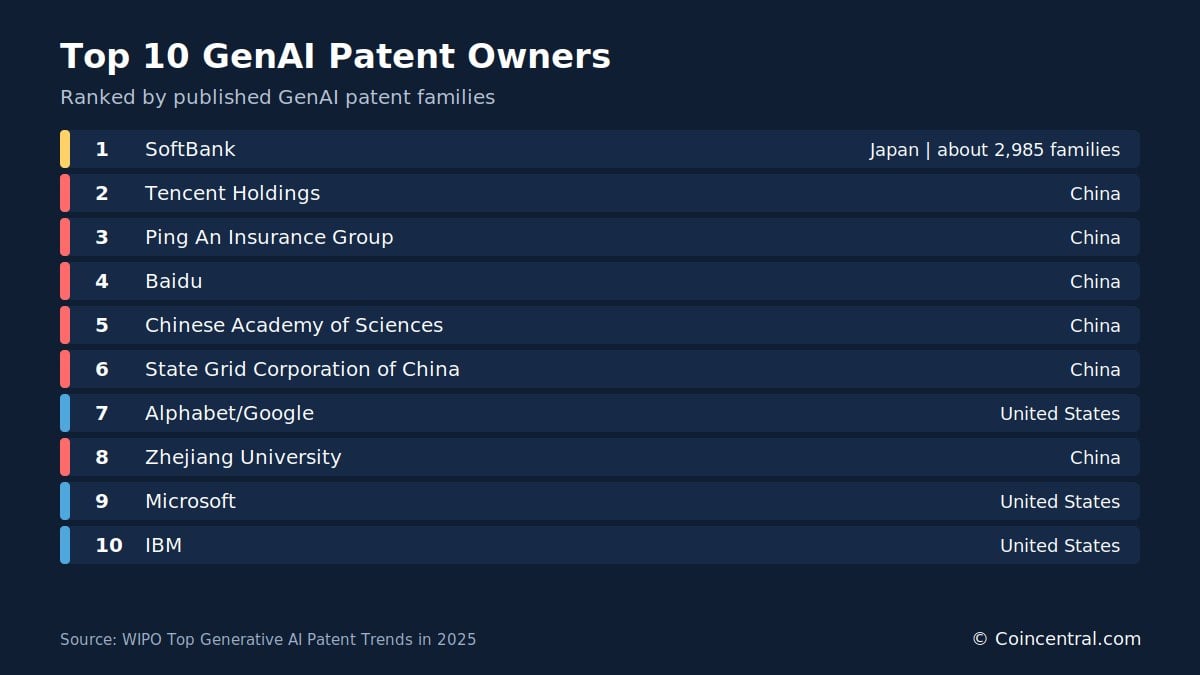
SoftBank has about 2,985 published GenAI patent families. Almost all were filed in 2023 and published in 2025. That jump put the Japanese company at number one.
Its AI strategy covers infrastructure, data centres, semiconductors, an investment in OpenAI, Japanese-language models and the Stargate project. The size of the portfolio suggests it wants protection across several layers of AI.
Six of the top 10 owners are Chinese organizations, including companies and research bodies. Alphabet is the largest U.S.-based owner. Nvidia, Inspur and Bosch have also entered the top 25.
Tencent held the top spot before SoftBank’s surge. It is strong in language models, image generation, video, speech and software, and uses its Hunyuan models across WeChat and gaming.
Ping An Insurance Group ranks third even though it is not known mainly as a technology company. It leads WIPO’s categories for banking and finance, medical and life sciences, education, government computing and smart cities.
Tencent’s patents span language models, image generation, video, speech, text generation, software, document management, entertainment and security. WIPO’s earlier analysis ranked it first in several GenAI application categories.
Because almost all of SoftBank’s families were filed in 2023, its position reflects one large filing program rather than steady yearly growth.
WIPO’s top 10 list includes universities and state bodies as well as companies. The Chinese Academy of Sciences, State Grid Corporation of China and Zhejiang University are all on it.
Alphabet, Microsoft and IBM are the three U.S. entries. SoftBank is the only Japanese organization in the top 10.
| Rank | Owner | Country |
|---|---|---|
| 1 | SoftBank | Japan |
| 2 | Tencent Holdings | China |
| 3 | Ping An Insurance Group | China |
| 4 | Baidu | China |
| 5 | Chinese Academy of Sciences | China |
| 6 | State Grid Corporation of China | China |
| 7 | Alphabet/Google | United States |
| 8 | Zhejiang University | China |
| 9 | Microsoft | United States |
| 10 | IBM | United States |
Large Language Models Have Overtaken GANs
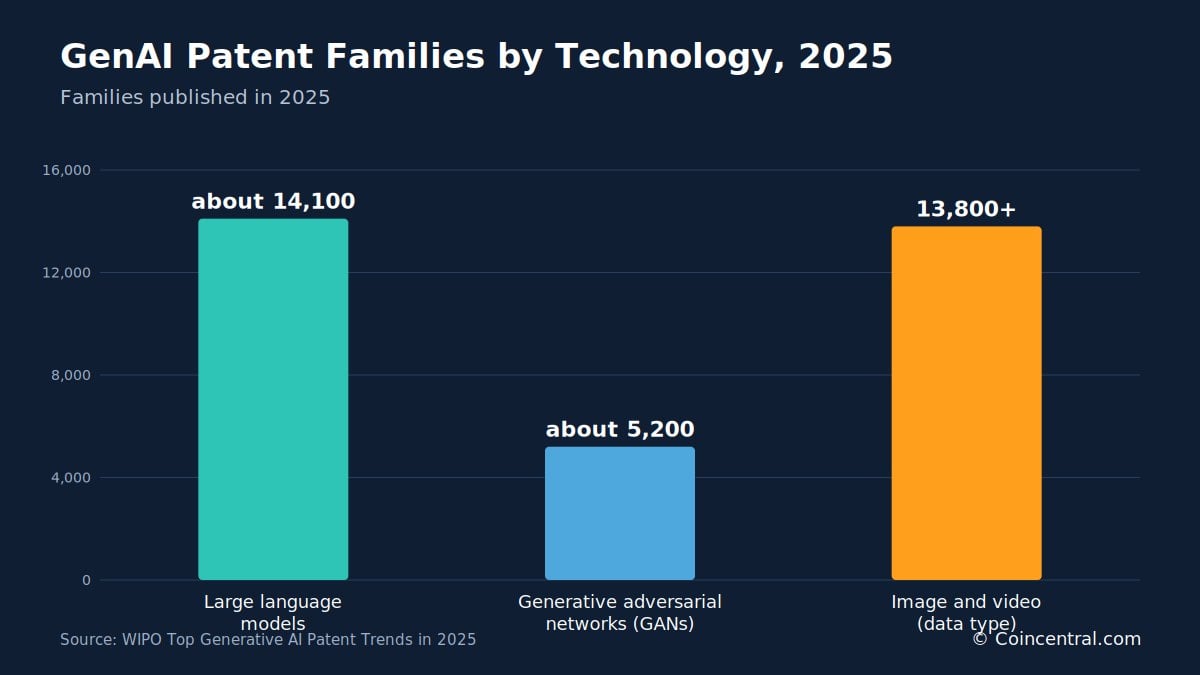
The technology being patented has shifted. About 14,100 large language model families were published in 2025, against 5,200 for GANs. LLMs now outnumber GANs by almost three to one.
Before the ChatGPT era, GANs drove much of generative AI research. Today the ranking is LLMs, GANs, diffusion models, variational autoencoders and autoregressive models.
Diffusion models grew fast earlier. WIPO found their families rose about 190% per year from 2021 to 2023, while LLM families rose about 155%. GAN growth slowed sharply.
Image and video is still the largest data category. About 40,000 families were published from 2014 to 2025, including more than 13,800 in 2025. Text is catching up, and software code and 3D models are the fastest-growing smaller categories.
The shift matches changes in research focus. GANs were common before large language models took over, and diffusion models now power many image and video tools.
Other uses are also being patented. These include speech, music, molecular design and protein and gene applications. They are smaller categories today.
| Technology | Rank by 2025 patent families |
|---|---|
| Large language models | 1 |
| Generative adversarial networks | 2 |
| Diffusion models | 3 |
| Variational autoencoders | 4 |
| Autoregressive models | 5 |
| Technology | Yearly family growth, 2021 to 2023 |
|---|---|
| Diffusion models | About 190% |
| Large language models | About 155% |
AI Patents Reach Into Almost Every Industry
GenAI patents now reach well beyond chatbots. WIPO lists uses in software, healthcare, finance, telecommunications, transportation, manufacturing, security, education, entertainment, agriculture, government, scientific research, smart cities and document management.
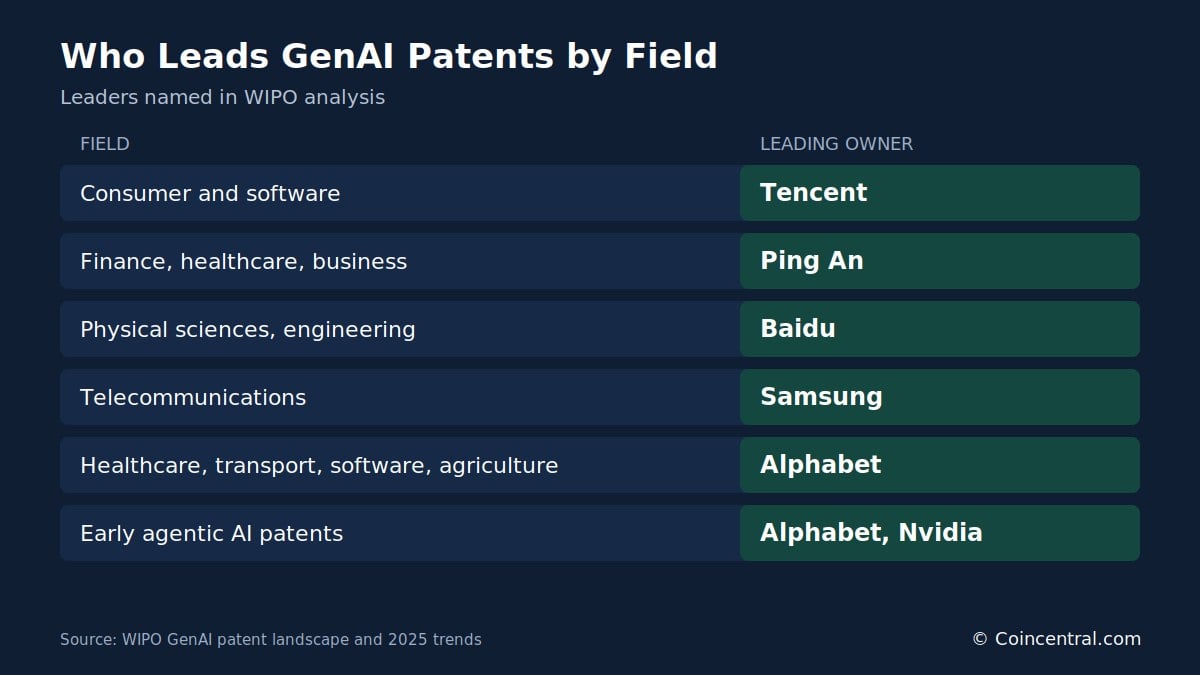
Leaders differ by field. Tencent leads many consumer and software categories.
Ping An is strong in finance, healthcare and business uses. Baidu leads physical sciences and engineering.
Samsung is strong in telecommunications. Alphabet is strong in healthcare, transportation, software and agriculture.
Agentic AI may be the next category. Agents can plan actions, use tools, access software, carry out workflows, make multi-step decisions and work with other AI systems. WIPO says it is still early, but Alphabet and Nvidia are already filing.
Patents on reasoning systems, multimodal agents and more efficient model inference are expected to grow in importance.
Agentic AI patents are still few compared with language models or image generation. Their numbers will be worth watching in future WIPO updates.
Ping An’s presence shows that competition is spreading beyond conventional technology companies. An insurer and a state grid operator now appear alongside search and software firms.
Each field has its own named leaders in WIPO’s analysis. Filing counts in newer categories, such as software code and 3D models, are growing quickly.
Why Patent Counts Do Not Equal AI Leadership
Patent counts need careful reading. China’s 74% share of grants does not mean it controls 74% of valuable AI technology. OpenAI and Anthropic are among the most influential AI developers, yet neither leads current patent rankings.
Firms use different strategies. Some inventions are patented. Others are kept as trade secrets, published openly, released as open-source software or protected through data and infrastructure advantages.
Patent rules also differ by country. Stanford warns against direct one-to-one comparisons because standards and laws vary.
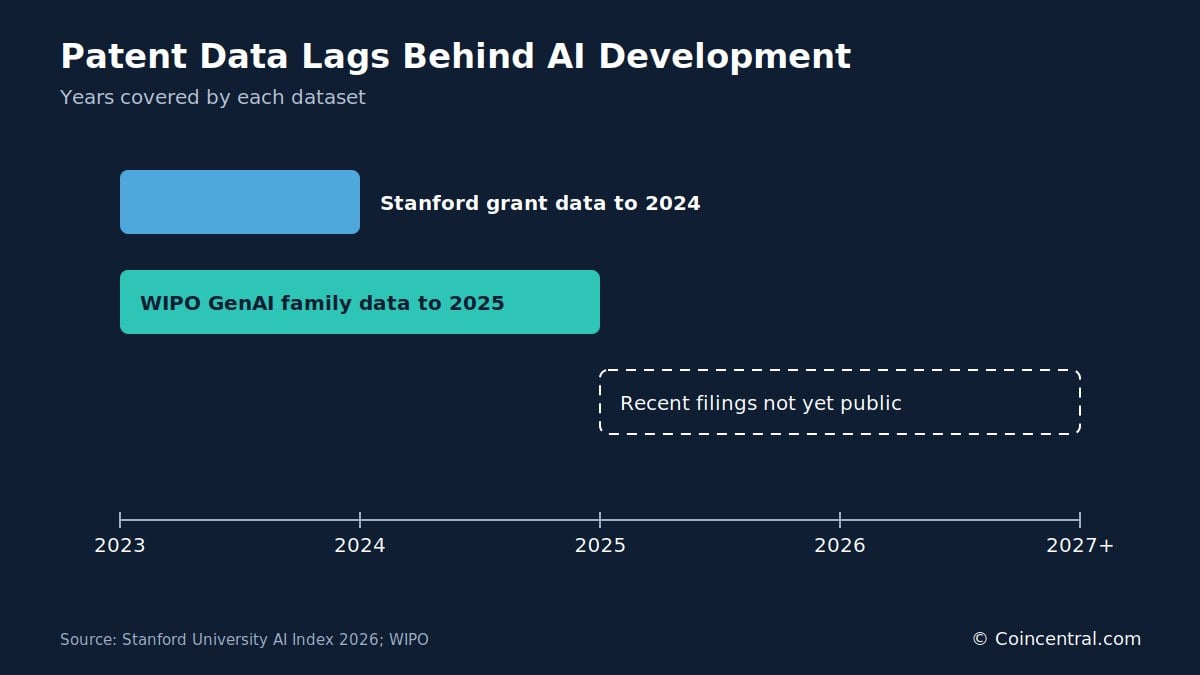
Data arrives late too. Stanford’s most complete grant data ends in 2024, while WIPO’s GenAI family data runs through 2025. Applications are usually published after a delay, so today’s inventions may not show up until 2027 or later.
Stanford and WIPO also use different methods, so their figures should be read side by side rather than added together. Treat them as two views of the same trend.
| Dataset | What it counts | Data through |
|---|---|---|
| Stanford AI Index | Granted AI patents | 2024 |
| WIPO GenAI update | Published GenAI patent families | 2025 |
The Bottom Line
AI patent grants rose from 3,866 in 2010 to 131,121 in 2024. China holds about 74.2% of grants, and the United States holds 12.1%. The United States receives more than half of forward citations.
GenAI families grew from about 14,000 in 2023 to more than 37,800 in 2025. China published more than 43,000 families in 2024 and 2025. U.S. growth was about 92% a year and Japan’s about 210%.
SoftBank is the largest GenAI patent owner with about 2,985 families, ahead of Tencent, Ping An and Baidu. Large language models now lead the technology mix, with about 14,100 families in 2025.
All figures above come from Stanford and WIPO data. Readers who want exact counts should check the original reports, since each dataset uses its own definitions and update schedule.
Patent counts cannot decide who wins the AI race. They do show where companies and countries expect valuable technology to come from.
Sources
- Stanford University: 2026 AI Index Report, Research and Development
- World Intellectual Property Organization: Patent Trends Update in GenAI, 2026
- WIPO: GenAI Innovation Soaring, With Patent Activity Nearly Tripling in Two Years
- WIPO: Global Patenting Trends in Generative AI
- WIPO: Top Generative AI Patent Trends in 2025
- WIPO: Patent Landscape Report: Generative Artificial Intelligence
- Stanford University: 2025 AI Index Report
- WIPO: Patent Cooperation Treaty Yearly Review 2026
The post AI Patent Statistics 2026: Countries, Companies and Growth appeared first on Blockonomi.
This articles is written by : Nermeen Nabil Khear Abdelmalak
All rights reserved to : USAGOLDMIES . www.usagoldmines.com
You can Enjoy surfing our website categories and read more content in many fields you may like .
Why USAGoldMines ?
USAGoldMines is a comprehensive website offering the latest in financial, crypto, and technical news. With specialized sections for each category, it provides readers with up-to-date market insights, investment trends, and technological advancements, making it a valuable resource for investors and enthusiasts in the fast-paced financial world.