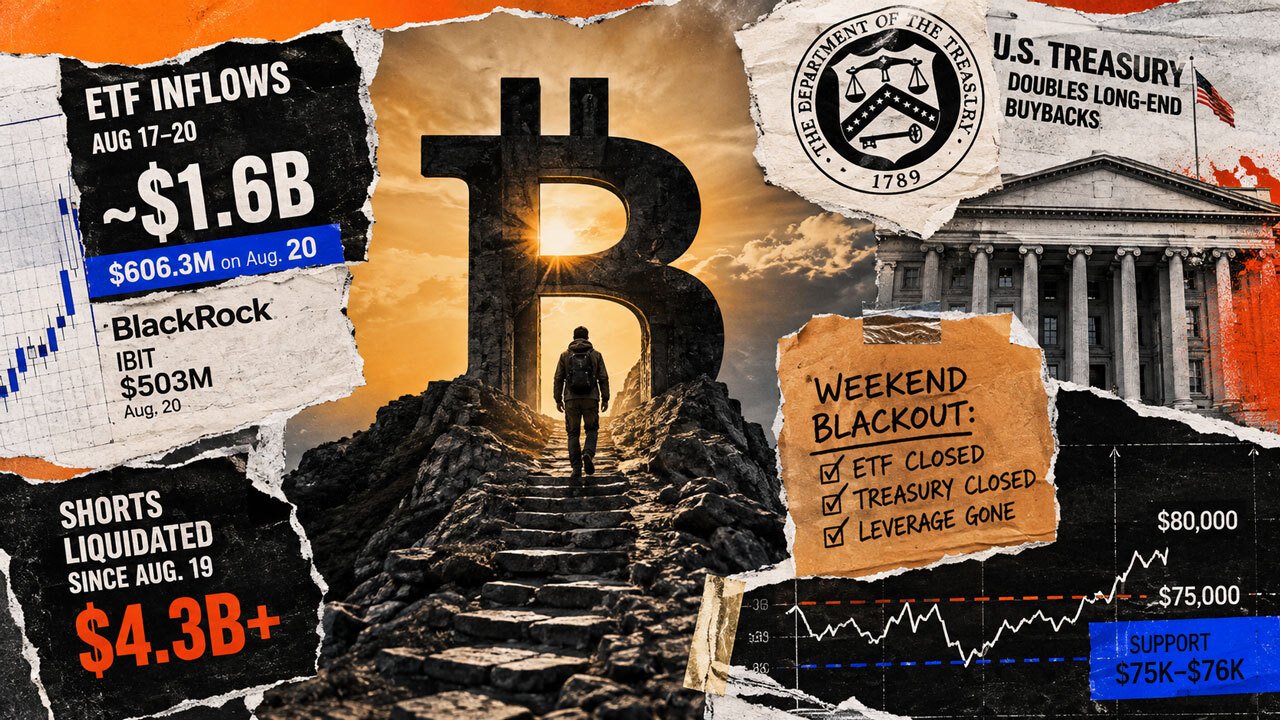
Bitcoin enters the weekend within striking distance of $80,000, registering an intraday high at $79,500 on Aug. 21.
The move caps the biggest weekly rally in two years, built on a rare combination. A surprise Treasury intervention, roughly $1.6 billion of spot ETF inflows, and billions of dollars in forced short liquidations all landed together.
That combination is also what makes the next two days a genuine test. ETF trading stops until Monday, Treasury markets close, and much of the leveraged short positioning that fueled the squeeze has already been forced out.
What remains once those three mechanical supports pause is Bitcoin’s native market structure, running on its own through a weekend most other markets sit out.
| Rally force | What happened this week | Weekend status | Why it matters |
|---|---|---|---|
| Spot Bitcoin ETF demand | ~$1.6B inflows from Aug. 17–20; $606.3M on Aug. 20 | Paused until Monday | Removes the clearest Wall Street demand channel |
| Short liquidations | $4.3B+ crypto shorts reportedly liquidated since Aug. 19 | Fades as shorts are forced out | Forced buying is finite |
| Treasury / macro repricing | Treasury doubled long-end buybacks after 30-year yield hit ~5.33% | Treasury markets closed | Bitcoin becomes the live macro outlet |
| Native BTC market | Trades 24/7 | Fully active | Weekend price action reveals real spot demand |
Wall Street bought Bitcoin, then the channel closed
US-traded spot Bitcoin ETFs took in about $1.6 billion between Aug. 17 and Aug. 20, including $606.3 million on Aug. 20 alone, the largest single-day inflow since May. BlackRock’s IBIT captured roughly $503 million of that Aug. 20 total, about 83% of the day’s net demand.
That flow supports the case that genuine buying demand showed up this week. It also creates the weekend’s central problem, since the channel that absorbed most of this week’s demand goes dark until Monday, leaving Bitcoin to hold its gains without the tool that built them.
Bitfinex analysts framed the rally as resting on three legs: steady accumulation through a volatile stretch, seller exhaustion, and a macro turn doing most of the work.
Bitcoin climbed roughly 11% on the week while open interest rose only around 4%, with funding rates staying close to neutral the entire time.
That gap points to something specific, since rallies built on fresh leverage typically show open interest climbing in step with price. Bitfinex analysts said:
“Price climbed 10% to 11% while open interest rose only around 4%, which points to spot buying and short covering doing the work, with leverage playing a minor role.”
The setup’s weaker version, where open interest stacks up while price stalls, describes a different market than the one that showed up this week.
More than $4.3 billion of crypto shorts have reportedly been liquidated since Aug. 19, citing CoinGlass data, with over $3.1 billion of that concentrated across Aug. 19 and 20. That forced-buying impulse cleared resistance fast, but it is also finite.
Once those positions close, the market needs fresh spot demand or genuine seller exhaustion to keep extending, which the weekend will now reveal.
| Indicator | This week’s signal | Bullish read | Bearish warning sign |
|---|---|---|---|
| BTC price | +10% to +11% | Strong repricing | Overextension if buyers disappear |
| Open interest | +~4% | Leverage did not chase price aggressively | OI surges while price stalls |
| Funding | Close to neutral | No punishing long/short imbalance | Funding spikes as late longs enter |
| ETF flows | ~$1.6B in four sessions | Real spot demand returned | ETF channel unavailable over weekend |
| Coinbase Premium | Approaching positive | US spot buyers may be returning | Premium fails to turn positive |
Why modest buying could still move the market a long way
Twenty One Capital CEO Raphael Zagury explained in a note why Bitcoin can keep climbing even without another massive ETF session behind it. His framing centers on where price gets set:
“Market capitalization is not liquidity. Price is set at the margin.”
He argued that when new demand shows up just as willing sellers thin out, years of pent-up frustration can reprice within days.
Bitcoin’s roughly $1.6 trillion market cap remains less than 5% of gold’s estimated value, and he said that Bitcoin does not need to replace gold, real estate or bonds outright. It only needs to capture a fraction of the monetary premium already embedded in them for the math to become large on its own.
Sygnum CIO Fabian Dori supplies the macro translation behind this week’s move. The Treasury’s decision to double its buybacks of long-dated government debt aimed to calm a bond market where borrowing costs had been climbing on debt and inflation worries. The 30-year yield had just touched roughly 5.33%, its highest level in 19 years.
Dori said the action sits entirely with Treasury debt management, which falls short of money printing in the traditional sense since it never touches the Federal Reserve’s balance sheet.
He argued that the signal still counts, because managing the cost of US debt has become an active policy priority, and that alone can revive the currency-debasement narrative that pulls capital toward scarce assets.
Gold rose to a more than three-month high and climbed over 5% on the week, with silver gaining alongside it. That is evidence capital was rotating broadly into non-sovereign stores of value, with Bitcoin as one part of that wider move.
Dori also points to two dates worth tracking past the weekend. The expanded Treasury buyback program begins Sept. 9, and the Senate’s procedural vote on the CLARITY Act is scheduled to ripen Sept. 15.
That vote would open floor debate, short of passing the bill outright, a positive signal without being a definitive one.
Bitcoin levels that decide which story is true
Bitcoin has already pushed through the $74,000 to $75,000 zone that Bitfinex flagged as resistance, turning that range into the weekend’s primary support.
Holding $75,800 to $75,000 would mean former resistance has genuinely become support. Losing it would mean the rally is giving back the structural ground that made the breakout credible in the first place.
Above the current price, $80,000 comes down to sustained acceptance above it, since Bitcoin has already traded above $79,000 and a brief wick would prove little. A confirmed break opens $82,000 as the next clean test.
Below the reclaimed support, the $68,000 to $69,000 zone that Bitfinex ties to short-term holder cost basis remains a real level, functioning as a deeper invalidation zone well outside the plausible weekend range.
A rally this size has pushed a large volume of Bitcoin into profit. Bitfinex warns that supply hitting exchanges could produce the year’s biggest profit-taking wave if sellers move faster than buyers can absorb them.
The market has eaten that supply so far, and continued absorption alongside steady ETF demand keeps the picture net positive.
The most credible external risk sits entirely outside crypto. Brent crude settled above $94 Friday as Iran-related tensions flared again, and with traditional markets closed until Monday, any serious escalation around the Strait of Hormuz would probably hit crypto’s 24/7 market first.
| Scenario | What must happen | Key BTC levels | What it would prove |
|---|---|---|---|
| Bull case | BTC holds $76k–$78k, funding stays neutral, Coinbase Premium turns positive | Break and acceptance above $80k; target $82k | Seller shortage was real |
| Base case | Profit-taking is absorbed but BTC fails to clear $80k | $75.8k–$80k range | Healthy consolidation after a major rally |
| Bear case | BTC rejects $80k while OI/funding rise and sellers accelerate | Loss of $75.8k–$75k | Squeeze may have manufactured the shortage |
| Tail risk | Iran/Hormuz escalation hits while TradFi is closed | Levels become secondary | Crypto prices macro shock first |
Whether the shortage was real or manufactured
The bull case has Bitcoin holding $76,000 to $78,000 through the weekend, funding staying neutral, open interest refusing to chase price, and Coinbase’s premium turning positive as US spot buyers keep participating.
In that scenario, acceptance above $80,000 becomes the marker that the squeeze exposed a genuine shortage of willing sellers, with $82,000 as the next test.
The bear case has Bitcoin rejecting $80,000 while open interest and funding climb even as price stalls, a sign of late leverage chasing a move it did not create.
Under that path, profitable coins hitting exchanges faster than demand can absorb them pushes Bitcoin back below $75,800. A loss of that zone would suggest the shortage of sellers was at least partly manufactured by the liquidations themselves.
If Bitcoin survives the weekend near its highs and ETF inflows resume Monday, the case for a genuine repricing gets meaningfully stronger heading into September’s buyback expansion and the CLARITY Act’s procedural vote.
The post Bitcoin hits $80,000’s doorstep just as the ETF bid disappears for the weekend appeared first on CryptoSlate.
This articles is written by : Nermeen Nabil Khear Abdelmalak
All rights reserved to : USAGOLDMIES . www.usagoldmines.com
You can Enjoy surfing our website categories and read more content in many fields you may like .
Why USAGoldMines ?
USAGoldMines is a comprehensive website offering the latest in financial, crypto, and technical news. With specialized sections for each category, it provides readers with up-to-date market insights, investment trends, and technological advancements, making it a valuable resource for investors and enthusiasts in the fast-paced financial world.