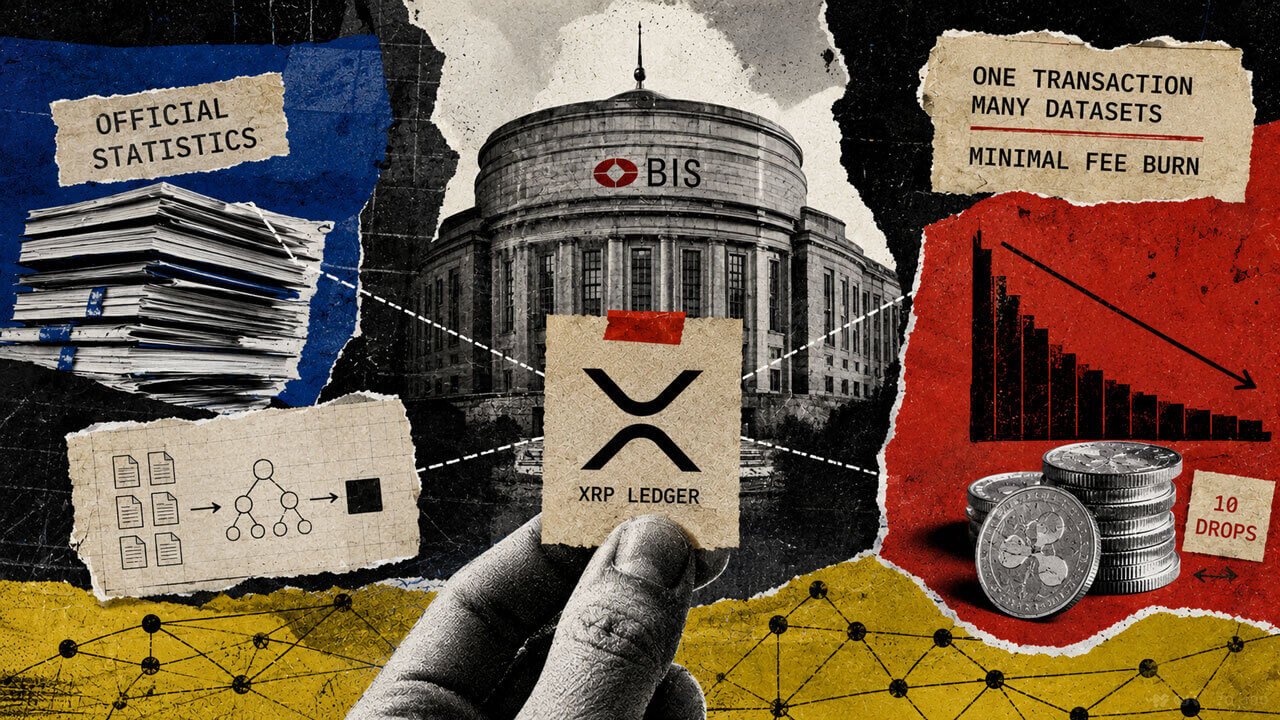
The Bank for International Settlements released a working paper on Sept. 2 describing a prototype for checking the authenticity of official statistics. The system turns a statistical file into a cryptographic fingerprint, anchors a summary of those fingerprints on XRP Ledger, and lets a recipient compare the file with the public record.
The result creates a split verdict for XRP. The prototype gives XRPL a credible institutional-style use case, while its batching design keeps the direct fee-burn pathway mechanically small. One ledger transaction can represent thousands of datasets, so useful activity can scale much faster than the number of transactions consuming XRP.
The research first appeared online through SAGE on Aug. 1; Sept. 2 marks its release as BIS Working Paper 1374. The paper presents the authors’ views and says its references to firms and projects are illustrative. Its implementation remains an experimental XRPL DevNet proof of concept, and the reviewed sources disclose no commercial relationship with Ripple.
How the authentication system works
Official statistics commonly travel in SDMX, a standard for exchanging statistical data and metadata. The prototype normalizes an SDMX file and applies SHA3-512 hashing to the whole file or to individual data series. It then combines those fingerprints in a Merkle tree, a structure that compresses a large group of records into one summary value called a root.
The root is written into the memo field of an XRPL transaction. Underlying statistics and the prototype’s operational stores and proofs stay off-chain. The returned SDMX file embeds the transaction reference, ordered fingerprints, and a signed verifiable credential, giving a recipient the material needed to rebuild the root and compare it with the ledger.
XRPL therefore serves as a timestamped public notary for the commitment. It does not serve as the database holding the economic figures. The open-source implementation describes itself as experimental, unsuitable for production, and unmaintained.
The authors selected XRPL for low nominal fees, fast consensus finality, and accessible developer resources. They also made the blockchain interface replaceable, so another ledger could perform the same anchoring role. That design choice makes the prototype evidence for the authentication method and for XRPL’s ability to host it, rather than evidence that the method depends on XRP Ledger.
Performance results came from a single developer workstation connected to XRPL DevNet and using a synthetic SDMX corpus. In those controlled tests, median publication latency was three to five seconds and verification took one to two seconds. The evaluation excluded sustained Mainnet load, an enterprise firewall, hardware-security-module-backed signing, and adversarial conditions. DevNet uses test XRP with no real-world value, so the run produced technical measurements instead of live token demand.
Those boundaries still leave a meaningful result. A statistical publisher could provide an independent integrity check without exposing confidential data on a public ledger. The economic trade-off appears in the same mechanism: Merkle batching reduces the number of on-chain commitments needed to authenticate a large body of information.
The XRP value-capture math
XRPL’s standard transaction cost normally starts at 10 drops, equal to 0.00001 XRP. When a transaction enters a validated ledger, its fee is destroyed. Network load can raise the cost, and special transaction types can carry different minimums, but the BIS paper uses 10 drops as its base case.
The fee scales with anchoring transactions, while dataset volume can be compressed into batches. The following arithmetic illustrates the gap under a constant 10-drop minimum and standard transactions:
| Activity pattern | Anchoring transactions | XRP burned |
|---|---|---|
| 1 million datasets, batched 1,000 per anchor | 1,000 | 0.01 XRP |
| 1 million individual anchors | 1,000,000 | 10 XRP |
| 1 anchor per minute for 365 days | 525,600 | 5.256 XRP |
| 1 anchor per second for 365 days | 31,536,000 | 315.36 XRP |
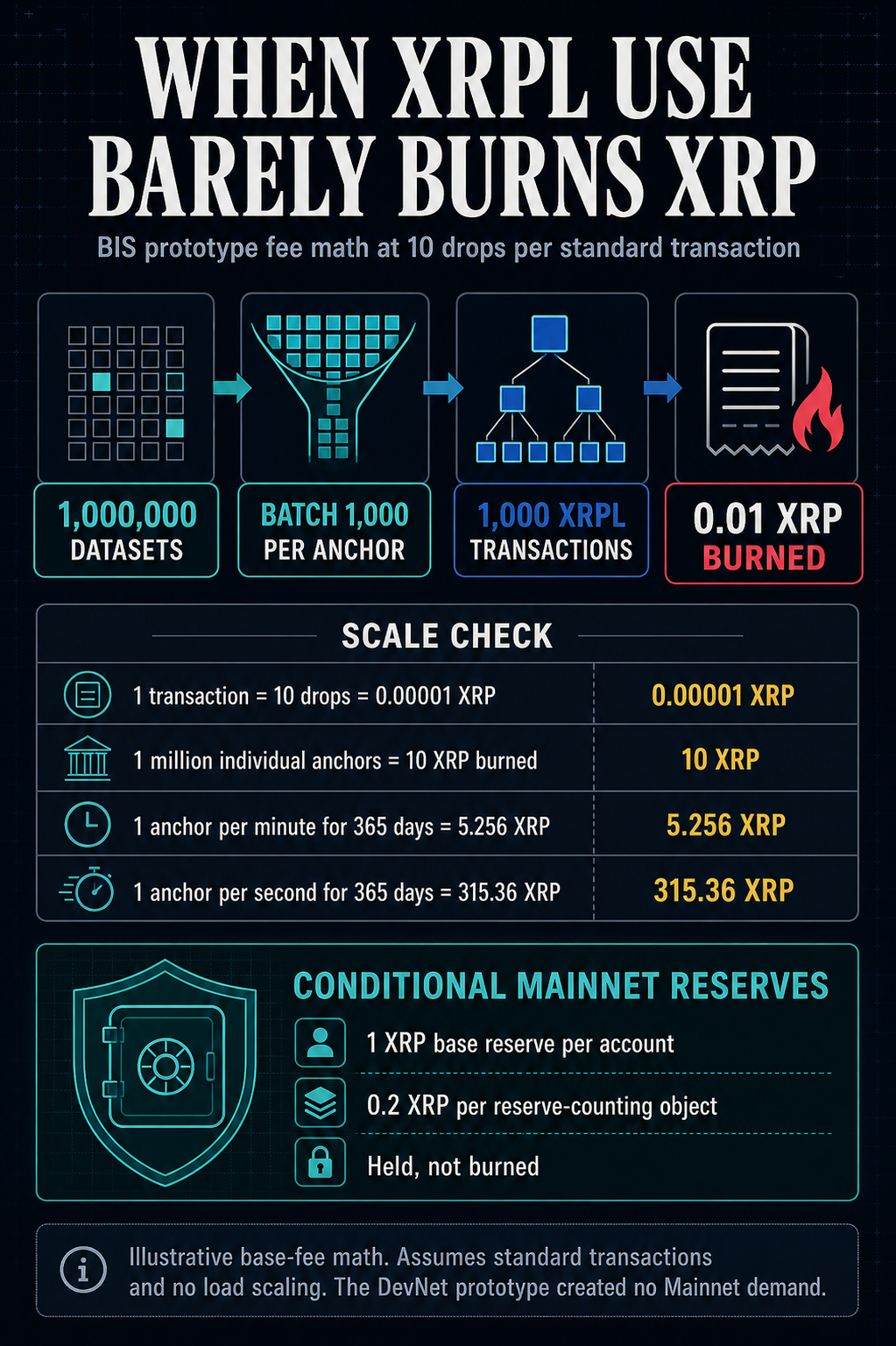
These are scale illustrations, not deployment forecasts. Actual burn would reflect how frequently publishers submit anchors, how many datasets they batch, prevailing network load, and the transaction type. The DevNet prototype generated none of this Mainnet demand.
The paper’s cost model points in the same direction. It assumes a 10-drop fee and an illustrative price of $0.30 per XRP, which is a model input rather than a current quote. With a batch size of 1,000, the authors calculate an on-chain cost of $0.000000003 per dataset. Above roughly 50 items per batch, processing and raw storage dominate the chain and proof-storage costs in their examples.
Urgent releases can favor smaller batches because waiting for more datasets creates delay. Even then, the paper says XRPL’s low nominal fee bounds the penalty. For XRP holders, this means production cadence matters more than the headline number of files or series authenticated.
Mainnet reserves create a second, conditional pathway. Under current XRPL reserve rules, each address must hold a 1 XRP base reserve, with another 0.2 XRP for every reserve-counting ledger object. The network holds those balances as prefunding; ordinary transaction fees are the XRP that gets destroyed.
Reserve demand grows when a deployment needs new accounts or ledger objects. A dataset does not carry its own reserve requirement, and repeated memo anchoring from an existing account does not lock another 1 XRP each time. Validator voting can also change the reserve levels. Production usage could therefore increase held XRP across many new institutional accounts, but the effect depends on deployment architecture rather than dataset throughput.
The paper supports a narrow value-capture conclusion. XRP would supply the fees and reserves for a Mainnet version, while Merkle batching deliberately compresses the recurring fee flow. Under the paper’s assumptions and current fee mechanics, the direct burn channel stays small even as authenticated data volume rises.
XRP’s market price can still respond to expectations, liquidity, and activity elsewhere on the network. Those forces sit outside this prototype. The BIS work establishes XRPL as a viable low-cost authentication layer under controlled conditions; material token demand would require sustained anchoring cadence, broad account creation, or other XRP-centered activity that the experiment did not demonstrate.
The post BIS shows why real institutional adoption on XRP Ledger won’t trigger the XRP supply squeeze holders expect appeared first on CryptoSlate.
One transaction can authenticate thousands of datasets, leaving fee burn tiny even as institutional-style usage scales.
The post BIS shows why real institutional adoption on XRP Ledger won’t trigger the XRP supply squeeze holders expect appeared first on CryptoSlate. Featured, Research, Ripple, xrp
This articles is written by : Nermeen Nabil Khear Abdelmalak
All rights reserved to : USAGOLDMIES . www.usagoldmines.com
You can Enjoy surfing our website categories and read more content in many fields you may like .
Why USAGoldMines ?
USAGoldMines is a comprehensive website offering the latest in financial, crypto, and technical news. With specialized sections for each category, it provides readers with up-to-date market insights, investment trends, and technological advancements, making it a valuable resource for investors and enthusiasts in the fast-paced financial world.