Meta released Muse Spark 1.3 on September 2 with two pricing tiers.
Developers who let Meta train on their prompts and outputs pay as little as one-twenty-first of the standard rate.
Muse Spark’s cached tokens drop 75x
A million input tokens run for $1.25, and a million output tokens run for $4.25 on the standard plan. The Contributor tier reduces those to 10 cents and 20 cents, a savings averaging about 95%.
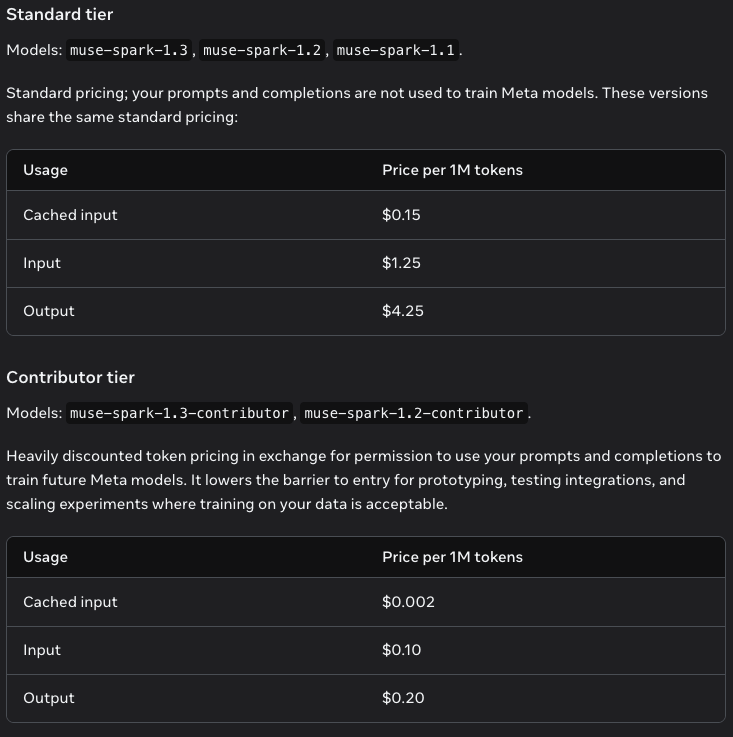
The biggest discount is on cached input tokens, which allows developers to reuse context without paying for reprocessing. Those fall from $0.15 to $0.002 per million, a 75x cut that’s close to free for repeated workflows to run.
In return, developers surrender control of their data. All prompts, responses, and usage patterns on the Contributor tier are included in Meta’s training pipeline.
The standard plan lets users make 3,000 requests per minute, but Contributor access only lets users make 100 RPM. This is too few requests for production-scale functionality.
Meta paused internal employee tracking program
Meta Superintelligence Labs, the division behind the Muse Spark line, built these models to fill a specific hole.
Facebook, Instagram, and WhatsApp yield a torrent of conversational and visual data. However, they yield very little of the quality coding interactions that agentic tools need to improve.
Mario Zechner, the developer behind the open-source harness Pi, said the increase in coding agent capability from April to October 2025 was mainly because Claude Code stored user sessions by default and fed them into reinforcement learning training.
Meta has had a hard time sourcing the material itself. A program inside the company that tracked how employees used their computers came under heavy critique and was put on hold in June.
Arvind Narayanan, a computer science professor at Princeton, pointed out that big firms stick with token-billed enterprise plans even when consumer subscriptions like Claude Max and ChatGPT Pro cost 10 to 20 times less, because the enterprise plans keep their data out of training runs.
Narayanan suggested the Meta offer could make those companies more cautious in differentiating between proprietary data and data they’d happily swap for a discount.
“It lowers the barrier to entry for prototyping, testing integrations, and scaling experiments where training on your data is acceptable,” Meta’s pricing guide says about the Contributor tier.
Meta experimented with the two-tier structure in Muse Spark 1.2 in August 2026. Muse Spark 1.3 features a 1 million-token context window, which can accommodate ~750,000 words in a single session, and claims to necessitate fewer tool calls to complete complex tasks compared to its predecessors.
Anthropic brought down the cost of cached tokens for its new Fable and Mythos models, while at the end of July, OpenAI lowered prices for all of its latest models.
OpenAI gets training data from its free ChatGPT tier users, while Anthropic has stricter rules about data.
The smartest crypto minds already read our newsletter. Want in? Join them.
This articles is written by : Nermeen Nabil Khear Abdelmalak
All rights reserved to : USAGOLDMIES . www.usagoldmines.com
You can Enjoy surfing our website categories and read more content in many fields you may like .
Why USAGoldMines ?
USAGoldMines is a comprehensive website offering the latest in financial, crypto, and technical news. With specialized sections for each category, it provides readers with up-to-date market insights, investment trends, and technological advancements, making it a valuable resource for investors and enthusiasts in the fast-paced financial world.