Most countries tax crypto profits. The rate depends on where you live, how long you held the asset and how much else you earn.
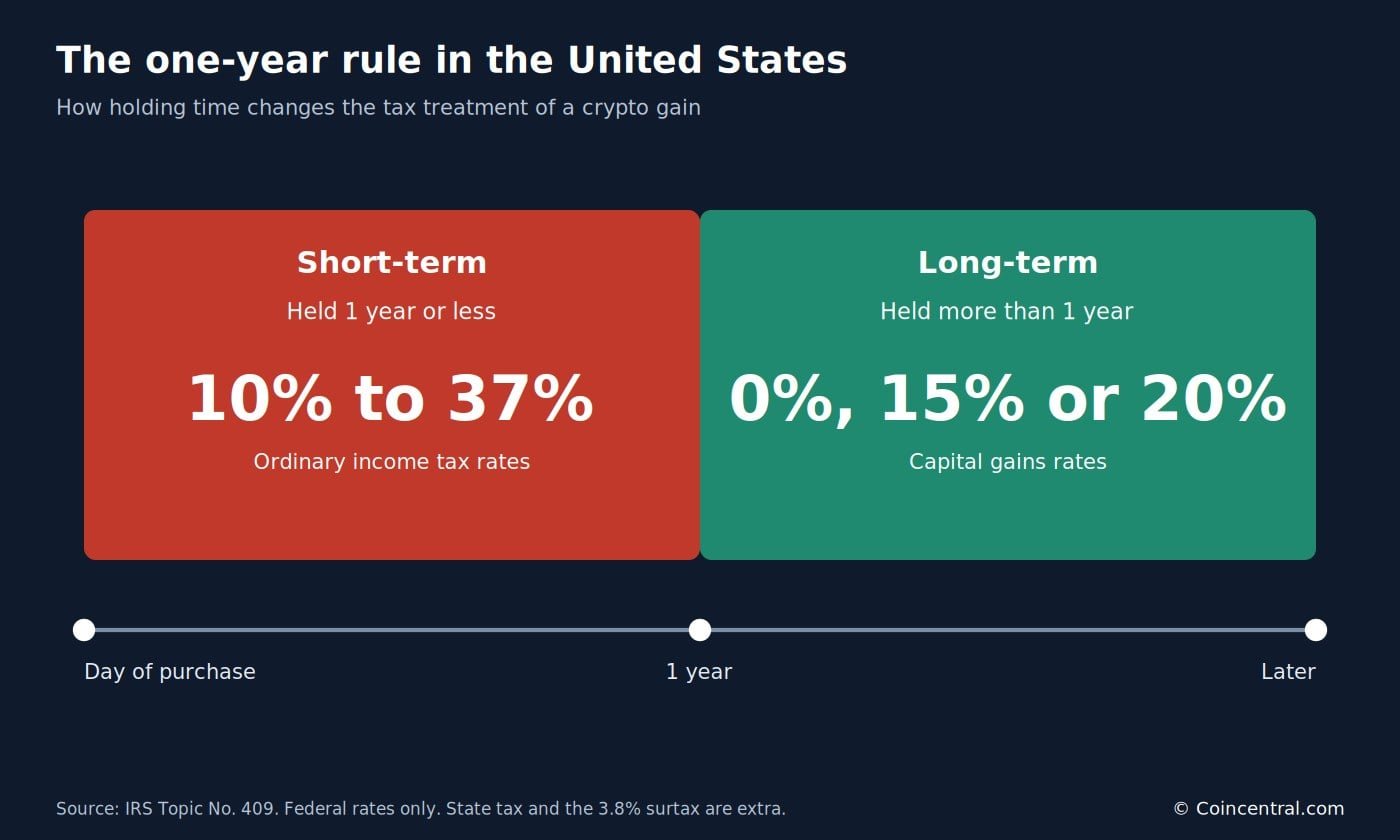
In the United States, a long-term gain is taxed at 0%, 15% or 20%. A short-term gain is taxed as ordinary income, at rates from 10% to 37%. In the United Kingdom, gains above a £3,000 yearly allowance are taxed at 18% or 24%.
This article uses rules published by tax authorities, mainly the IRS and HMRC. US figures are for the 2025 tax year. UK rates are those in force since 30 October 2024.
Rates and thresholds change, so check current numbers before you file. The examples below are illustrations built on stated assumptions. This is general information, not tax advice.
How Crypto Profits Are Taxed: The Basic Rules
In the United States, the IRS treats crypto as property, not as money. It set out this view in Notice 2014-21. That means the same rules that apply to selling a stock or a piece of land apply to selling a coin.
You owe tax on the profit, not on the full sale. The profit is the sale value minus your cost basis. Cost basis is what you paid for the coin, including fees.
Say you buy one coin for $20,000 and sell it for $30,000. Your gain is $10,000. That $10,000 is what gets taxed.
A tax event happens when you dispose of crypto. Many people think only a sale for cash counts. In fact, several common actions are taxable, as the table shows.
| Action | US tax treatment |
|---|---|
| Selling crypto for cash | Taxable. Capital gain or loss. |
| Swapping one coin for another | Taxable. Treated as a sale and a new purchase. |
| Spending crypto on goods or services | Taxable. Gain or loss based on value at the time. |
| Buying crypto with cash | Not taxable on its own. |
| Moving crypto between your own wallets | Not taxable. |
| Receiving mining, staking or airdrop rewards | Taxable as income when received. |
| Giving crypto as a gift | Generally not taxable to the giver. Gift tax rules may apply to large gifts. |
Cost basis gets harder when you buy the same coin at different prices. You need a method to decide which units you sold. The IRS lets you pick specific units if you keep records that identify them, and otherwise it uses first in, first out.
The UK uses pooling instead. Coins of the same type go into one pool with an average cost. Special rules apply to coins bought on the same day as a sale or within 30 days after it.
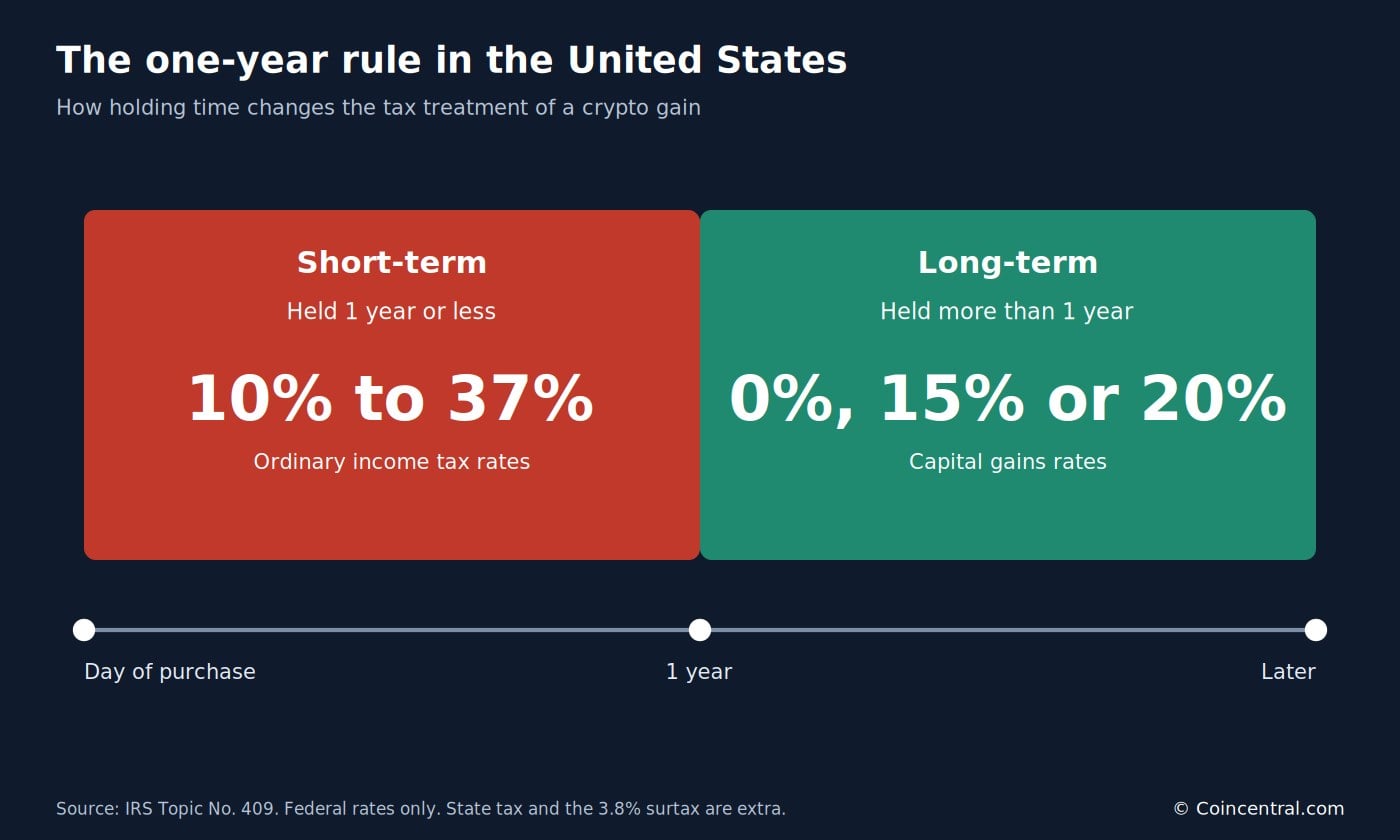
How long you hold the asset also matters. In the US, a gain on an asset held for one year or less is short-term. A gain on an asset held for more than one year is long-term.
This single rule can change the tax bill by a large amount. Long-term gains get lower rates than short-term gains for most taxpayers.
The UK uses a similar idea but with a different structure. HMRC treats most crypto as a capital gains asset for individuals. Selling, swapping, spending and gifting (except to a spouse or civil partner) are all disposals.
The UK has no short-term and long-term split. Instead, it gives each person a yearly tax-free allowance and taxes the rest at flat rates based on income.
US Capital Gains Rates for the 2025 Tax Year
US long-term gains are taxed at three federal rates: 0%, 15% and 20%. Which one applies depends on your taxable income, including the gain itself. The IRS sets the thresholds each year.
| Rate | Single filer taxable income | Married filing jointly taxable income |
|---|---|---|
| 0% | Up to $48,350 | Up to $96,700 |
| 15% | $48,351 to $533,400 | $96,701 to $600,050 |
| 20% | Above $533,400 | Above $600,050 |
The brackets work on taxable income, not on the gain alone. Your gain stacks on top of your other income. A person with $30,000 of taxable income and a $10,000 gain ends the year at $40,000, which is still in the 0% band.
Counting the days matters. The holding period starts the day after you acquire the asset. Selling a day too early can move a gain from the long-term rate to the short-term rate.
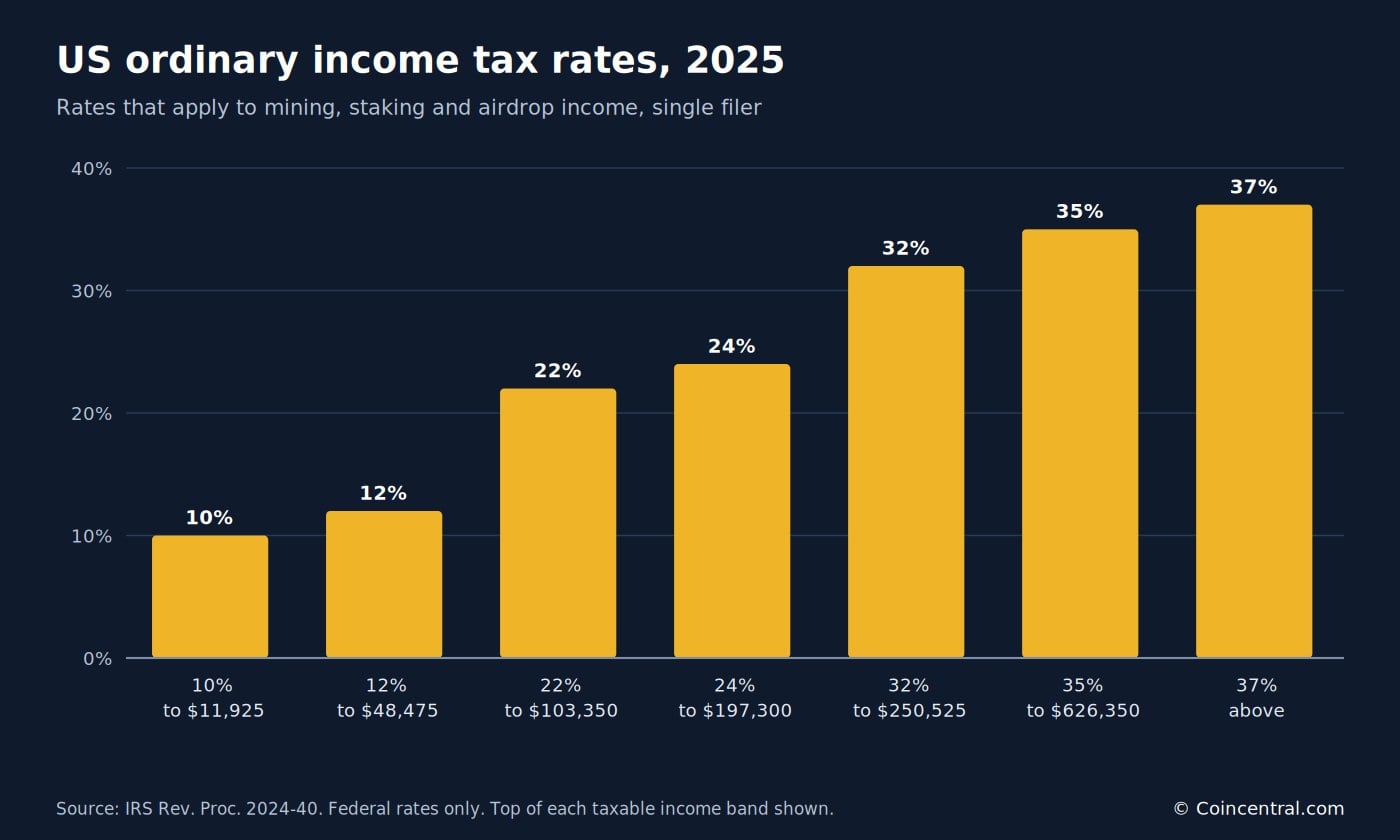
Short-term gains are taxed at the same rates as wages. For 2025, those rates run from 10% to 37%. Figure 2 compares the two for a single filer at six income levels.
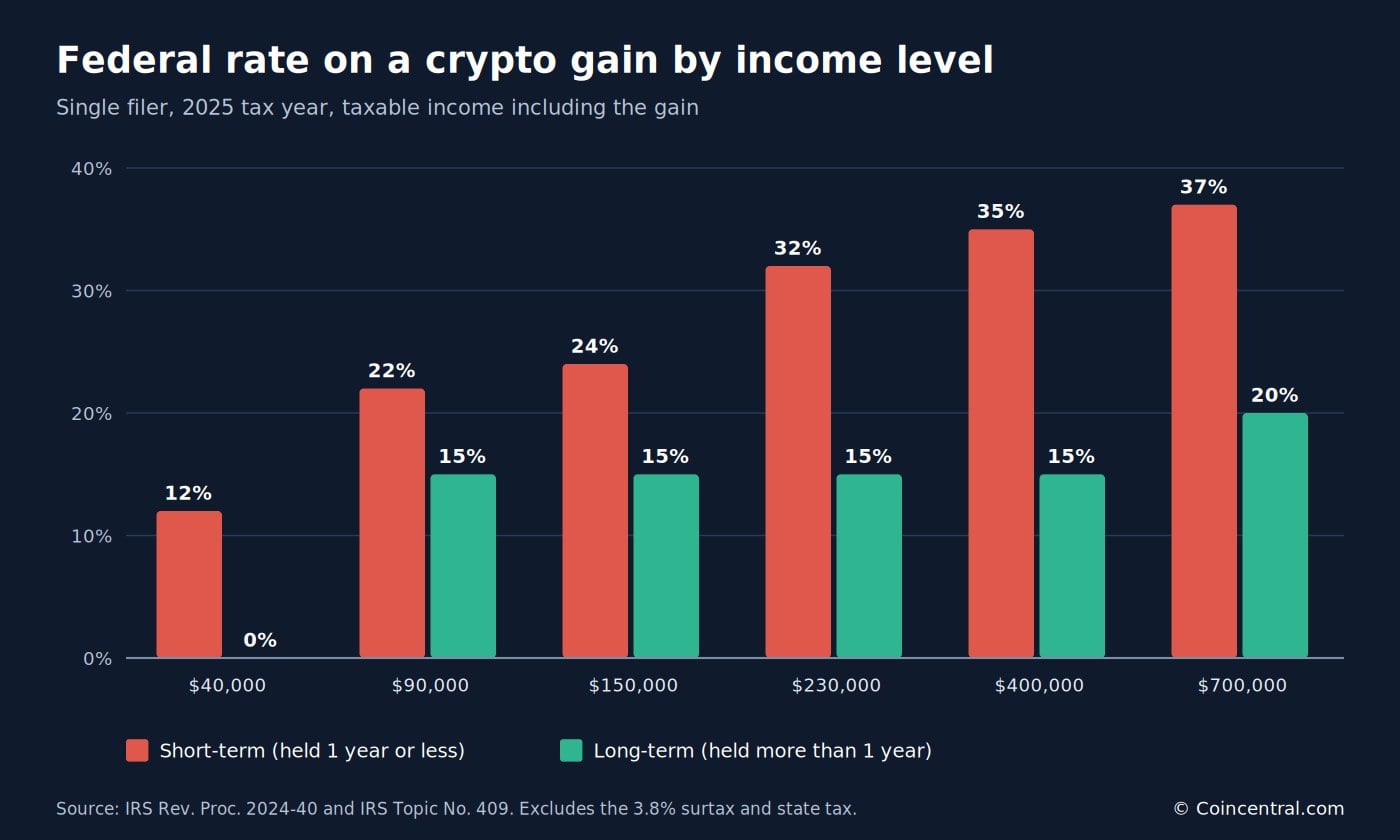
The gap is widest in the middle and upper ranges. At $150,000 of taxable income, the short-term rate is 24% and the long-term rate is 15%. That is a nine-point difference.
Higher earners may also owe the 3.8% net investment income tax. It applies when modified adjusted gross income is above $200,000 for single filers or $250,000 for joint filers. A single filer in the top long-term bracket can face a combined federal rate of 23.8%.
State tax is extra in most places. Some states have no income tax, while others tax crypto gains as regular income. Check your own state rules.
Inflation adjustments mean the thresholds rise each year. The figures above are for 2025. Figures for 2026 are higher, so use the current IRS tables when you file.
Worked Examples: What a $10,000 Gain Costs
Numbers are easier to follow with cases. Each example below uses a $10,000 gain, or £10,000 for the UK cases. They show how the same profit can lead to very different bills.
| Case | Assumptions | Tax owed | Share of gain |
|---|---|---|---|
| US short-term | Single filer, $90,000 taxable income before the gain, held 6 months | $2,200 (22%) | 22% |
| US long-term | Same filer, held 18 months | $1,500 (15%) | 15% |
| US long-term, lower income | Single filer, $30,000 taxable income before the gain, held 18 months | $0 (0%) | 0% |
| UK basic-rate taxpayer | £3,000 allowance leaves £7,000 taxable, all within the basic-rate band | £1,260 (18%) | 12.6% |
| UK higher-rate taxpayer | £3,000 allowance leaves £7,000 taxed at 24% | £1,680 (24%) | 16.8% |
| Germany, held over 1 year | Private sale of crypto held more than one year | €0 | 0% |
The first two rows show the effect of holding time. Waiting past the one-year mark cut the US bill from $2,200 to $1,500. That is a saving of $700 on the same profit.
The third row shows the 0% band at work. A lower-income filer can sell a long-term gain and owe no federal capital gains tax. State tax and other rules may still apply.
The UK rows show the effect of the yearly allowance. The first £3,000 of gains is tax-free, so the share of the gain that is taxed is lower than the headline rate. A higher-rate taxpayer pays 24% on £7,000, which is 16.8% of the full £10,000.
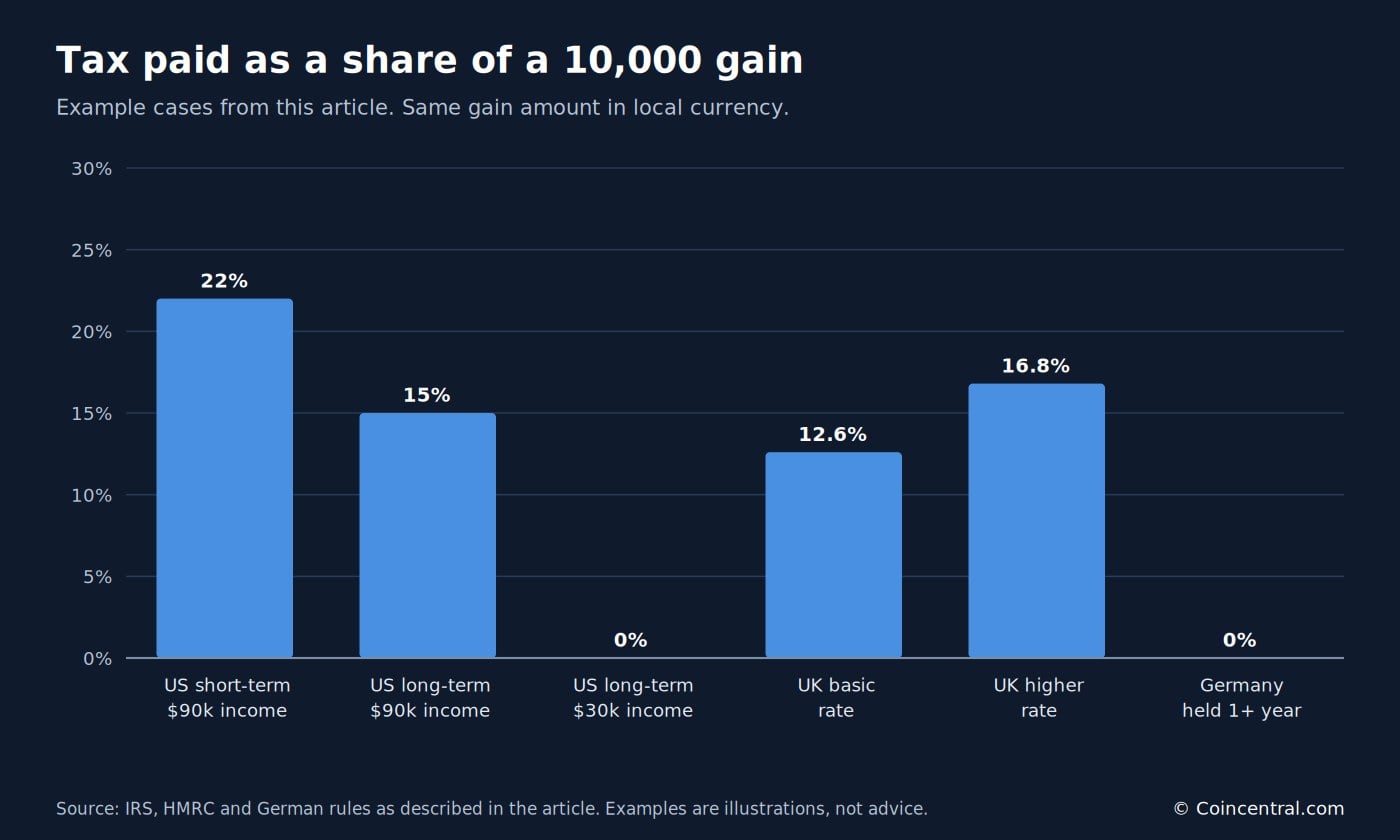
Germany is a different model. Private sales of crypto held for more than one year are generally free of income tax. Gains on assets held for a year or less are taxed as income, though total gains from private sales under €1,000 a year are exempt.
Fees can lower the gain. Trading fees and network fees may be added to your cost basis or subtracted from your proceeds, depending on the transaction. That makes careful records worth the effort.
These examples leave out fees, state taxes and other income that could change the result. They also assume a single sale. Real tax bills depend on the full year of activity.
Tax on Mining, Staking and Airdrops
Not all crypto income comes from selling. Mining, staking and airdrops can create income when you receive the coins. In the US, that income is taxed at ordinary rates, not capital gains rates.
The amount counted is the fair market value of the coins when you gain control of them. The IRS confirmed this for staking rewards in Revenue Ruling 2023-14. It covered airdrops and certain forks in Revenue Ruling 2019-24.
Those ordinary rates are the same rates that apply to wages. Figure 4 shows the 2025 federal rates for a single filer.
Mining may also trigger self-employment tax if it is run as a business. That tax covers Social Security and Medicare contributions. It is separate from income tax.
There is a second step. The value counted as income becomes your cost basis. If you later sell the coins, you report a capital gain or loss on any change from that basis.
Here is an example. You receive staking rewards worth $1,500 when they arrive. You report $1,500 as income. Later you sell them for $2,000, so you also report a $500 gain.
The UK treats these cases in a similar way. HMRC guidance says rewards such as staking and some airdrops can be taxed as income, depending on the facts. Selling those coins later can then create a capital gain.
Timing of receipt can be a point of dispute. Tax authorities look at when you have control over the coins, not when the network records the reward. Keep a log of the date and price for every reward you receive.
Canada works differently again. The Canada Revenue Agency says half of a capital gain is included in income. Frequent traders may be taxed on all profits as business income, so the activity matters.
Losses, Reporting and Record Keeping
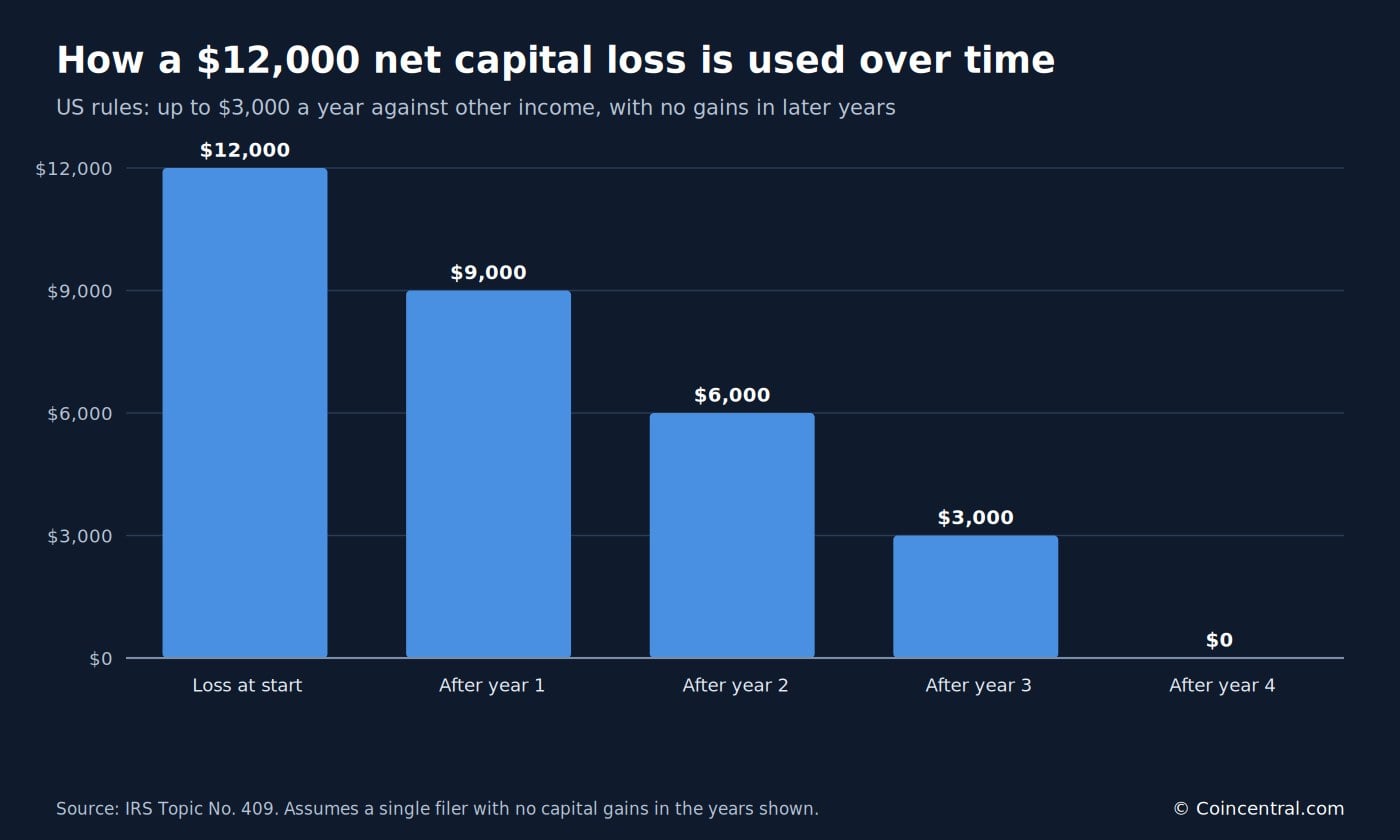
Crypto losses can reduce your tax bill. In the US, capital losses first offset capital gains. If losses are larger than gains, up to $3,000 of the excess can reduce other income each year.
Any remaining loss carries forward to later years. There is no time limit on the carryforward. Figure 5 shows how a $12,000 net loss would be used if you had no gains in the following years.
A loss can also cancel a gain. Suppose you have a $10,000 long-term gain and a $4,000 long-term loss. You are taxed on $6,000. At a 15% rate, the tax falls from $1,500 to $900.
The wash sale rule bars a loss when you buy the same asset within 30 days before or after the sale. Today it applies to stocks and securities. It does not generally apply to crypto, though lawmakers have proposed changes, so check current law.
Reporting rules are tightening. For US filers, crypto sales are reported on Form 8949 and Schedule D. The main tax form also asks every filer whether they received or disposed of digital assets during the year.
Exchanges are now part of the process. Under new US broker rules, platforms report gross proceeds on Form 1099-DA for 2025 transactions. Cost basis reporting for covered assets begins with transactions in 2026.
The UK has its own thresholds. You must report disposals if your gains are above £3,000. You must also report if your total sale proceeds are above £50,000, even when you made no gain.
Losses in the UK must be reported to HMRC within four years of the end of the tax year to be carried forward. Missing that step can cost you the loss.
Data sharing is growing across borders. The OECD built the Crypto-Asset Reporting Framework so tax authorities can exchange information about crypto accounts. The European Union applies its own version, known as DAC8, from 1 January 2026.
Good records are the best defense. Keep the date, amount, price in local currency and fees for every transaction. Also keep wallet addresses and exchange statements, since tax authorities can ask for them.
How Other Countries Tax Crypto Gains
Countries use very different models. Some tax crypto gains like income. Some give relief for long holding periods. A few do not tax individual gains at all.
| Country | How gains are taxed | Key rule |
|---|---|---|
| United States | Capital gains for long-term, ordinary income for short-term | Rates from 0% to 37%, plus a possible 3.8% surtax |
| United Kingdom | Capital gains tax | 18% or 24% above a £3,000 yearly allowance |
| Canada | Half of a gain is included in taxable income | Taxed at your marginal rate, federal and provincial |
| Australia | Capital gains added to income | 50% discount for individuals who hold for 12 months or more |
| Germany | Private sales taxed as income if held a year or less | Generally tax-free after one year, with a €1,000 exemption on short-term gains |
| Portugal | Short-term gains taxed at a flat rate | 28% on gains from assets held less than 365 days, with long-term gains generally exempt |
| Singapore | No capital gains tax for individuals | Income from crypto trading as a business may still be taxed |
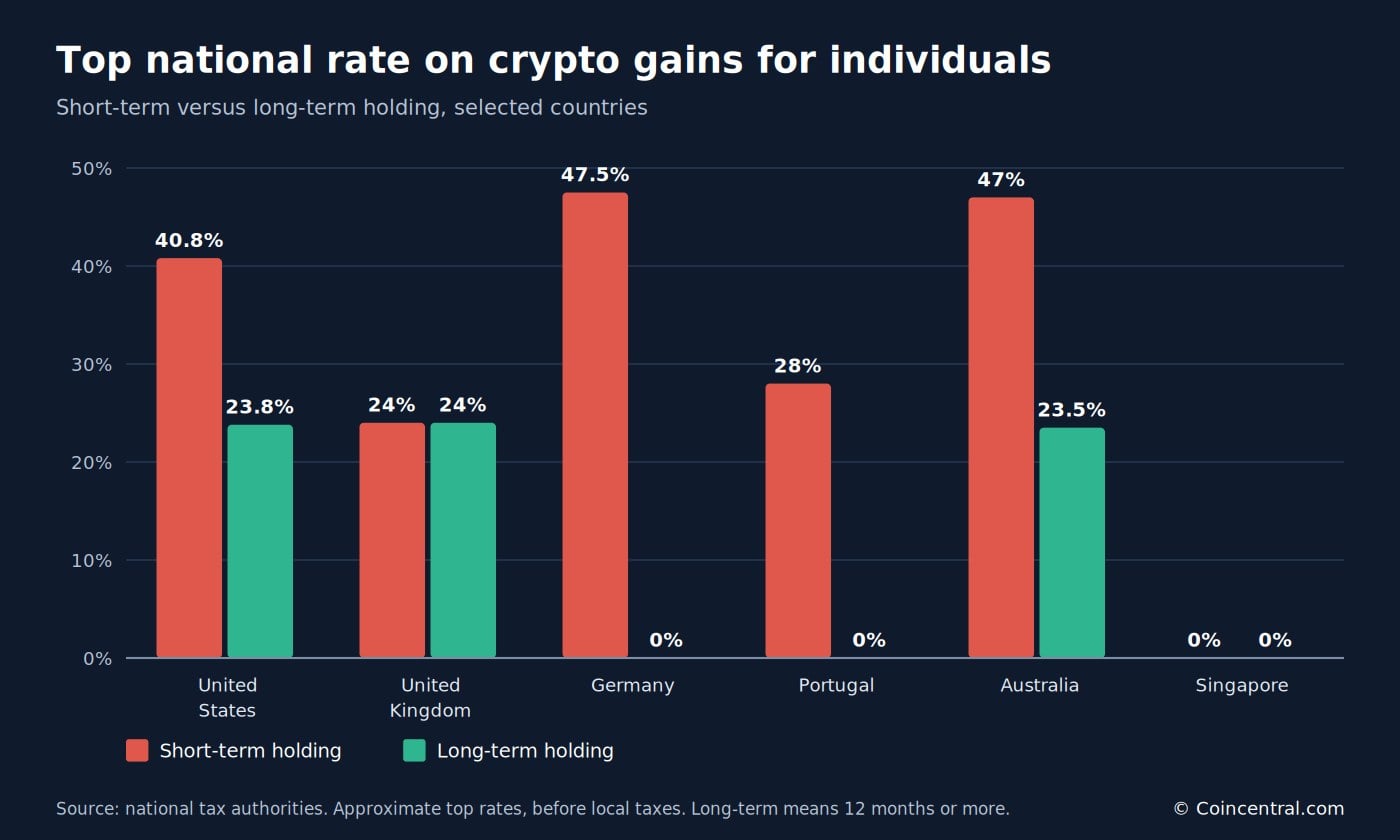
Australia is a clear example of a holding-period discount. The Australian Taxation Office says an individual who holds an asset for 12 months or more can reduce the gain by half. With a top marginal rate of 45% plus a 2% Medicare levy, that works out to about 23.5% on the discounted gain.
Germany and Portugal go further. Both generally exempt long-held crypto gains for individuals, though both tax short-term gains. Singapore does not tax individual capital gains, which is why it is often named as a low-tax option.
Figure 6 compares top national rates for short-term and long-term holdings. The chart uses approximate top rates for individuals before local taxes. Real bills depend on income, deductions and local rules.
Canada sits between these models. Only half of a capital gain is taxable, and that half is taxed at your normal rate. The Canada Revenue Agency also says the rules can differ if crypto activity looks like a business.
Moving to a low-tax country is not a simple fix. Tax residency rules look at where you live and spend your time, not where you hold an exchange account. Many countries also tax their citizens or former residents on certain gains.
Rules are also changing quickly. New reporting standards mean exchanges send more data to tax authorities. Treat any country summary as a starting point and confirm the details with the local tax authority.
Bottom Line
There is no single tax rate on crypto profits. In the US, the bill ranges from 0% to 37% federally, depending on income and holding time. In the UK, it is 18% or 24% after a £3,000 allowance.
Holding period and income level drive most of the difference. A $10,000 US gain cost $2,200 as a short-term gain and $1,500 as a long-term gain in our example. A lower-income filer owed nothing federally.
Using a tax calculator or software can help with large numbers of trades. The result is only as good as the data that goes in. Always check that imported exchange records match your own.
Swaps, spending and rewards can all create tax, even without a cash sale. Reporting is also getting stricter, with exchange reports and cross-border data sharing now in place or on the way.
The practical steps are simple. Keep full records, know your holding periods, report losses properly and check current thresholds each year. For large or complex cases, talk to a qualified tax professional.
Sources
- IRS: Digital assets
- IRS Notice 2014-21: Virtual currency guidance
- IRS Revenue Ruling 2019-24: Hard forks and airdrops
- IRS Revenue Ruling 2023-14: Staking rewards
- IRS Revenue Procedure 2024-40: 2025 inflation adjustments
- IRS Topic No. 409: Capital gains and losses
- IRS Topic No. 559: Net investment income tax
- IRS: About Form 1099-DA, Digital Asset Proceeds From Broker Transactions
- GOV.UK: Tax on cryptoassets for individuals (HMRC)
- GOV.UK: Capital Gains Tax rates and allowances
- Australian Taxation Office: Crypto asset investments
- Canada Revenue Agency: Guide for cryptocurrency users and tax professionals
- OECD: Crypto-Asset Reporting Framework and amendments to the Common Reporting Standard
The post How Much Tax Do You Pay on Cryptocurrency Profits? appeared first on Blockonomi.
This articles is written by : Nermeen Nabil Khear Abdelmalak
All rights reserved to : USAGOLDMIES . www.usagoldmines.com
You can Enjoy surfing our website categories and read more content in many fields you may like .
Why USAGoldMines ?
USAGoldMines is a comprehensive website offering the latest in financial, crypto, and technical news. With specialized sections for each category, it provides readers with up-to-date market insights, investment trends, and technological advancements, making it a valuable resource for investors and enthusiasts in the fast-paced financial world.