
NVIDIA CEO Jensen Huang has dismissed allegations that the semiconductor company is subsidizing its own AI demand, saying the company’s investments are immaterial when compared with the business they help create. At the Goldman Sachs Communacopia + Technology Conference, Huang dismissed the theory that the growing investment ecosystem of NVIDIA constitutes circular finance.
Huang’s defense moves the debate on to bigger issue: as chipmakers, cloud companies and AI labs keep investing in each other, just how much of the demand in today’s world is organic — and how much financial risk is being created?
Why the “funding its own demand” charge sticks
One can read the worry easily. NVIDIA is investing in either an AI firm or a cloud computing company; that firm then buys certain NVIDIA hardware, and the revenue flows back to NVIDIA. This is not to say that the demand is not real, but the distinction between an investment and a sale becomes blurry.
One can read the worry easily. NVIDIA is investing in either an AI firm or a cloud computing company; this results in that firm purchasing certain NVIDIA hardware, bringing revenue back to NVIDIA. This is not to say that the demand is not real, but the distinction between an investment and a sale becomes blurry.
The companies in question include OpenAI and CoreWeave. NVIDIA is both a partner and investor in OpenAI. At the same time, CoreWeave is using the infrastructure provided by NVIDIA and is supported by NVIDIA. Cryptopolitan previously reported Huang’s opinion that NVIDIA does not use the money of its investments to sustain its customers’ business rather, it evaluates each investment on its own merits.
Where NVIDIA’s money actually flows
While the figures involved sound impressive, they refer to different types of investments. In January, NVIDIA put $2 billion into CoreWeave Class A shares at $87.20 per share and stated that it would also be working with CoreWeave to build more than 5 gigawatts of AI factories by 2030.
Then OpenAI put together the announcement of $110 billion in investments with a pre-money valuation of $730 billion. That includes $30 billion from NVIDIA, $30 billion from SoftBank, and $50 billion from Amazon.
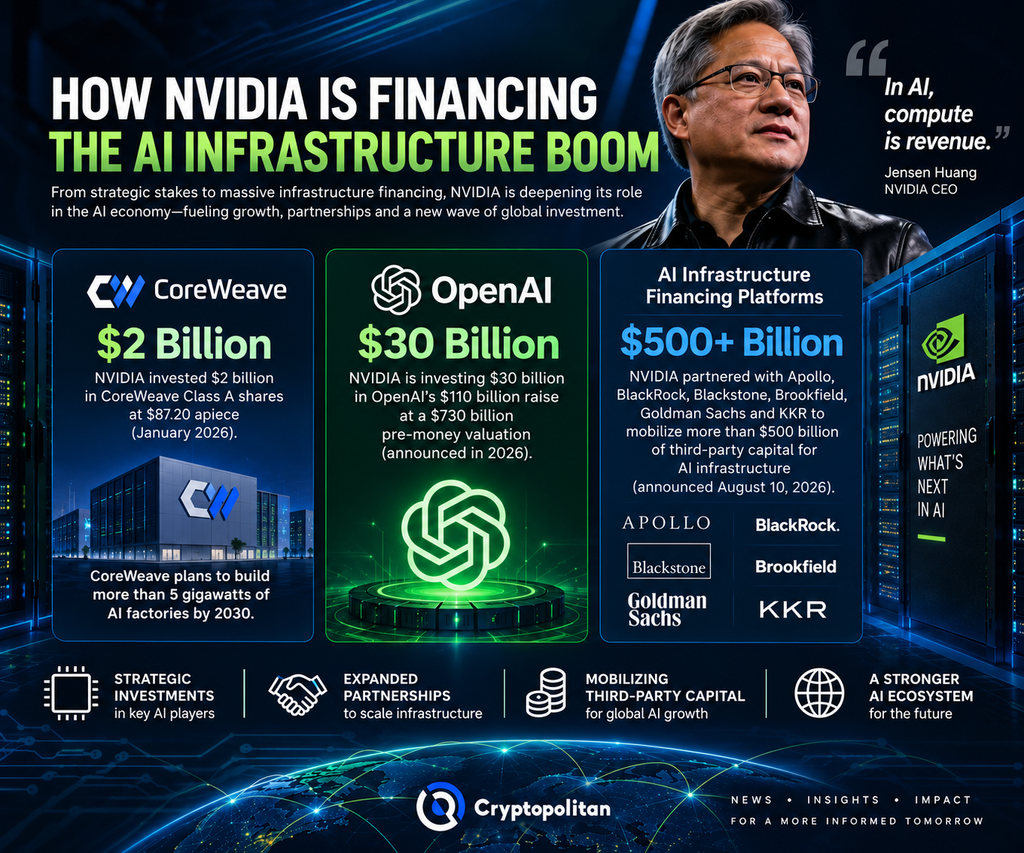
After that, NVIDIA expanded beyond direct investments in shares. On August 10, the company teamed up with Apollo, BlackRock, Blackstone, Brookfield, Goldman Sachs, and KKR to create platforms aimed at mobilizing more than $500 billion in third-party capital for AI infrastructure. Note that this is a target for raising financing, not NVIDIA making the commitment of $500 billion.
“In AI, compute is revenue.” — Jensen Huang, NVIDIA CEO
Huang emphasized that GPUs have turned to be productive assets that can generate regular compute revenues instead of being regarded as hardware purchases. In addition, NVIDIA’s quarterly SEC documents proved the importance of customer concentration: the three direct customers made up 16%, 15%, and 13% of the revenues of the first half of the fiscal 2027 year.
Regulators start naming the loop
People are concerned not just about the investors anymore. The IMF revealed in its report released in April that investments in AI could face some difficulty in downturns and that many companies that make up the entire value chain of AI investments are increasingly making use of circular financing. However, the financial stability impact at this moment has been described as insignificant at the current stage.
Concerns expressed by BIS on September 10 have pointed to increased usage of debt and private credit for financing the capital outlays for AI projects. In case the returns are not aligned, the current investment boom is likely to result in a much bigger financial crisis.
Due to the size of the sector, it is not surprising that NVIDIA’s financing model has drawn attention. According to estimates from S&P Global, the five largest hyperscalers may spend an additional $5.3 trillion in capital expenditures until 2030. In addition, the 2026 AI Index from Stanford University estimates that global AI compute capacity has gone up to 17.1 million H100-equivalents, with NVIDIA being responsible for more than 60% of the total.
The debate predates the latest denial
Huang has been narrowing expectations for months. In February, referring to earlier discussions of an OpenAI investment of up to $100 billion, he said:
“It was never a commitment.” — Jensen Huang, NVIDIA CEO
He added that NVIDIA would invest “one step at a time,” as Cryptopolitan reported.
The differentiation is important beyond just NVIDIA. In the case where end-user demand supports the infrastructure at play that is currently financed, this could lead to an accelerated evolution of AI. On the other hand, if financing, orders, and valuations go hand in hand too fast compared to revenues, the consequence could mean trouble for the semiconductor industry, cloud companies, data centers, and any startups working with AI. This is the risk that markets are facing now.
Don’t just read crypto news. Understand it. Subscribe to our newsletter. It’s free.
This articles is written by : Nermeen Nabil Khear Abdelmalak
All rights reserved to : USAGOLDMIES . www.usagoldmines.com
You can Enjoy surfing our website categories and read more content in many fields you may like .
Why USAGoldMines ?
USAGoldMines is a comprehensive website offering the latest in financial, crypto, and technical news. With specialized sections for each category, it provides readers with up-to-date market insights, investment trends, and technological advancements, making it a valuable resource for investors and enthusiasts in the fast-paced financial world.