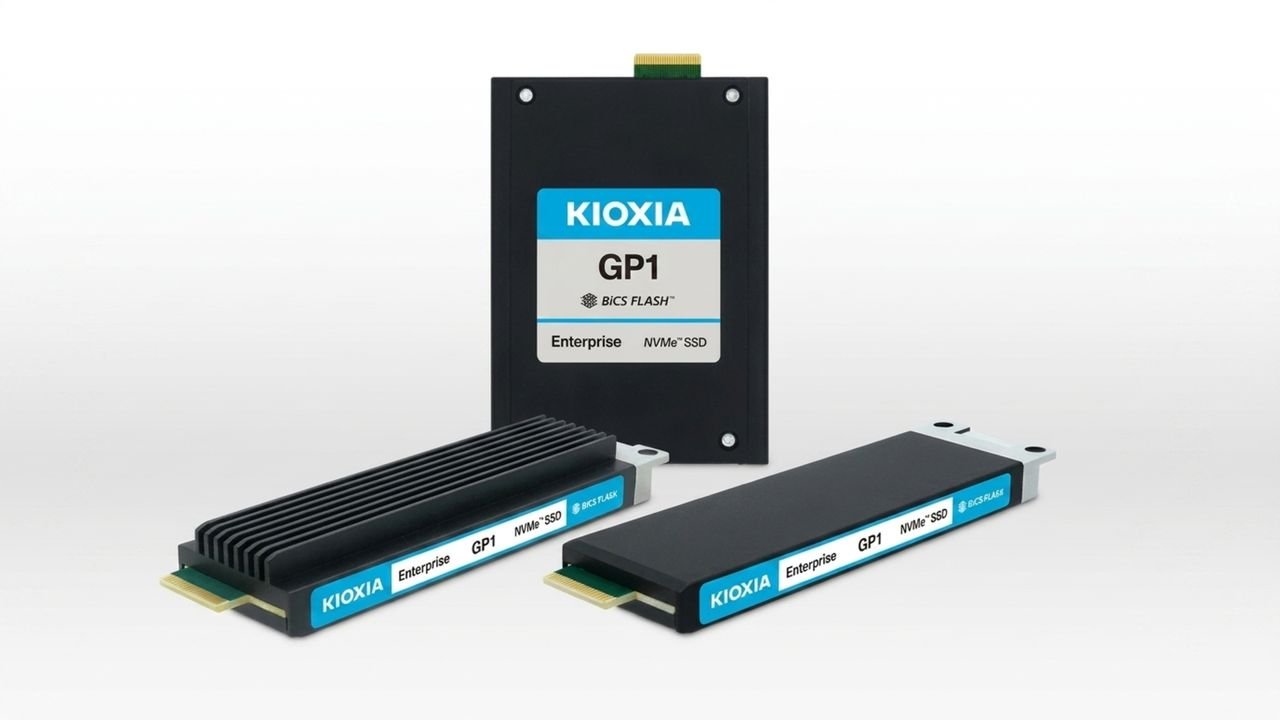
- Kioxia’s GP1 reaches 10 million IOPS using PCIe 6.0 and XL-FLASH technology
- Its 50 DWPD rating indicates substantial endurance for sustained enterprise workloads
- A hypothetical 3TB model could theoretically withstand 109.5 PB written
KIOXIA Europe GmbH has unveiled the GP1 Series, a PCIe 6.0 NVMe SSD engineered for direct GPU access within demanding AI infrastructure — the first product in the KIOXIA GP Series introduced in early 2026.
The drive reaches up to 10 million random read IOPS at a 512-byte block size, using KIOXIA’s XL-FLASH generation 2 flash memory, a type of SLC NAND paired with a new in-house controller.
Built to PCIe 6.0 and NVMe 2.2 specifications, the SSD carries an endurance rating of up to 50 drive writes per day (DWPD).
Why IOPS performance matters
The GP1 Series is intended to support emerging AI storage architectures that extend high-bandwidth memory using a flash-based tier for capacity.
This approach allows AI systems to access considerably larger datasets at a lower cost than continually adding more high-bandwidth memory.
The company states that this method also improves GPU utilization by keeping processing units supplied with data instead of waiting idle.
IOPS measure how many read and write requests a storage device can process every second, directly shaping how quickly GPUs receive fresh data.
In AI training and inference, thousands of parallel operations must move between storage and processing units without introducing costly delays.
Higher IOPS therefore reduce the risk of GPUs sitting idle while waiting for data, which can otherwise limit overall system performance.
KIOXIA’s endurance claims for the GP1 Series offer a further measure of how the drive is positioned for sustained AI workloads.
Assuming a two-year warranty and a 3TB capacity, a 50 DWPD rating would translate into roughly 109.5 PB of total write endurance over that period.
By comparison, Gigabyte’s AI TOP 100E drive claims an endurance rating of 219 PB, equivalent to a full year of continuous writing at maximum speed.
That endurance figure is notable partly because the Gigabyte drive relies on TLC NAND rather than the SLC-based flash found in KIOXIA’s design.
Form factors and industry context
The KIOXIA GP1 Series will ship in E3.S and E1.S form factors, available in both 9.5 mm and 15 mm heights.
These variants support cold-plate liquid cooling on the E3.S and 9.5 mm E1.S options, while every configuration also works in standard air-cooled setups.
Evaluation samples will be available to select customers by the end of 2026, ahead of a showcase at the FMS conference in California.
“The growing performance and memory demands of AI infrastructure require a broader memory hierarchy that can keep GPUs supplied with data efficiently,” said Paul Rowan, Vice President & Chief Marketing Officer at KIOXIA Europe GmbH.
“The KIOXIA GP1 Series enables flash-based memory extension and GPU direct access, helping to reduce latency and CPU overhead while increasing throughput for AI, HPC and data analytics workloads.”
The GP1 Series architecture is designed to scale well beyond current levels, with future generations aiming for as much as 100 million IOPS.
That figure aligns with a target Nvidia has reportedly been pushing SSD manufacturers to pursue for AI infrastructure deployments.
Reaching that goal, however, may ultimately require entirely new categories of memory beyond what exists in current SSD designs.

This articles is written by : Nermeen Nabil Khear Abdelmalak
All rights reserved to : USAGOLDMIES . www.usagoldmines.com
You can Enjoy surfing our website categories and read more content in many fields you may like .
Why USAGoldMines ?
USAGoldMines is a comprehensive website offering the latest in financial, crypto, and technical news. With specialized sections for each category, it provides readers with up-to-date market insights, investment trends, and technological advancements, making it a valuable resource for investors and enthusiasts in the fast-paced financial world.