
- Researchers are developing a tent that could produce its own electricity
- It’s made out of magnetoelastic material
- It’s still in early stages, but scientists intent to use them in off-grid camps and disaster zones
There are plenty of high-tech camping accessories you can get your hands on to spruce up your outdoor vacations — but have you ever thought about a tent that can produce its own electricity? Well, it could be the future of camping.
Researchers have been developing a ‘magnetoelastic’ tent that could generate and harvest its own electricity, kind of like a wind turbine, but one that you sleep in and use to power small devices. I thought I’ve seen my fair share of whacky tech, but this discovery is truly something else.
The tent is made out of a special material with ‘magnetoelasticity’, a textile property that can produce electrical energy from bending and stretching motions, which was first coined by physicist Emilio Villari in 1865. But it relies on fabric layering to harness its electrical production powers.
As mentioned in the Cell Press journal, Matter, the tent’s design consists of a magnetomechanical coupling layer and a magnetic induction layer. This is fused together with weaving patterns, layer stacking, and conductive fiber, allowing the tent to respond to movement.
The tent consists of two different components, one for the flooring and another for the roof. While the tent floor integrates woven fabric embedded with magnetoelastic ribbons, its roof features a layered material made of conductive fibers and magnetoelastic film.
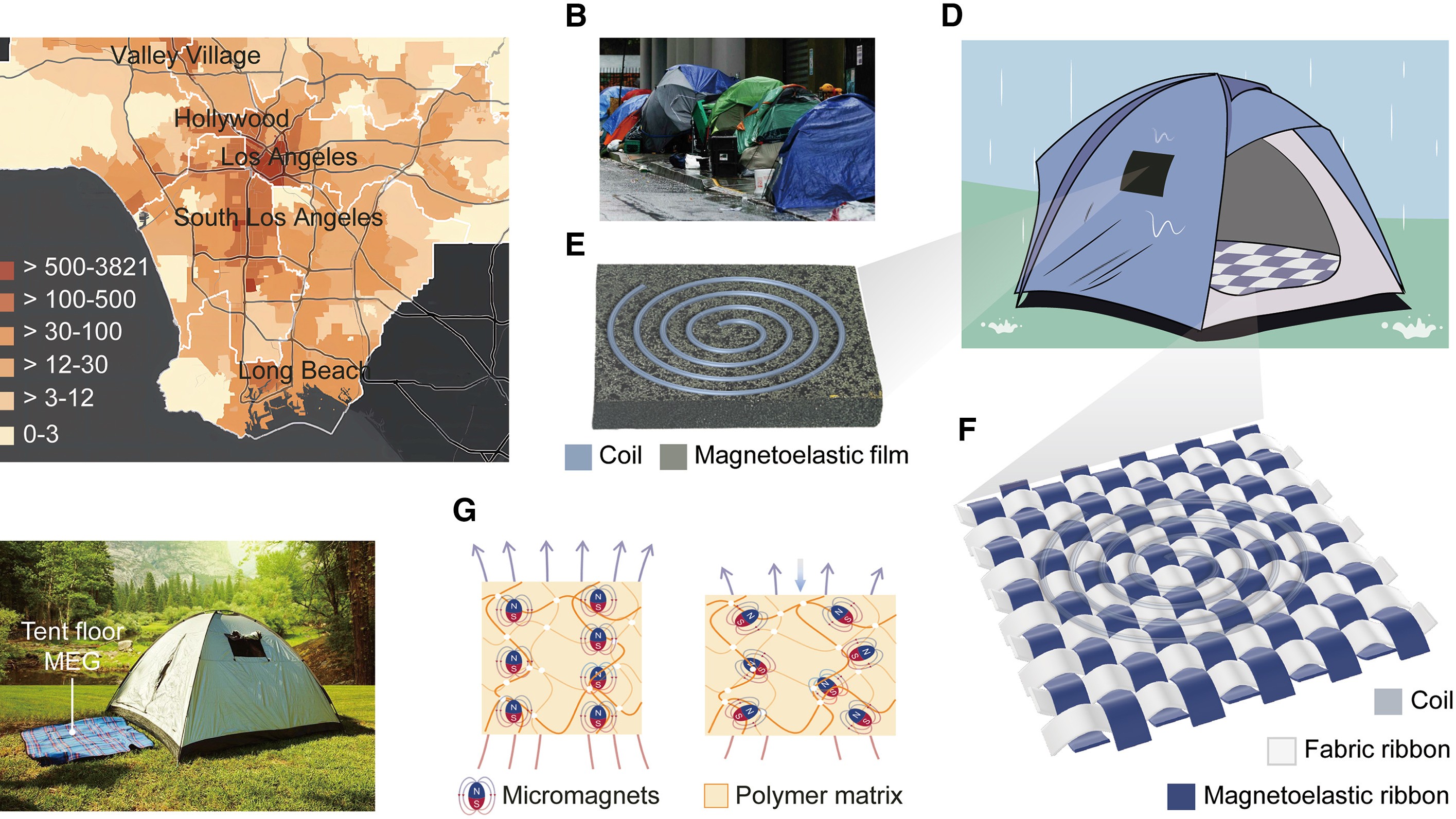
The interesting part is that the material can respond to more than just human movement happening inside the tent — it can absorb action from environmental surroundings, too. Even motions such as wind and movement during the setup can also help — but how?
Essentially, the material’s fabric state shifts when it bends and flexes, converting mechanical movement into electricity through induction. During the testing period, researchers found that hand-tapping a small sample of the material could charge a 0.22-μF capacitor to 5.80V in 1.5 seconds. While this is nowhere near enough to power a smartphone, for example, it shows that the material certainly has potential.
Despite the successful early-stage experiments, there’s still a long way to go before it becomes a fully realized product, but the researchers behind it have a vision.
For them, the tent isn’t intended for leisurely camping trips. Instead, they see it as the ideal opportunity to provide sanctuary in shelters, disaster zones, off-grid camps, and areas where electricity access is limited or relies solely on sunlight.
That’s one of the clever elements of the tent: it doesn’t need the sun to power itself as solar panels do. Motion alone is enough to give the tent the power it needs to create its own source of energy, meaning that it can function in the shade and after sunset.
On paper it’s a genius product, but there are many tests that are yet to come — so don’t expect to score one in time for Glastonbury 2027.
This articles is written by : Nermeen Nabil Khear Abdelmalak
All rights reserved to : USAGOLDMIES . www.usagoldmines.com
You can Enjoy surfing our website categories and read more content in many fields you may like .
Why USAGoldMines ?
USAGoldMines is a comprehensive website offering the latest in financial, crypto, and technical news. With specialized sections for each category, it provides readers with up-to-date market insights, investment trends, and technological advancements, making it a valuable resource for investors and enthusiasts in the fast-paced financial world.