Breaking
Bumble is in advanced talks to go private in a deal worth about $1 billion, Reuters reported on Monday, October 12, 2026. Ithaca Holdings is the prospective buyer. The talks come as Bumble tries to win back users with AI. Neither company has confirmed a deal. Both declined to comment. Still, Bumble shares surged roughly 50% to $3.80 that Monday, their biggest one-day percentage gain on record. A $1 billion price tag for a $14 billion debut Founded by Whitney Wolfe Herd in 2014, Bumble went public in 2021 at a valuation of about $14 billion. Five years later, the proposed price tells a very different story. Paolo Pescatore, an analyst for PP Foresight, said the potential agreement is proof of Bumble’s difficulties, adding that: Going private looks less like a strategic masterstroke and more like an admission that Bumble’s current strategy is failing. The numbers a buyer would inherit Bumble’s Q2 results indicate the reasons for the investors’ concerns. Its revenue declined by 15.2% year-over-year to $210.5 million. The number of paying users also dropped by 16.4% to 3.2 million. Bumble reported a net loss of $127.9 million of which $169.3 million were impairment charges, even though the adjusted EBITDA represented $72.9 million. The slide started earlier. In 2025, the company registered a near 10% drop in revenue that amounted to approximately $966 million, while its paying user base declined by more than 11% to approximately 3.7 million. Bumble Revenue and Paying Users Decline in 2025 and Q2 2026 Industry fatigue, or a Bumble problem Bumble’s competitor, Match Group, appears to be doing better as revenue fell only 1% to $853 million in the second quarter. Meanwhile, net income increased by 36% to $171 million. Tinder also showed signs of improvement. Daily active users dropped by only 4% year-on-year, which was the smallest decline in the last 10 quarters. Hinge’s revenue has increased by 22%. Match aims to bring Hinge’s annual revenue to $1 billion by 2027. Dating-app fatigue remains a challenge. But Match’s results suggest Bumble’s issues range beyond just the users getting bored with swiping. Bumble vs Match Group Q2 2026: Revenue, Profit and User Trends Can AI pull users back, or push them away Bumble hopes its AI-led Bumble 2.0 can change that. The redesign brings richer, chapter-style profiles and the possibility of swipe-free dating. Its March unveiling helped send shares up more than 40%. Wolfe Herd had earlier floated AI dating concierges, as Cryptopolitan reported. Whether users want that help is less clear. A peer-reviewed study suggests confidence in algorithms can encourage AI dating adoption. Yet an SSRN working paper reported 54% fewer usage minutes and 62% fewer app openings among the AI adopters studied. Those findings do not represent all daters. At the same time, less expensive AI will make companion chatbots more attractive than dating apps. However, the use of these chatbots raises privacy and security issues, as noted by the Congressional Research Service. The opportunity remains substantial: Grand View Research estimates a $10.7 billion global dating-app market in 2026, reaching $17.9 billion by 2033. The challenge is converting AI features into users who stay, pay, and trust the platform Micah Abiodun | usagoldmines.com
October 13, 2026

Stablecoin Expansion to Drive the Next Crypto Rally as Market Cap Hits $200B: CryptoQuant Tanzeel Akhtar | usagoldmines.com

Liquidity in the cryptocurrency market has surged, with the total market capitalization of stablecoins recently surpassing $200 billion. This increase has historically preceded price rallies.

According to data from CryptoQuant, stablecoin liquidity has increased since the U.S. presidential election, with major stablecoins like Tether’s USDT and Circle’s USDC leading the expansion.

Market Cap Hits Record High Amid Growing Liquidity

The total value of USD-denominated stablecoins reached an all-time high of $200 billion last week. Since then, it has grown further to $204 billion, representing an increase of $37 billion since November 4.

CryptoQuant reports that this surge in stablecoin liquidity reflects growing investor confidence, which has historically catalyzed crypto market upswings.
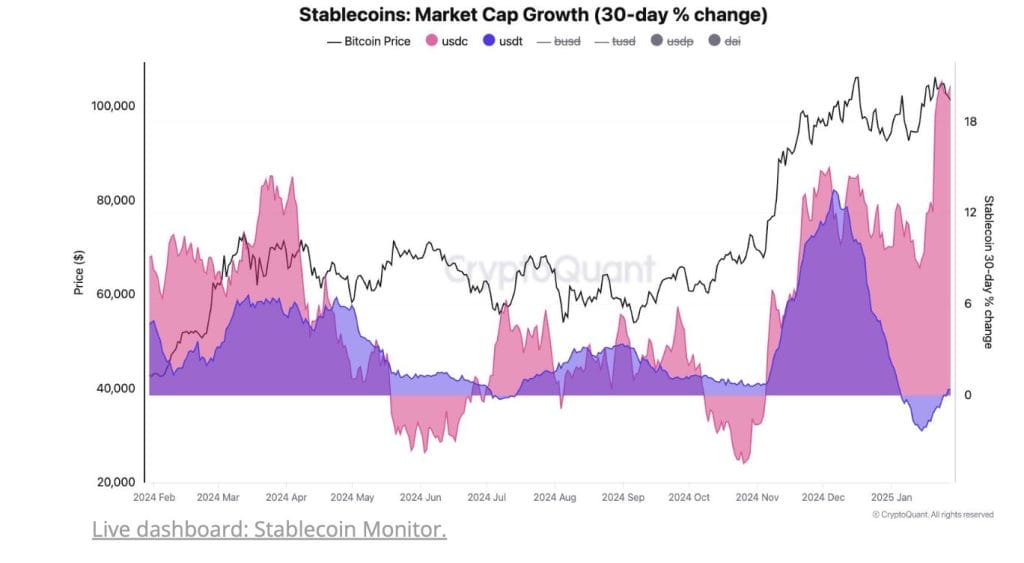
The expansion has been primarily driven by Tether’s USDT, the dominant stablecoin in the market. However, USDC, which had been losing market share, is now regaining traction.

A growing stablecoin supply often indicates increased buying power for traders, fueling demand for cryptocurrencies like Bitcoin and Ethereum.

Another key indicator of market liquidity, according to CryptoQuant, is the volume of stablecoins held on centralized exchanges.

The total value of USDT on these platforms has risen from $30.5 billion on November 4 to $43 billion, an increase of about 41% ($12.5 billion).

More stablecoins on exchanges show that traders have large amounts of capital on hand to deploy into crypto assets.

Such liquidity inflows have often preceded major price rallies, as traders convert stablecoins into volatile assets to seek gains.

USDT and USDC Lead the Stablecoin Expansion

Stablecoin liquidity impulse, measured as the 30-day percentage change in market capitalization, has turned positive.

CryptoQuant analysts suggest this may signal an upward move in Bitcoin and the broader crypto market.

USDT’s liquidity impulse had been contracting by 2% at the beginning of 2024 but has now turned slightly positive, hinting at an uptick in crypto demand.

Meanwhile, USDC’s liquidity impulse has expanded by 20%, the fastest growth rate in at least a year.

Tether’s USDT remains the dominant player, with its market capitalization reaching $139 billion, increasing by $19 billion (15%) since November 4.

Meanwhile, USDC has experienced a strong comeback, increasing by $17 billion (48%) over the same period to reach a market cap of $52.5 billion.

The increase in liquidity and trading capital has historically coincided with crypto market rallies.

If past trends continue, an expanding stablecoin supply may contribute to increased market activity in Bitcoin and other digital assets.

The post Stablecoin Expansion to Drive the Next Crypto Rally as Market Cap Hits $200B: CryptoQuant appeared first on Cryptonews.


This articles is written by : Nermeen Nabil Khear Abdelmalak

All rights reserved to : USAGOLDMIES . www.usagoldmines.com

You can Enjoy surfing our website categories and read more content in many fields you may like .

Why USAGoldMines ?

USAGoldMines is a comprehensive website offering the latest in financial, crypto, and technical news. With specialized sections for each category, it provides readers with up-to-date market insights, investment trends, and technological advancements, making it a valuable resource for investors and enthusiasts in the fast-paced financial world.

You Missed

Bumble is in advanced talks to go private in a deal worth about $1 billion, Reuters reported on Monday, October 12, 2026. Ithaca Holdings is the prospective buyer. The talks come as Bumble tries to win back users with AI. Neither company has confirmed a deal. Both declined to comment. Still, Bumble shares surged roughly 50% to $3.80 that Monday, their biggest one-day percentage gain on record. A $1 billion price tag for a $14 billion debut Founded by Whitney Wolfe Herd in 2014, Bumble went public in 2021 at a valuation of about $14 billion. Five years later, the proposed price tells a very different story. Paolo Pescatore, an analyst for PP Foresight, said the potential agreement is proof of Bumble’s difficulties, adding that: Going private looks less like a strategic masterstroke and more like an admission that Bumble’s current strategy is failing. The numbers a buyer would inherit Bumble’s Q2 results indicate the reasons for the investors’ concerns. Its revenue declined by 15.2% year-over-year to $210.5 million. The number of paying users also dropped by 16.4% to 3.2 million. Bumble reported a net loss of $127.9 million of which $169.3 million were impairment charges, even though the adjusted EBITDA represented $72.9 million. The slide started earlier. In 2025, the company registered a near 10% drop in revenue that amounted to approximately $966 million, while its paying user base declined by more than 11% to approximately 3.7 million. Bumble Revenue and Paying Users Decline in 2025 and Q2 2026 Industry fatigue, or a Bumble problem Bumble’s competitor, Match Group, appears to be doing better as revenue fell only 1% to $853 million in the second quarter. Meanwhile, net income increased by 36% to $171 million. Tinder also showed signs of improvement. Daily active users dropped by only 4% year-on-year, which was the smallest decline in the last 10 quarters. Hinge’s revenue has increased by 22%. Match aims to bring Hinge’s annual revenue to $1 billion by 2027. Dating-app fatigue remains a challenge. But Match’s results suggest Bumble’s issues range beyond just the users getting bored with swiping. Bumble vs Match Group Q2 2026: Revenue, Profit and User Trends Can AI pull users back, or push them away Bumble hopes its AI-led Bumble 2.0 can change that. The redesign brings richer, chapter-style profiles and the possibility of swipe-free dating. Its March unveiling helped send shares up more than 40%. Wolfe Herd had earlier floated AI dating concierges, as Cryptopolitan reported. Whether users want that help is less clear. A peer-reviewed study suggests confidence in algorithms can encourage AI dating adoption. Yet an SSRN working paper reported 54% fewer usage minutes and 62% fewer app openings among the AI adopters studied. Those findings do not represent all daters. At the same time, less expensive AI will make companion chatbots more attractive than dating apps. However, the use of these chatbots raises privacy and security issues, as noted by the Congressional Research Service. The opportunity remains substantial: Grand View Research estimates a $10.7 billion global dating-app market in 2026, reaching $17.9 billion by 2033. The challenge is converting AI features into users who stay, pay, and trust the platform Micah Abiodun | usagoldmines.com