Have you ever struggled to lift your shopping cart’s conversion rate? Your products are strong, your pricing is clear, and traffic is showing up, yet visitors leave before they buy.
The shopping cart is one of the most critical touchpoints in your online business: it’s where intent turns into revenue. A high-performing checkout doesn’t just close the sale in front of you, it lowers your acquisition costs and shapes how customers see your brand every time after. A smooth, frictionless purchase builds trust; a poor one erodes it fast.
In recent years, the eCommerce ecosystem has been flooded with shopping cart apps and templates that are easy to bolt onto any storefront. That abundance is useful, but picking the wrong one, or switching carts too often, can quietly cost you conversions and customer trust over the long run.
Quick insight: A shopping cart that converts fits your business model, localizes for every market you sell into, supports the payment methods your buyers actually use, and actively helps grow order value, not just process whatever’s already in the basket.
This post walks through what actually matters when you’re choosing, or re-evaluating, a shopping cart for your business.
1. Does it fit your business model?
Knowing whether you’re selling to B2C, B2B, or both, and whether you run one-time purchases, subscriptions, or a mix, shapes which cart setup actually works for you.
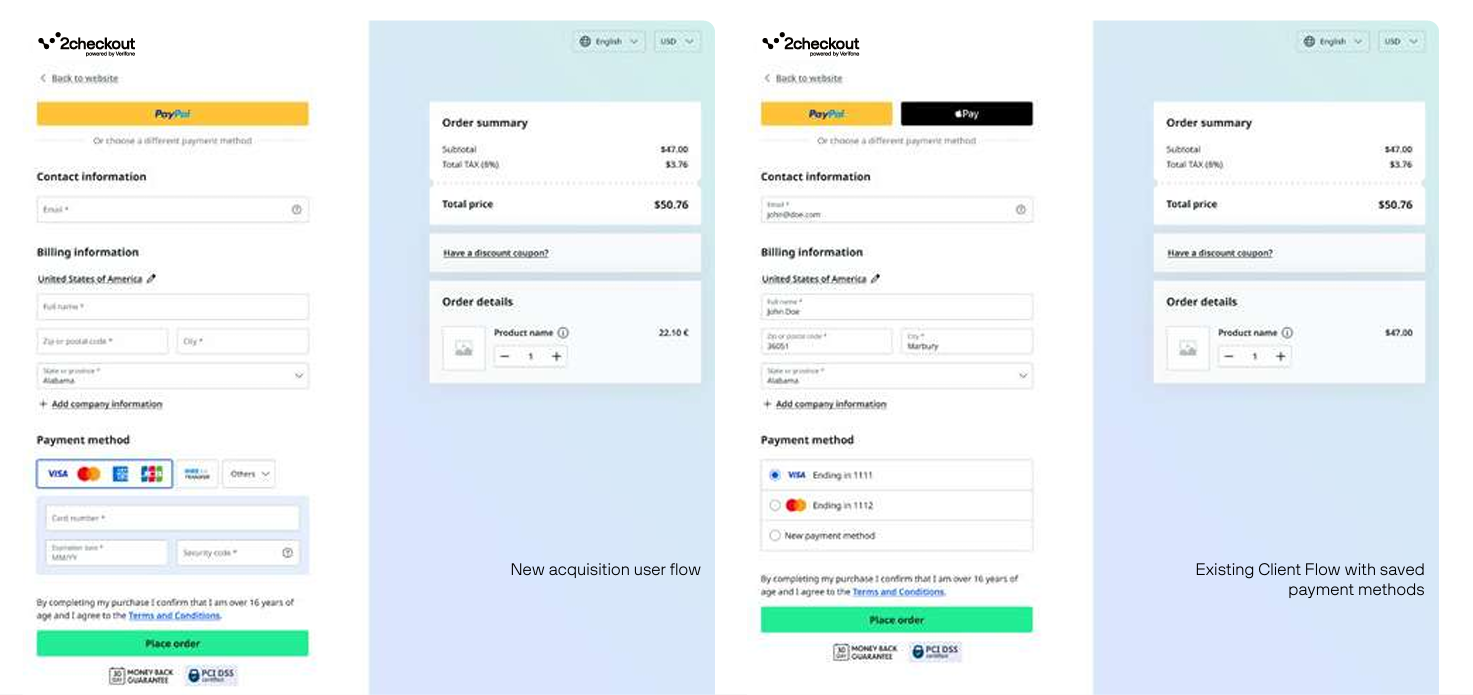
That decision also determines what the checkout itself should look like at different points in a customer’s life. A first-time buyer needs trust and guidance: clear pricing, a review step before they commit, minimal friction. A returning or upgrading customer needs the opposite: pre-filled details, one-click actions, no re-entering a card that’s already on file. A cart that treats every shopper the same way leaves conversion on the table at both ends.
If you run a SaaS or subscription business, this matters earlier than most teams assume. Most SaaS companies optimize hard for customer lifetime value and treat average order value (AOV) as an afterthought, but AOV plays a critical role right at acquisition, before retention even has a chance to kick in. A checkout that under-sells your plans at the first purchase is revenue you don’t get a second shot at. For more on capturing that revenue early, see our guide to SaaS upselling tactics.

New-acquisition checkout vs. existing-client flow with saved payment methods. Source: Shopping Cart Best Practices eBook, 2026, p.51.
2. Does it understand your customers? (Localization)
Cross-border eCommerce keeps expanding, and every shopper you reach will judge your storefront by how well it fits their own context, not yours. Shoppers are simply more likely to complete a purchase when the experience feels familiar, clear, and tailored to where they are.
A well-localized checkout should:
- Display content in the shopper’s preferred language
- Show prices in their local currency
- Automatically detect location and relevant settings
- Let shoppers adjust language or region easily if the defaults are wrong
One detail that’s easy to miss: localized, fixed pricing per market tends to outperform real-time currency conversion. Showing $24.99 instead of a converted $23.67 creates a cleaner, more predictable price than one that shifts with the exchange rate, and predictability builds trust at the exact moment a shopper is deciding whether to hand over their card.

A localized checkout: language switcher and order summary shown in context. Source: Shopping Cart Best Practices eBook, 2026, p.15.
3. Is it built to get paid, not lose the sale? (Payment methods)
Nothing drives a shopper away faster at the final step than not seeing a payment method they recognize or trust. Cart abandonment across eCommerce typically runs between 50% and 75%, and limited or unfamiliar payment options are consistently one of the top reasons shoppers give for leaving.
Payment preferences vary sharply by region, and credit cards aren’t always the default. A shopper checking out from China, for example, expects to see Alipay, WeChat Pay, or UnionPay alongside a card option, not instead of one, but as real alternatives. The cart you choose should let you:
- Support locally preferred payment methods in each market
- Offer digital wallets and express checkout (PayPal, Apple Pay, Google Pay) with pre-populated billing details
- Keep payment options clearly visible without extra redirects or steps
Express and in-context checkout matter as much as breadth of choice. The fewer steps and re-typed fields between “add to cart” and “paid,” the fewer shoppers you lose at the last moment, especially on mobile.

Regionally relevant payment methods shown for a shopper checking out from China. Source: Shopping Cart Best Practices eBook, 2026, p.16.
4. Does it help you sell more, not just check out?
If you sell more than one product or price tier, your cart should actively help you grow revenue per visitor, not just process whatever’s already in the basket. Three tactics do most of the work:
Cross-selling: offering genuinely complementary products increases AOV, but where you place the offer matters. Adding cross-sell prompts inside the checkout flow can introduce a little friction; moving those offers to the thank-you page or a follow-up confirmation email protects your conversion rate while still capturing the extra revenue.
For a full breakdown of when to use each tactic, see our guide to choosing between upselling and cross-selling.
Upselling: encouraging a shopper to choose a higher-value plan, longer subscription term, or added capacity instead of their original pick. Unlike cross-selling, upselling replaces the original choice. Done well, with a clear value comparison and a one-click upgrade, it’s one of the highest-impact, lowest-friction revenue levers available.
Bundling: packaging complementary products or services together, ideally as a one-click addition with no extra forms. Malwarebytes used exactly this approach, a post-purchase bundle letting customers add extra device licenses without re-entering payment details, and grew revenue per visitor by 9%.

A post-purchase bundle offer: the shopper adds a license without leaving the cart or re-entering payment details. Source: 2Checkout
2Checkout’s cart, built for conversion
Once you know what to look for, you need a cart that actually delivers it. On the 2Checkout platform, the ConvertPlus cart editor lets marketing teams adjust checkout design, flow, and copy without pulling in engineering, while InLine cart embeds checkout directly into your own page for teams that want full design control. Both support PayPal, Apple Pay, and Google Pay express checkout with pre-filled billing data, and both are built on the same localization and payment-method coverage described above.

The same checkout, adapted to desktop and mobile. Source: Shopping Cart Best Practices eBook, 2026, p.20.
Shopping cart evaluation checklist
| Criterion | Ask yourself | What good looks like |
| Business model fit | Does it adapt to new vs. returning/upgrading customers, and to how I actually sell (B2C, B2B, subscription)? | Separate flows for first-time trust-building vs. one-click repeat purchase; AOV considered at acquisition, not just LTV |
| Localization | Does it feel local to every market I sell into, not just my home market? | Local language, local currency, fixed localized price points, easy region/language switching |
| Payment methods | Can shoppers pay the way they actually want to, everywhere I sell? | Regionally preferred methods (e.g. Alipay, WeChat Pay, UnionPay), digital wallets, express checkout, minimal redirects |
| Revenue growth (AOV) | Does the cart help me sell more, or just process what’s already in the basket? | Post-purchase cross-sell, one-click upsell with clear value comparison, low-friction bundles |
Frequently asked questions
What’s the biggest reason shopping carts lose sales?
Cart abandonment, typically 50-75% of started checkouts, driven most often by slow load times, unfamiliar or missing payment methods, unexpected costs revealed late, and missing localization (Shopping Cart Best Practices eBook, 2026).
Does checkout localization really affect conversion?
Yes. Shoppers convert more often when language, currency, and pricing feel native to their market. Fixed local price points (e.g. $24.99) tend to outperform real-time currency-converted prices (e.g. $23.67) because they read as more predictable and trustworthy.
What’s the difference between cross-selling and upselling?
Cross-selling adds a complementary product alongside the original purchase; upselling replaces the original choice with a higher-value plan or tier. Both grow average order value, but upselling is generally lower-friction since it’s a single substitution rather than an addition.
How much can bundling increase revenue?
It varies by offer and audience, but with a single post-purchase bundle that required no extra forms or re-entered payment details.
Choosing with confidence
The shopping cart you choose has to work across your whole customer lifecycle, not just the first purchase, from acquisition through renewal and expansion. Best practices give you a strong starting point, but there’s no universal answer: what works depends on your customers, your market, and your product. Continuous testing is what turns a good checkout into a consistently high-performing one.
Ready to put these tactics into practice? Get the refreshed Shopping Cart Best Practices eBook for the full set of best practices and test results behind this post.
The post How to Choose a Shopping Cart That Converts appeared first on he 2Checkout Blog | Articles on eCommerce, Payments, CRO and more.
This articles is written by : Nermeen Nabil Khear Abdelmalak
All rights reserved to : USAGOLDMIES . www.usagoldmines.com
You can Enjoy surfing our website categories and read more content in many fields you may like .
Why USAGoldMines ?
USAGoldMines is a comprehensive website offering the latest in financial, crypto, and technical news. With specialized sections for each category, it provides readers with up-to-date market insights, investment trends, and technological advancements, making it a valuable resource for investors and enthusiasts in the fast-paced financial world.