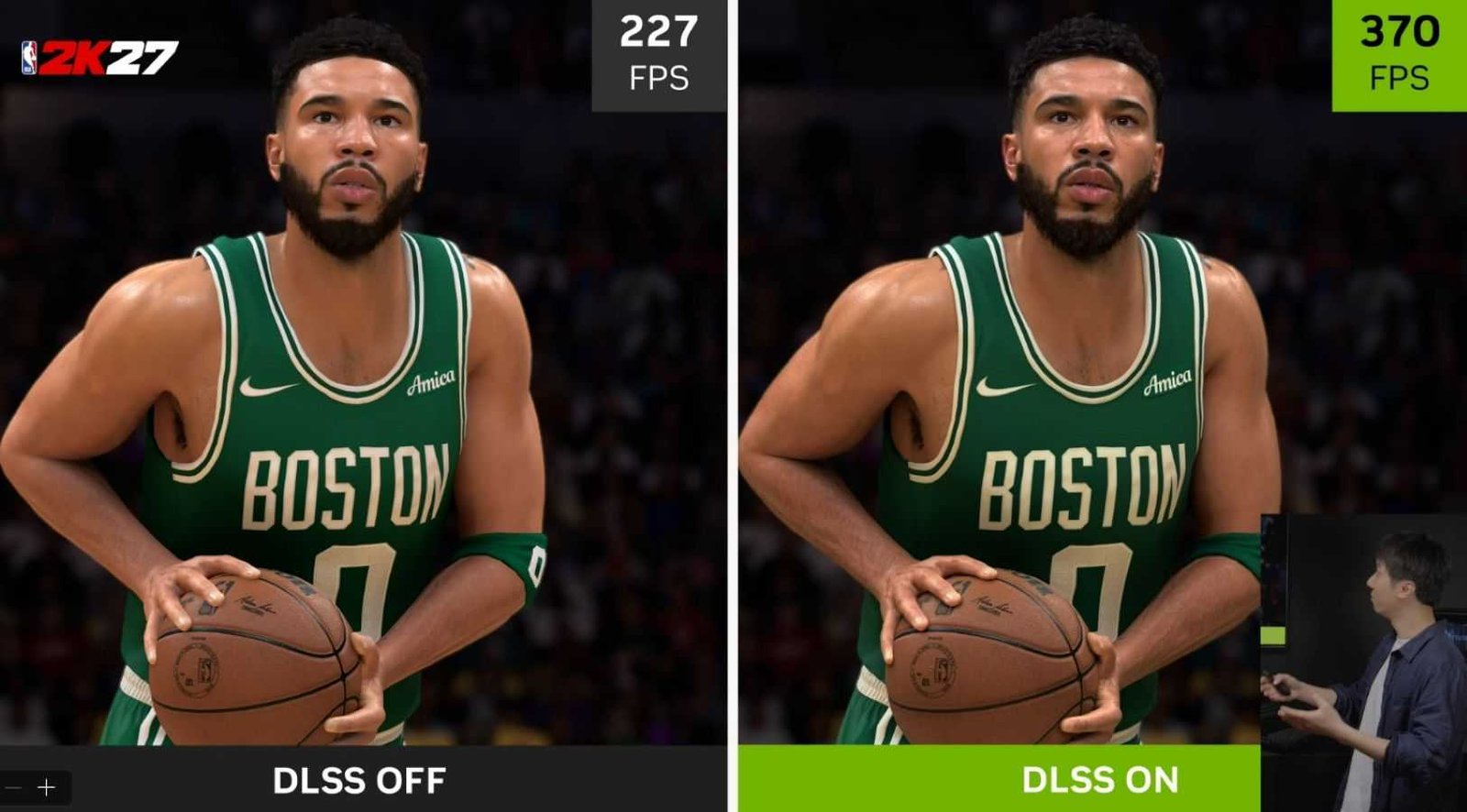
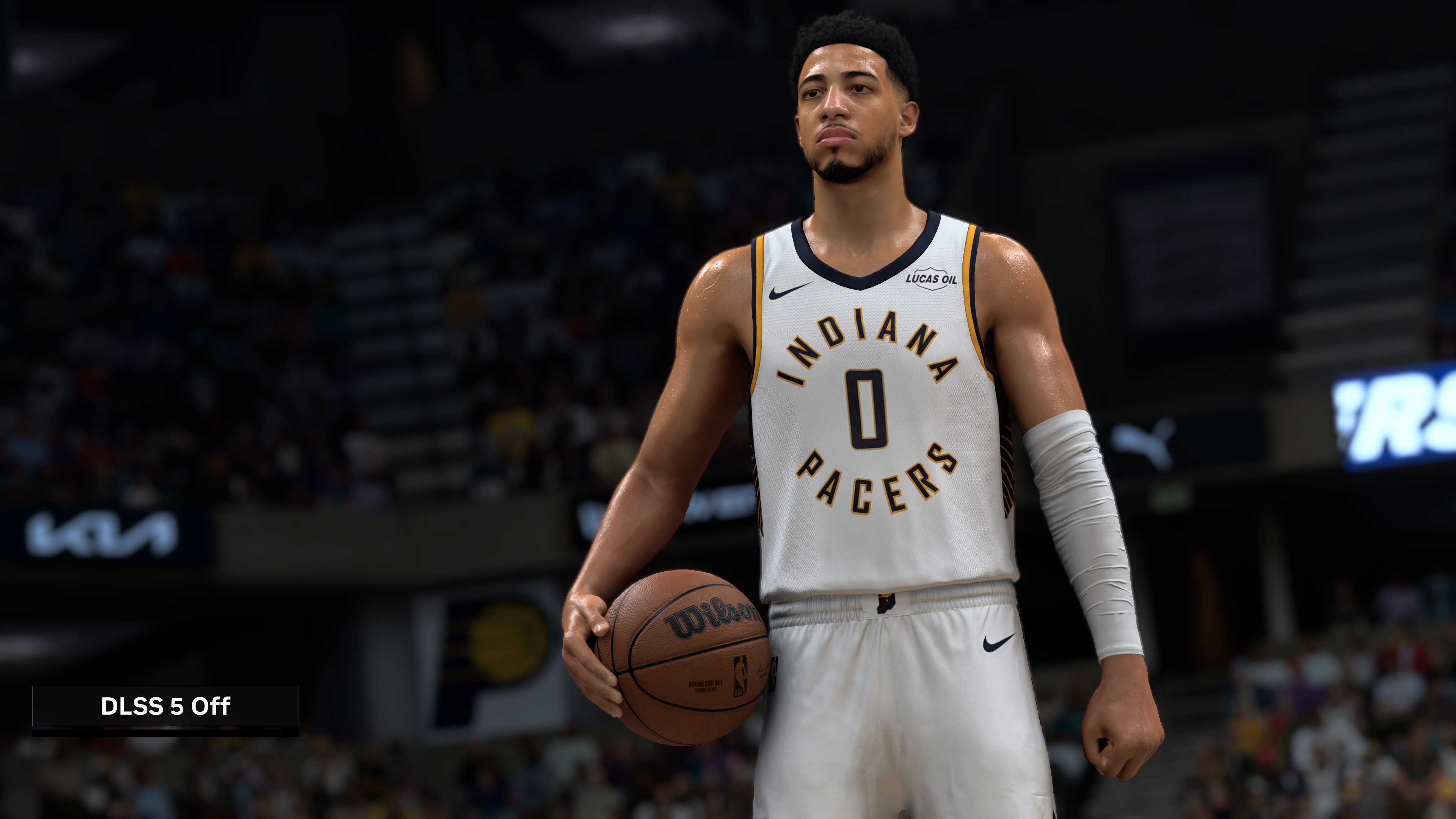
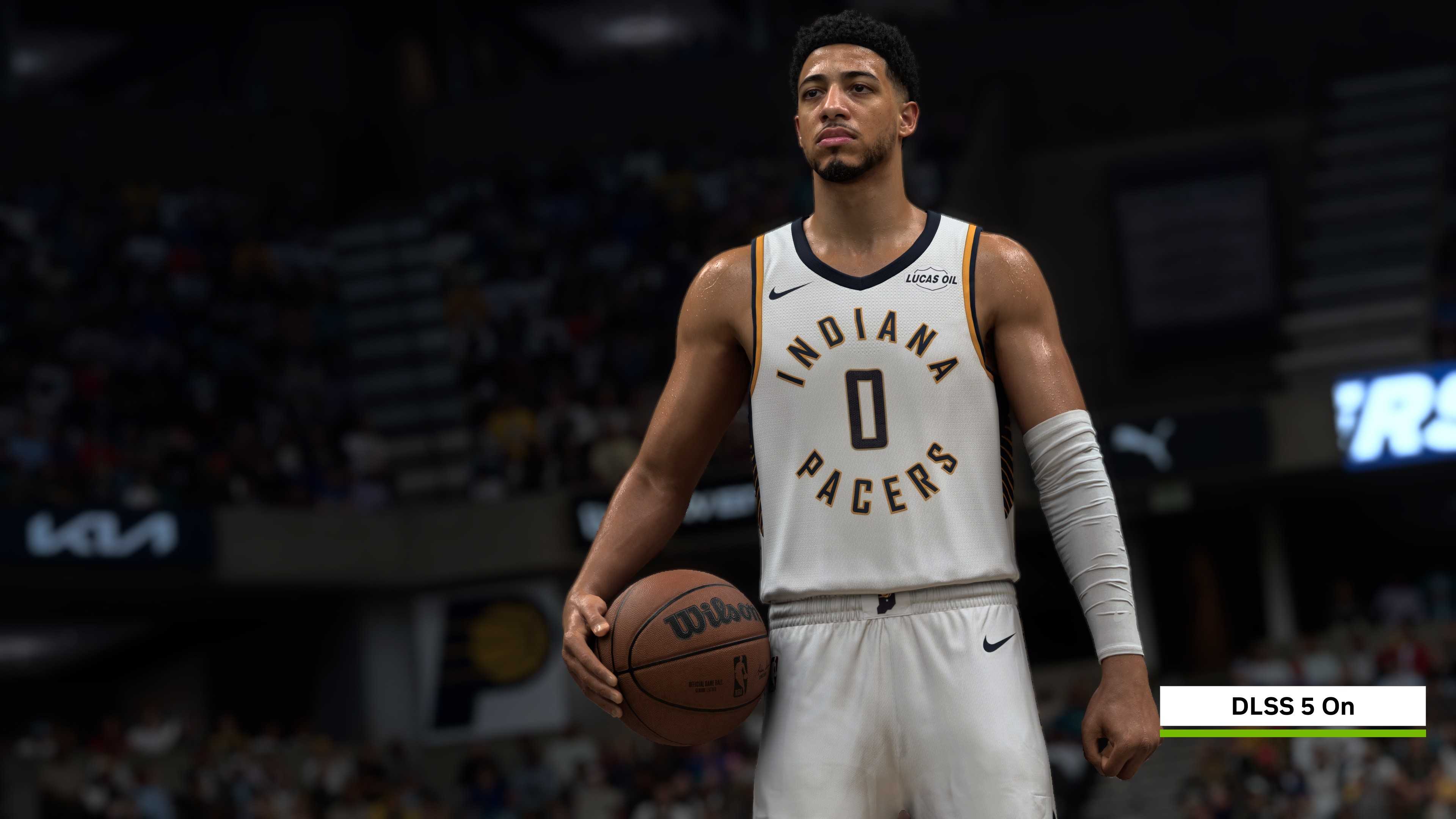
I couldn’t stop staring at the shadows on Tyrese Haliburton’s hand.
That sounds weird, but hear me out. Nvidia showed me and other journalists an early preview of 2K’s NBA 2K27 ahead of the game’s September 4 launch, because NBA 2K27 will also mark the debut of Nvidia’s DLSS 5 technology, which applies AI models to rendered game scenes to drastically improve realism.
It’s the little things that sell it. Shadows fell naturally across Haliburton’s hand as it gripped the ball. Jerseys met skin much more convincingly. Lighting behaved in ways that made players feel less like collections of polygons wrapped in expensive textures and more like, you know, actual people.
DLSS 5 can look damn good. Just zoom in on the DLSS 5 on/off comparison shots below to see those jaw-dropping shadows and sweat for yourself!
Then one of those startlingly realistic players started moving awkwardly during a cutscene. And suddenly I couldn’t stop staring at that either.
That may wind up being one of the most interesting side effects of Nvidia’s latest neural rendering push. Making video game characters look this lifelike exposes everything else that isn’t.
DLSS 5 made me wonder whether we’re reaching the point where the graphics themselves aren’t the weakest link anymore. Consider that a hell of a compliment, Nvidia.
DLSS 5 gives game developers a lot of control
There’s been a lot of confusion and hate floating around DLSS 5 since its controversial reveal earlier this year. But DLSS 5 isn’t just a binary “make graphics gud” switch that devs slap onto a game and call it a day.
Nvidia says developers get extensive control over how its new neural rendering technology affects a scene, retaining a significant amount of input over where and how aggressively the technology gets used. (It’s important to note that DLSS 5 never adjusts the structural geometry of objects.) They can create effectively an unlimited number of masks that target individual objects or entire classes of objects—foliage or food, for example—then adjust the intensity of the DLSS 5 effects independently, on an object-by-object and scene-by-scene basis.
That’s important because neural rendering isn’t something you’d necessarily want applied uniformly everywhere. A basketball player’s skin might benefit from a different treatment than his jersey, the hardwood court, or the crowd sitting behind him. A developer may want to unleash DLSS 5’s power on scenery, but stick to their artists’ pure character designs, or vice versa.

Nvidia
Nvidia says adding more masks doesn’t inherently increase the performance penalty, either (more on that soon!), giving developers plenty of room to fine-tune how DLSS 5 is deployed.
That developer control was obvious in NBA 2K27. Humans are brutally difficult to render convincingly because our brains are incredibly good at noticing when another human looks wrong. Slightly unnatural lighting, shadows, skin, or clothing can immediately scream “video game.” But with DLSS 5 flipped on and properly tuned, you could mistake NBA 2K27’s on-court action for actual on-court action from NBA League Pass.
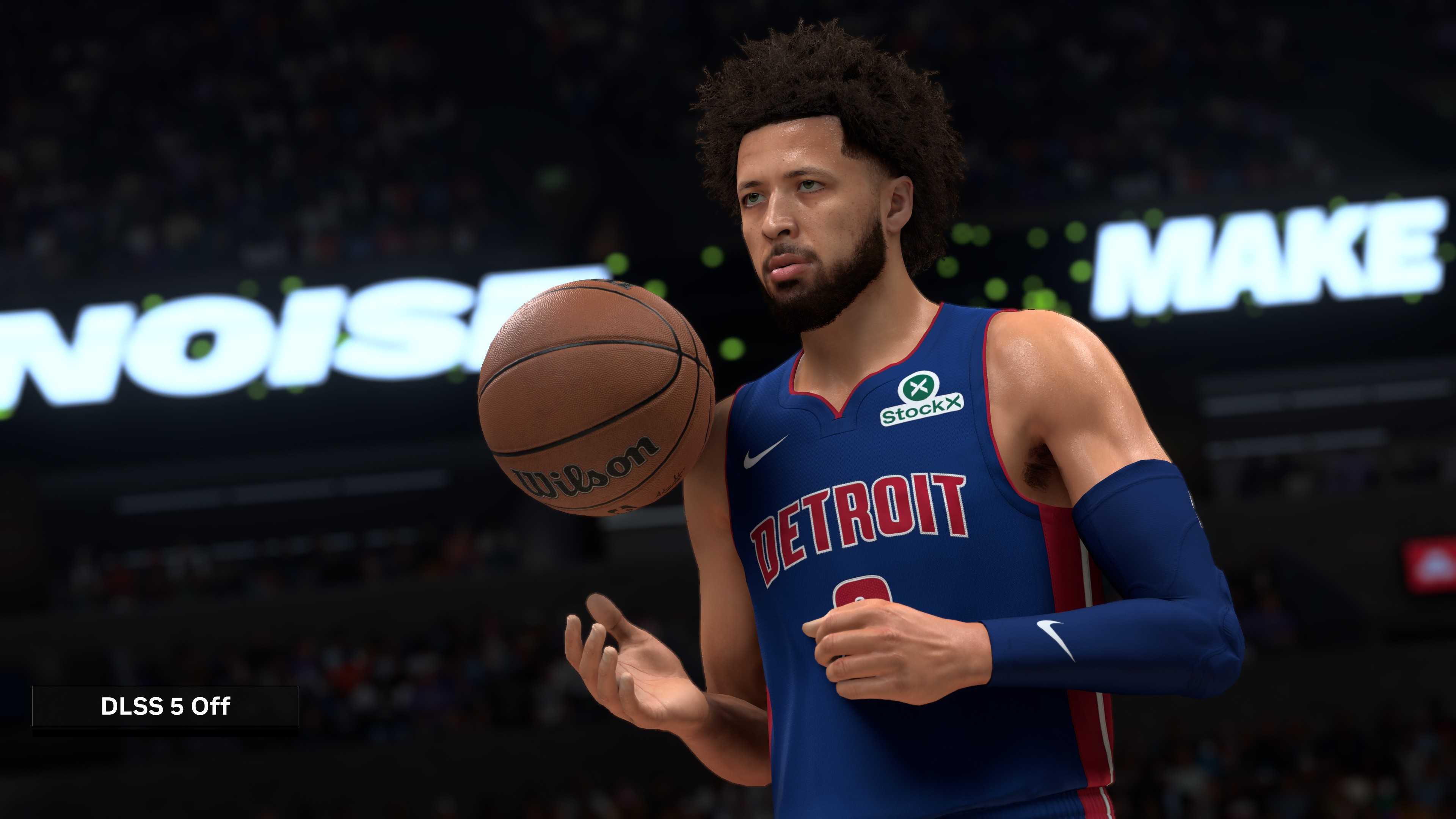
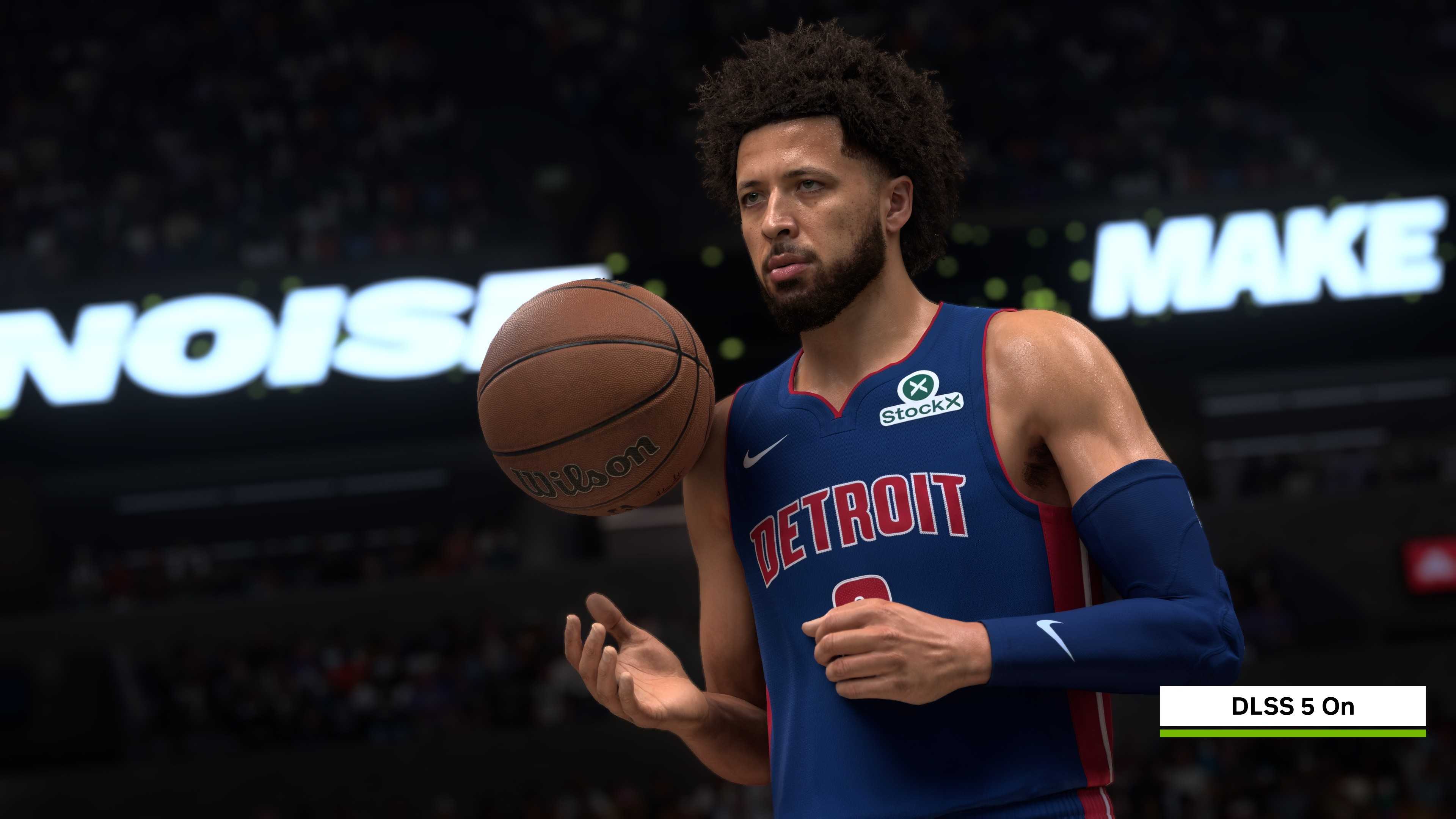
You may have already seen purported DLSS 5 comparisons bouncing around the internet over the weekend. Modders discovered the technology inside NBA 2K27’s early-access build and began transplanting it into other games, but those unofficial examples—many of which look damn good, especially sports games—aren’t necessarily representative of what developers can accomplish when DLSS 5 is actively integrated and tuned for a specific game.
DLSS 5 comes with a hefty performance cost
All those neural rendering smarts aren’t free, though.
Nvidia says enabling DLSS 5’s new rendering technology on its own can knock roughly 50 to 60 percent off frame rates, depending on the game, scene, and resolution. Modders are seeing similar frame rate hits in the early games they’ve guerrilla-ported NBA 2K27’s DLSS 5 files into.
Oof. That’s a huge performance hit… but “on its own” is doing a lot of work there.
Sure, DLSS 5 can operate independently of Super Resolution and Multi Frame Generation, the other well-known performance-enhancement AI features in the DLSS suite, but Nvidia clearly intends all these technologies to work together.

Since DLSS 5 enhances visuals on a per-frame basis, having a higher-quality rendered frame can create even better DLSS 5-enhanced visuals. This same scene in an Nvidia DLSS 5 demo uses traditional rendering on the left, and ray tracing on the right; the ray-traced DLSS 5-enhanced visuals look even more luscious.
Nvidia
Think of it this way: Super Resolution claws back much of DLSS 5’s performance hit by rendering fewer pixels internally and reconstructing the final image at a higher resolution. Multi Frame Generation then creates additional frames to make the game appear dramatically smoother. DLSS 5 wraps things up by spending GPU horsepower making the final image look better than native rendering.
Put the whole package together and the numbers get ridiculous. As part of its briefing for journalists, Nvidia showed NBA 2K27 looking substantially better with DLSS 5 flipped on, but with a frame rate over 150fps higher thanks to the effects of Super Resolution and Multi Frame Gen.
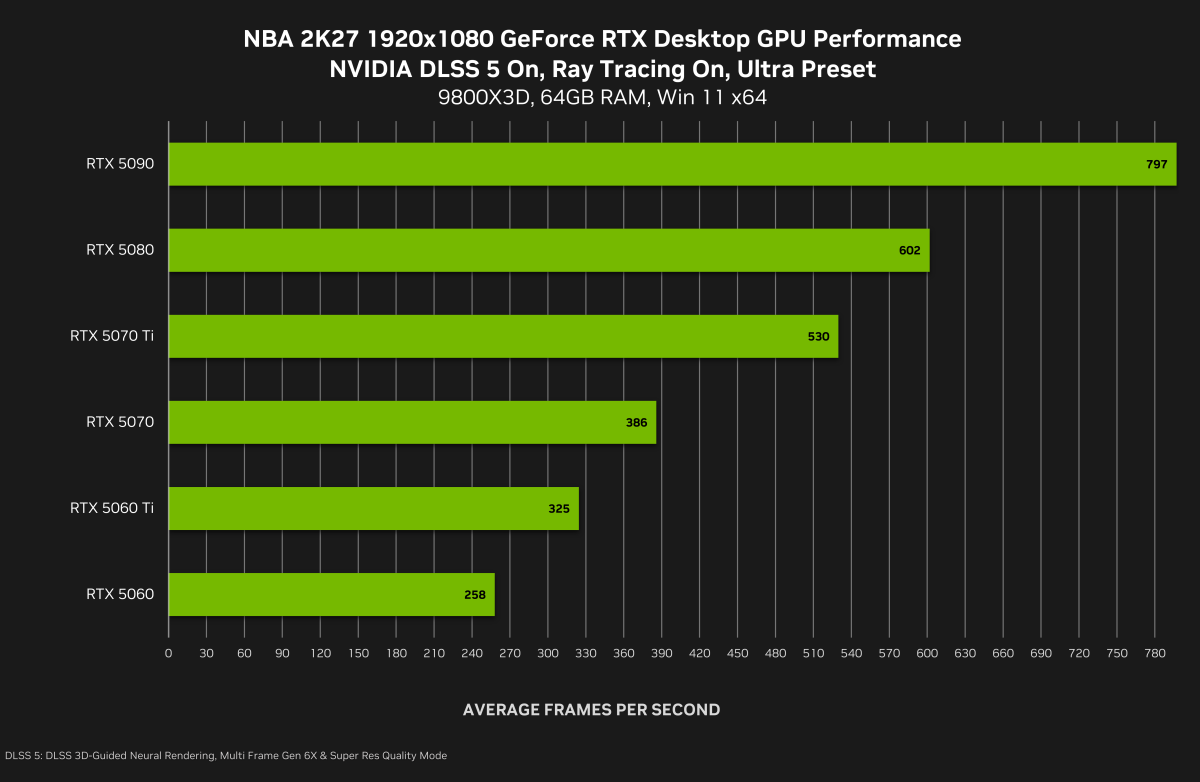
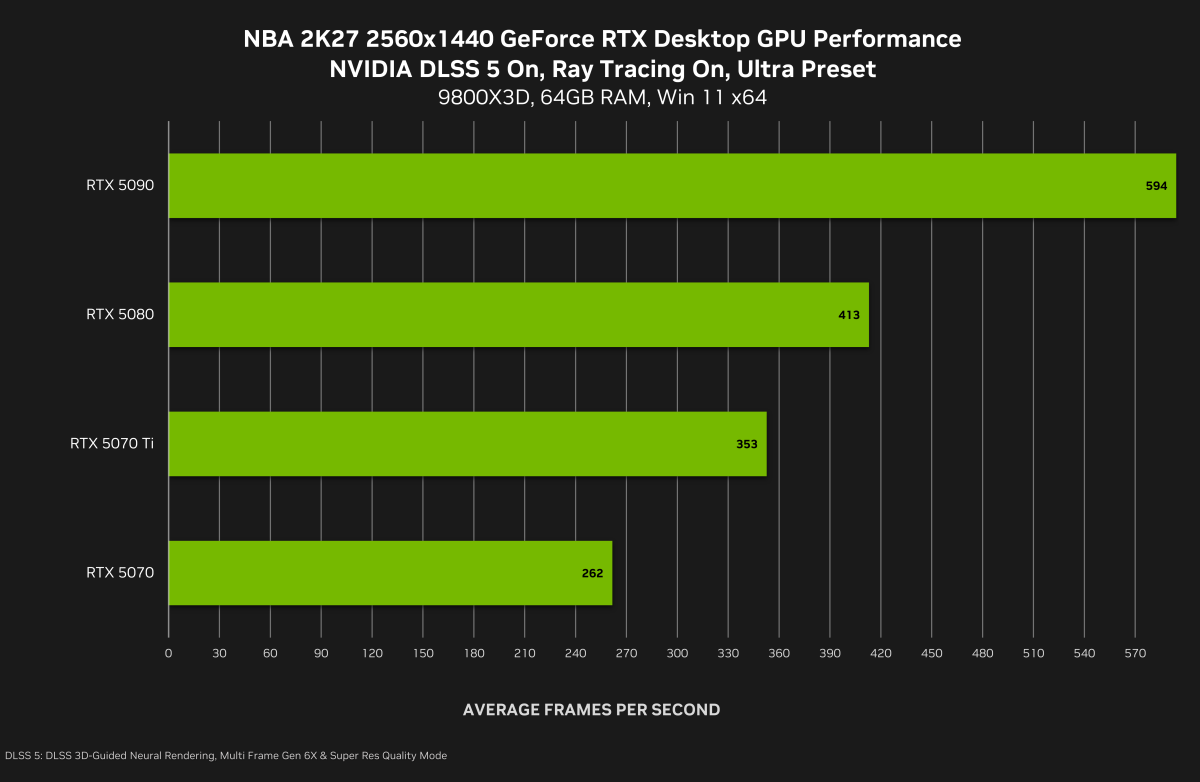
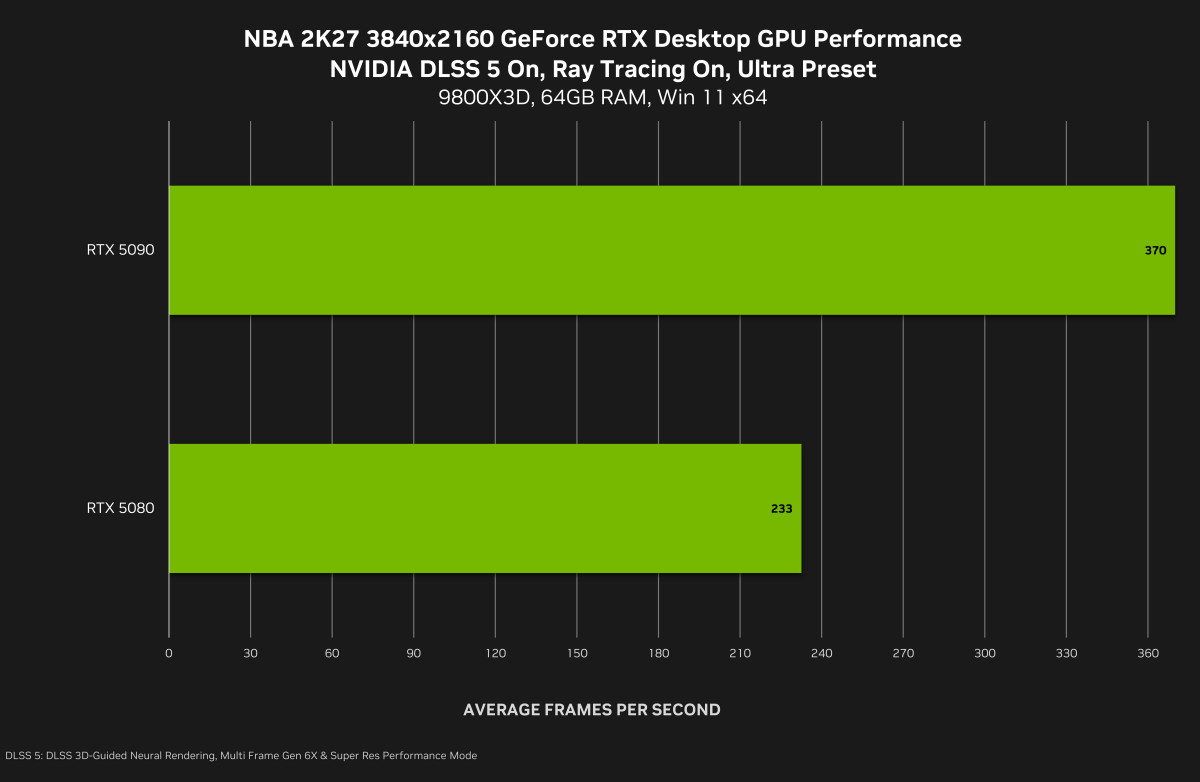
That’s not just impressive; it’s utterly transformative. And no, it doesn’t need a pair of ferocious RTX 5090s to run either. Let’s look at some tangible performance numbers Nvidia shared across 1080p, 1440p, and 4K resolution with all DLSS features enabled.
Note that these are Nvidia’s numbers, not independent PCWorld benchmarks, so keep a few pinches of salt handy.
Nvidia
Yes, you’re reading that correctly. Nvidia is claiming a ludicrous 797 frames per second on an RTX 5090…though playing a sports game on a beastly 5090 at 1080p resolution is kind of laughable in and of itself.
Even better news: The humble RTX 5060 blasts past 250 fps.
Nvidia
A vanilla RTX 5070 pushing a 262 fps at 1440p Ultra with ray tracing sounds bonkers, considering DLSS 5’s neural rendering itself carries such a heavy computational cost. Though to be fair, the lighting and luscious character models DLSS 5 can enable would be utterly impossible for real-time gaming without Nvidia’s AI-powered features.
Nvidia
At 4K, Nvidia showed the RTX 5090 hitting 370 fps, while the RTX 5080 managed 233 fps. Considering this is at 4K output with full ray tracing and Ultra settings, those are hellaciously fast numbers.
But there’s an important caveat: Nvidia used Super Resolution’s Quality mode in the lower-resolution tests and switched to Performance mode at 4K. Another caveat: These numbers use 6X Multi Frame Generation, meaning many of those displayed frames aren’t traditionally rendered frames. Instead, Nvidia’s MFG tech inserts multiple AI-generated frames between “normal” frames to greatly enhance visual smoothness, with help from the game’s motion vectors.
Those frightfully fast numbers and DLSS caveats drive home how much “DLSS” has changed since its 2018 inception. This isn’t really an upscaling technology anymore. It’s becoming an entire AI-assisted rendering pipeline, improving performance and image quality alike.
DLSS 5’s realism exposes NBA 2K27’s animation problem
But the thing that stuck with me most watching DLSS 5 in action wasn’t the frame rate. It was the animation.
NBA 2K27 looked absolutely outstanding during gameplay. The improved lighting and rendering helped players blend into the scene much more convincingly, and the in-game graphics and presentation could easily be mistaken for a live NBA broadcast. I could practically hear Charles Barkley chortling in my head.
Then a cutscene would start.
The player models still looked fantastic, but slightly stiff movements suddenly became far more noticeable. All of a sudden, everyone looked like robotic Pinocchios rather than lifelike players gliding across the court.


That’s the uncanny valley working in a whole new direction.
When everything obviously looks like a video game, your brain happily forgives slightly unnatural animation—usually you won’t even notice it. But when the person on screen starts looking almost real, you expect them to move like a real person, too.
DLSS 5 may help solve gaming’s graphics problem, only to expose a new animation problem. And that’s not a criticism of DLSS 5; if anything, it’s a compliment.
As graphics rendering becomes more convincing, I wouldn’t be surprised if developers pour even more attention into character animation, facial expressions, cloth simulation, physics, and the countless little movements that make people feel alive. Seeing a lifelike NBA player mimicking a marionette during cutscenes yanks your brain right out of its happy forgiveness zone.
Bottom line

Nvidia
Calling DLSS “Nvidia’s AI upscaling technology” already felt outdated. DLSS 5 makes that description feel downright ancient.
Nvidia is building a collection of AI rendering technologies where one component can spend GPU resources making games prettier than traditional rendering allows, while others reconstruct pixels and generate frames to keep everything running fast.
I’ll need to test DLSS 5 myself before drawing any hard conclusions. I’m looking forward to playing with DLSS 5 myself when NBA 2K27 launches in just a couple of days, and I can’t wait to see it in other types of games.
But NBA 2K27 made one thing clear: The closer games get to looking real, the easier it becomes to see everything that still isn’t. For now, though, I’ll keep drooling over those shadows on Tyrese Haliburton’s hand.
This articles is written by : Nermeen Nabil Khear Abdelmalak
All rights reserved to : USAGOLDMIES . www.usagoldmines.com
You can Enjoy surfing our website categories and read more content in many fields you may like .
Why USAGoldMines ?
USAGoldMines is a comprehensive website offering the latest in financial, crypto, and technical news. With specialized sections for each category, it provides readers with up-to-date market insights, investment trends, and technological advancements, making it a valuable resource for investors and enthusiasts in the fast-paced financial world.